Editor’s Note
The U.S. Supreme Court is poised to rule on a landmark case challenging the legality of presidential tariffs imposed without congressional approval. This decision could significantly impact a central pillar of the current administration’s trade policy and redefine the balance of power between the executive and legislative branches on matters of national emergency.
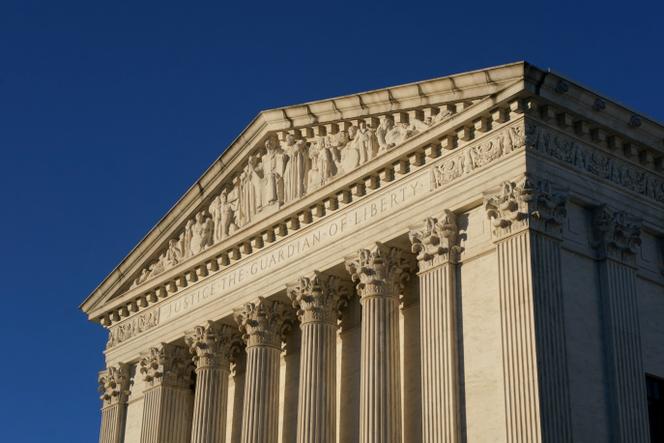
One year after his return to the White House, could Donald Trump see one of the pillars of his economic policy collapse? The U.S. Supreme Court is soon expected to issue a highly anticipated decision on the legality of tariffs imposed by the American president without a vote from Congress – the legislative branch in the United States – in the name of national emergency. Since Mr. Trump’s return to power, these import taxes have been at the heart of a legal dispute closely followed by economic circles and by U.S. trade partners.
The nine justices must decide a central institutional question: can a president alone impose tariffs in the name of a national emergency? Their answer will determine how far executive powers extend in trade matters and will condition Donald Trump’s ability to continue using import taxes as an economic and diplomatic lever.
From the beginning of his second term, Donald Trump imposed new tariffs on imports from many countries, a term he calls
After targeting Canada, Mexico, and China, he raised tariff barriers for most countries in the world during the summer, to varying levels depending on the “deals” concluded along the way.
This caused shock and anger internationally and also within the United States, where businesses and states decided to challenge this policy in court. The Supreme Court ultimately decided to combine two cases brought before it by small businesses and a dozen Democratic states, which argue that the administration overstepped its powers.
To justify these measures, the president indeed
However, this emergency law had never been used as a basis for imposing widespread tariffs, while the U.S. Constitution explicitly assigns Congress the power to levy taxes and set tariff policy. The nine Supreme Court justices – mostly conservative – must therefore answer a key question: does the IEEPA truly allow the president to impose import taxes alone, or did Donald Trump assume a power reserved for the legislature?
Beyond this specific case, this ruling could have lasting effects on American law. By validating or not the use of the IEEPA to impose import taxes, the U.S. Supreme Court is not only ruling on a past policy but is also defining how a president can conduct his economic policy.
Validation of this interpretation would pave the way for a much broader use of emergency laws, allowing the executive branch to bypass Congress in major economic areas. Future presidents could invoke national emergency to quickly impose trade measures without parliamentary debate, transforming an exceptional tool into an instrument of routine policy.
Conversely, an invalidation would send a strong signal to the executive branch: emergency powers cannot serve as a general basis for structuring economic policy choices. Such a decision would strengthen the role of Congress.
If the Supreme Court rules the contested import taxes illegal, the economic consequences could be significant, though not immediate. In theory, such a decision would open the door to refund requests from businesses and importers who paid these levies between February and mid-December 2025. More than $133 billion (€113 billion) in taxes could now be challenged, according to
the U.S. Customs and Border Protection agency.
On his platform
Truth Social, Donald Trump warned of
in case of invalidation, stating that the United States
to refund such amounts, especially if, according to him, one considers the “investments made by companies to circumvent” these taxes.
he insisted.