Editor’s Note
This article reports on the first major investment under a U.S.-Japan trade agreement, focusing on AI infrastructure. The scale of the commitment highlights the strategic priority and vast capital being directed toward the foundational power needs of the digital economy.
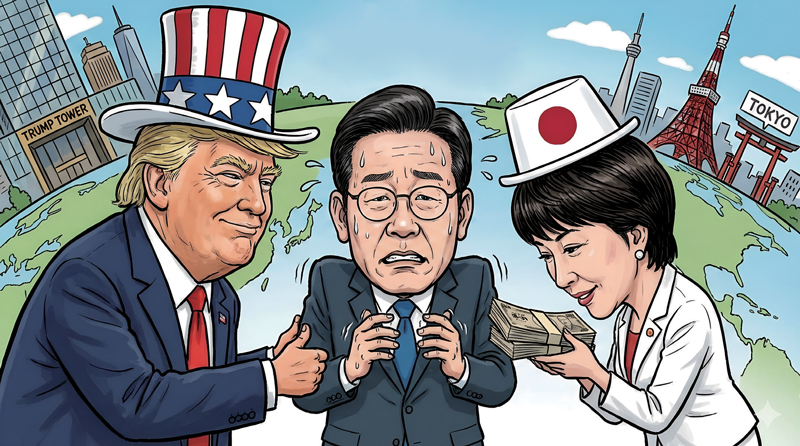
On February 17, President Trump announced that the first project under the U.S.-Japan trade agreement would officially commence. Japan had promised a total of $550 billion in investment in the U.S., conditional on a 15% tariff application, and this marks the first tangible outcome from that promise. The total amount is $36 billion (approximately 52 trillion Korean won). For us, who are facing complaints and pressure from the U.S. about the slow fulfillment of promises, the likelihood of facing greater pressure has increased. It is necessary to analyze the bilateral agreement, understand what the U.S. wants, and derive the best alternative from our standpoint.
According to both countries, this investment consists of three parts. The first is the construction of a 9.2GW (gigawatt) natural gas-fired power plant in Ohio. A capacity of 9.2GW is equivalent to nine nuclear power plants and can supply electricity to approximately 7.4 million households. It involves building a power plant on par with the world’s largest, the Jebel Ali power plant in the UAE, which has a capacity of 9.54GW. The electricity produced at the Ohio plant is expected to be supplied through the PJM (the largest power grid operator in the U.S.) transmission network, which serves the eastern United States.
The reason for building a super-large gas-fired power plant in this region is the presence of AI (Artificial Intelligence) data centers. The region with the highest concentration of data centers in the world is not China, California, or Texas, but the eastern U.S., centered around Virginia and Ohio. As AI data centers surge in this area, power demand is skyrocketing. In Virginia, data centers consume 39% of the total electricity, and in Ohio, the figure reaches 9%.
As power demand surges, electricity prices are also soaring. Electricity rates for data centers have increased by up to 267% compared to five years ago, and this is also affecting residential power. PJM, responsible for power supply in the region, expects household electricity bills to increase by more than $17 due to the construction of additional power plants and transmission networks. Initially, President Trump campaigned on a promise to reduce electricity prices by 50% within 18 months of taking office, but in reality, electricity prices are rising every month. Because President Trump wants to solve this problem, the construction of a super-large gas-fired power plant has been prioritized.
The construction of the Ohio gas-fired power plant, estimated at a total of $33 billion, is reportedly led by the SoftBank Group. Electrical and power equipment manufacturers including Panasonic Holdings, Toshiba, Hitachi, Murata Manufacturing, and TDK are expected to participate, along with financial institutions from both countries, including Mizuho Bank and Goldman Sachs. Japanese companies are showing interest not only in supplying gas turbines, substation equipment, and transmission equipment but also in large-scale construction and civil engineering projects.
The second project is a deep-sea crude oil export facility in the Gulf of Mexico, which President Trump renamed ‘America’s Gulf.’ Japanese funds will be invested in the GulfLink export terminal, whose construction is being promoted in Brazoria County, Texas. The GulfLink project aims to build a crude oil export terminal about 50 km offshore, allowing Very Large Crude Carriers (VLCCs) to dock directly.
Typically, VLCCs have a deep draft (the depth a ship sinks in water) and cannot dock directly at ordinary ports; instead, four smaller tankers offload crude oil from the VLCC at sea. Naturally, this leads to port congestion, increased transportation costs, and lower overall efficiency. To solve this problem, it is necessary to build a deep-water port where VLCCs can dock directly.
Japan is known to be investing about $2.1 billion in this project. President Trump hopes to lower domestic energy prices through increased oil production. However, as many companies, including oil majors, do not want price drops due to increased production, investment in new oil exploration and development is not increasing as much as expected. President Trump has hoped to supplement the insufficient domestic investment by mobilizing external funds, and Japan’s decision to participate has lifted a significant burden.
The third is an industrial synthetic diamond project. Ordinary diamonds are used for cutting and polishing. Methods for artificially producing diamonds are divided into the High-Pressure High-Temperature (HPHT) method, which replicates the natural diamond production process, and the Chemical Vapor Deposition (CVD) method, which decomposes carbon gas in a vacuum chamber to grow diamonds.
The global synthetic diamond market is estimated to be about $30 billion, with China holding 85% and India 10%. China primarily produces industrial diamonds using the HPHT method, while India mainly produces gem-quality diamonds using the CVD method. Diamonds are not only hard but also have thermal conductivity more than five times superior to copper. High thermal conductivity means the ability to easily dissipate heat. In the recent AI technology competition, the biggest problem is how to lower and manage the heat generated by high-performance chips.
For the U.S., which is continuing large-scale investments in AI data centers to stay ahead in competition with China, domestic production of synthetic diamonds is crucial. With Japan’s decision to invest $600 million in building a synthetic diamond factory in Georgia, the U.S. can escape its dependence on the Chinese supply chain.
Japan’s decision to invest in the U.S. was thoroughly composed of stable projects that respect America’s intentions while ensuring its own national interests. In a situation where large-scale power demand is expected, if a gas-fired power plant can be built quickly with federal-level permitting support, the time required for investment recovery is significantly reduced. The same applies to investment in oil export facilities. As for synthetic diamonds, they can be usefully utilized in Japan’s recent push for technological leaps and expanded investment in the AI field. This is because it is highly likely that Japanese companies will continuously participate in equipment supply and maintenance, going beyond simple investment. It is known that President Trump initially gave Japan the consideration of choosing one out of the three options. Prime Minister Takachi’s choice of all three greatly satisfied President Trump.
Japan’s confirmation of its U.S. investment projects has given us much to ponder. It has become clear that we can no longer delay. Above all, it has become crucial to accurately understand what the U.S. wants and decide on investments on a bold scale. A shift in perception is required—moving away from a victim mentality of being forced to invest and toward seeing it as a strategic decision for the future. It is necessary to select future strategic fields and establish cooperative systems that go beyond the complex regulations and political interests of shipbuilding and steel.