Editor’s Note
Despite market fluctuations, gold continues to attract investors seeking stability and diversification. This article explores the outlook for gold prices, forecasting favorable conditions into 2026.

Despite short-term volatility, demand for gold as a safe-haven investment and portfolio diversification tool remains high among various investor groups. It is forecast that gold prices will remain quite favorable in 2026.
Global gold prices have been falling for nearly a month. Last night, on February 17, global gold prices fell from $4,950 per ounce to a low of $4,853 per ounce, followed by a slight recovery. Today, February 18, global gold prices briefly rose to $4,940 per ounce but fell back to $4,920 per ounce by 4:30 PM.
In fact, recent fluctuations in gold prices have been extremely dramatic. At the beginning of 2026, the global gold price rose from levels above $4,300 per ounce to nearly $5,600 per ounce on January 28, then rapidly fell to around $4,900 per ounce and subsequently below $4,500 per ounce on February 2.
Several reports broadly indicate that the sharp drop in gold prices, which caused them to fall below $5,000 per ounce, stemmed from news of President Trump nominating Kevin Warsh for the position of Federal Reserve (Fed) Chairman.
However, according to Heng Koon How, this interpretation somewhat oversimplifies the complex dynamics behind the recent gold price fluctuations. Heng Koon How analyzed that during January, when gold prices surpassed the $5,000 per ounce mark, there were specific signs that speculative activity had become “overheated.”
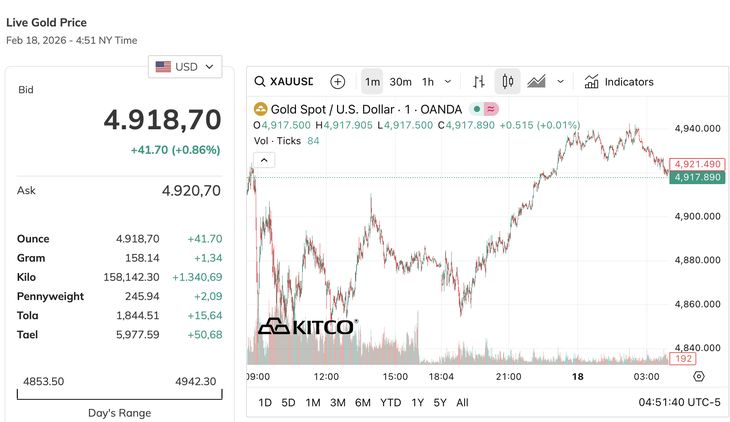
Specifically, there were continuous and sharp intraday reversals in gold prices, the bid-ask spread widened, and a growing gap emerged between the converted futures contract prices on major exchanges like COMEX and SHFE and the spot gold price.
More importantly, physical gold shortages have been observed at several major global gold trading centers as retail investors rushed in, creating a buying frenzy.
Total open interest in the COMEX gold futures market, along with increased trading volume of the GLD Gold ETF on the NYSE, is unprecedented.
According to Heng Koon How’s analysis, the unstable combination of excessive speculation ultimately “broke” on January 30. Kevin Warsh’s appointment was seen as an excuse for profit-taking in gold, as during his tenure as a Fed Governor under Ben Bernanke, he adopted a vigilant and aggressive stance on inflation and questioned the need for Quantitative Easing (QE) and the Fed’s large balance sheet.
Meanwhile, domestic news from China emerged, mentioning fraud risks and the collapse of some gold-investment schemes. Local media reported that Chinese authorities have tightened regulations, including suspending trading in several gold-investment schemes.
This development has heightened concerns that the sharp rise in gold prices may have reached excessive speculative levels, especially considering the surge in warrant holdings on SHFE in recent weeks and capital inflows into Gold ETFs in China.

The sell-off in gold that began in Asian markets on the afternoon of January 30 intensified and spread during the New York trading session, as the drop in gold prices triggered a “gamma reversal” event, forcing the liquidation of large-scale option positions. Delta hedging, which previously required buying more gold as prices rose, now reversed to the downside.
Subsequently, the heaviest selling pressure was seen on gold futures prices as margin difficulties increased due to COMEX’s new maintenance margin requirements.
Earlier in mid-January, in an effort to reduce extreme volatility, COMEX changed the margin calculation method for gold and precious metals from a fixed nominal margin in USD to a calculation based on a percentage of the contract value.
This new rule is believed to have accelerated the forced liquidation process during the sell-off. Amid rising volatility, on January 30, COMEX announced an increase in initial and maintenance margin requirements for gold futures contracts from 6% to 8%, effective February 2.
This announcement of increased margin requirements further intensified selling pressure on gold, as weak long positions unable to meet the higher margin requirements were forced to close.
![[फोटो] महासचिव तो लाम गाजा पर शांति परिषद के उद्घाटन सत्र में भाग लेते हुए।](https://vphoto.vietnam.vn/thumb/1200x675/vietnam/resource/IMAGE/2026/02/19/1771516865192_tbttolam5-jpg.webp)
Heng Koon How also stated that in the coming period, the market will need more time for speculative activity to cool down, which will help gold prices gradually stabilize and establish a new equilibrium.
It is important to note that despite short-term volatility, the long-term demand for gold as a safe-haven investment and portfolio diversification tool among major investor groups remains unchanged.