Editor’s Note
The GUILD Gem Laboratory’s annual gala remains a key event for tracking the evolution of the global jewelry industry, consistently offering a forward-looking view of trends, research, and innovation.

On the evening of January 15th, the 2026 “Transcend Time, See Renewal” Annual GALA Gala, jointly hosted by GUILD Gem Laboratory and GUILD Gemological Education, successfully concluded. As a significant event in the jewelry industry that has been held for nine consecutive years, the cutting-edge industry dynamics, research perspectives, and technological achievements released each year represent important trend guidance and technical directions for the global jewelry industry.
This year’s gala gathered market dynamics and development trends across three major categories: colored gemstones, jadeite, and pearls. Based on annual real testing data and field research covering over 15 countries and regions worldwide, the GUILD gemologist team released market development trend reports for the Chinese and global jewelry industries.
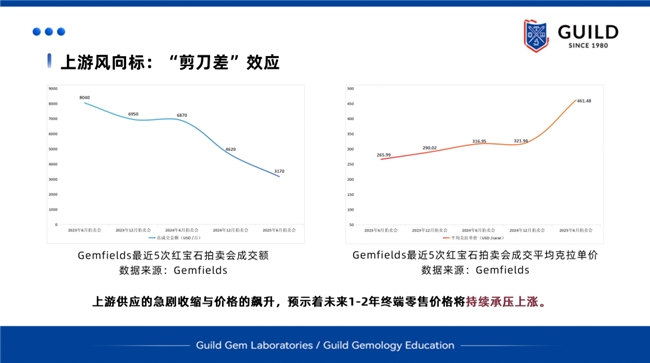
At this GALA Gala, Li Kai, Director of the Colored Gemstone Department at GUILD Gem Laboratory, first pointed out: The colored gemstone market in 2025 is undergoing a transformation. Consumers no longer focus solely on a single label but comprehensively consider color, crystal, cut, and light effects, driving the market to focus on high quality and diverse aesthetics. Ruby supply remains scarce. Data from the recent five Gemfields auctions shows a decline in ruby transaction volume and an increase in rough stone prices. The “Pigeon’s Blood” color still dominates the ruby market, with aesthetic preferences showing a trend towards diversification. Rubies under 2 carats are mainstream, while high-quality rubies over 2 carats remain stable. Myanmar and Mozambique maintain their core status as source origins.
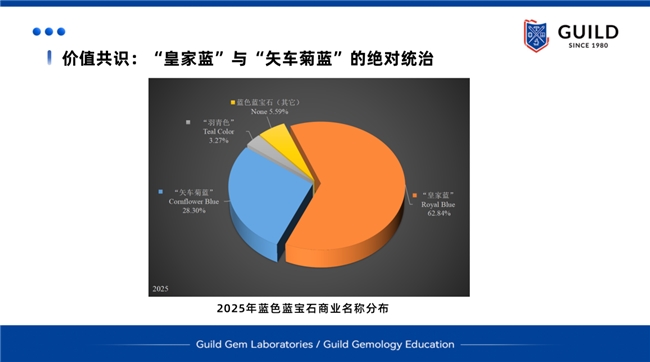
The sapphire market prefers classic blue hues. Padparadscha sapphires show strong performance, and lavender color has maintained high popularity for two consecutive years. Major origins are still concentrated in Sri Lanka, Myanmar, and Madagascar, with the supply chain gradually concentrating towards core origins. Emerald market demand is concentrated on top-quality “Verdant Green,” whose proportion continued to rise in 2025, reflecting consumers’ sustained preference for high-value colors. Zambia remains the primary source for commercial-grade emeralds.
From rubies to nephrite, to jadeite, the origin, perception, and cultural value of gemstones have always influenced market pricing. In the current market environment, origin identification for jadeite is particularly important. Huang Tiantian, Deputy Director of the Colored Gemstone Department at GUILD Gem Laboratory, cited data, mentioning:
In the future, origin premiums will continue to exist in the jadeite market. However, as consumer awareness improves and information transparency increases, the market will pay more attention to the quality of jadeite, such as color, texture, craftsmanship, and aesthetic characteristics. Currently, the jadeite market exhibits three major trends: origin diversification, a younger consumer base, and breakthroughs in detection technology, driving industry vitality and innovation.
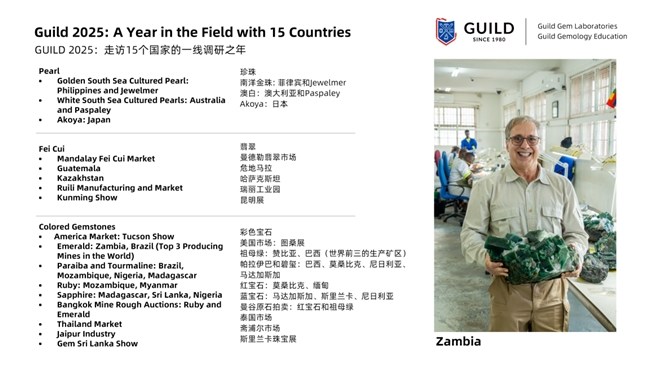
At the GALA Gala, as two of the world’s most active field gemologists, Andrew Lucas, President of GUILD Education, and Liu Lihong, President of GUILD Gem Laboratory, on behalf of the gemologist team, shared first-hand information covering the pearl and colored gemstone industry chains after their 2025 investigations across fifteen countries and regions:
Regarding pearls, overall, seawater pearls are constrained by factors such as seawater temperature, pH levels, and expansion of farming areas. South Sea golden pearls and South Sea white pearls belong to niche markets, with demand across all quality tiers, and the supply-demand gap is particularly evident in the high-end market. The supply of high-quality Akoya pearls continues to shrink, exacerbating the supply-demand imbalance, while commercial-grade products must directly face competition from Chinese freshwater pearls. Chinese freshwater pearls have become an indispensable force in the world pearl market, with significant progress in both quality and technology.
Regarding colored gemstones, from 2024 to 2025, only emerald production remained stable and continuous in the market, but high-quality, large-carat emeralds are still scarce. Over the past two years, demand for colored gemstones has diverged across countries, with some countries seeing increased demand and others decreased demand. However, demand for high-quality, large-sized colored gemstones has remained consistently strong.
From a category structure perspective, compared to 2024, the market shares of freshwater and seawater pearls remained basically stable, with freshwater pearls accounting for 76% and seawater pearls for 24%, consistent with the global production structure. However, within seawater pearls, there is a trend of South Sea pearls growing by 10%, Akoya pearls adjusting downward by 11%, and Tahitian pearls maintaining a stable proportion. Behind these figures lies not short-term aesthetic changes but close correlation with farming cycles, production constraints, and the stability of the price system. Highly scarce categories show greater resilience in the current environment.
Small-sized pearls became a key structural variable in 2025. The market is shifting towards 4-6mm and under 4mm sizes. The essence of the growth in small-sized pearls is a change in consumption logic. On one hand, there is increased demand for cost-effectiveness from a younger market; on the other hand, pearls are no longer just about “the value of the material itself” but an expression of design, matching, and emotional identification.
Lin Moqing, Director of the Pearl Department at GUILD Gem Laboratory, believes that in the next three to five years, the Chinese pearl market will continue to develop in the direction of structural optimization. High-quality pearls will maintain their scarcity value and resilience. Collectors and investment-oriented consumers will pay more attention to quality, certification, and traceability. Establishing unique brands, design innovation, and quality standards remains key to winning the market.
Zhou Dan, Vice President of GUILD Gemological Education, also reviewed changes in gemological education and talent trends at this gala. From early industry practitioners to the influx of cross-border personnel, the new “gem people” have accumulated rich resources and strong consumption power within their circles. 62% of GUILD Gemological Education students have independent media accounts. They may become more aggressive new entrants, presenting both opportunities and challenges for existing practitioners.
Regarding overseas markets, most students participating in overseas courses and origin-tracing courses do not have long-term backgrounds in the jewelry industry. However, they are willing to invest significant effort in exploring and outputting origin narratives, directly connecting with consumers in source markets. This model further shortens the transaction chain. Zhou Dan also cited the example where the revenue of the Chinese domestic high-end gold brand Lao Pu Huang Jin in 2025 exceeded the sum of Richemont Group’s jewelry business in China, stating:
The 2026 GUILD GALA Gala showcased the profound changes in the jewelry industry against the backdrop of globalization. From mining areas to the market, from data to trends, the GALA Gala presented a full-chain, multi-dimensional exchange feast for the industry. Standing at a critical juncture in industry development, this grand event not only demonstrated the power of academic depth and technological innovation but also united gem practitioners in their common pursuit of transparency, responsibility, and sustainable development. Looking to the future, it is hoped that the gem industry can build a more scientific, traceable, and resilient global jewelry ecosystem based on collaboration and trust.