Editor’s Note
This article highlights a key challenge in Sri Lanka’s renowned gem industry—the gap between producing world-class stones and achieving international recognition for their certification. It introduces the Gemological Report of Ceylon (GRC) as an initiative aiming to address this issue.
Steps into a Critical Void to Earn Recognition in International Markets
For decades, Sri Lanka has been globally revered as the “Island of Gems,” yet the industry has long grappled with a paradoxical challenge: while the Sri Lankan soil yields the world’s finest stones, the local certification process has often struggled to command the same recognition in international markets.
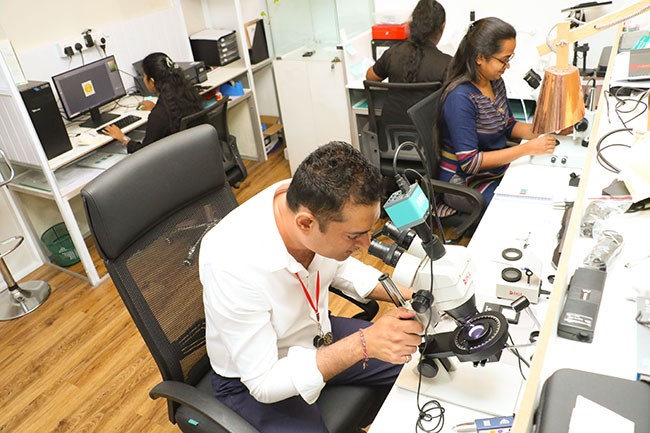
Stepping into this critical void is the Gemological Report of Ceylon (GRC). Located at No. 97, Galle Road, Colombo 3, this newly launched laboratory is on a mission to redefine the standards of local gem certification, ensuring that the “fatherhood” of Sri Lankan gemstones remains firmly within its home soil.
Founded by Milinda Edirisinghe, a seasoned gemologist with over 20 years of experience in mining, trading, and geological study, GRC is the result of a lifelong observation of the industry’s “trust gap.”
“I saw a critical disparity,” says Edirisinghe, who received specialised training in Thailand, the global hub for gemstone treatments. “Sri Lankan exporters often face unfair skepticism in markets like Thailand, Hong Kong, and the US. International buyers often view local reports with doubt. I launched GRC to provide a local institute that is on par with the highest-caliber laboratories in the world.”
He made these comments while speaking to media at the new laboratory.
According to him, in its first month of operation, GRC has already seen a surge in demand, processing 30 to 40 stones daily – a success driven largely by its word-of-mouth reputation.
A Foundation of Total Transparency and Rigorous Process
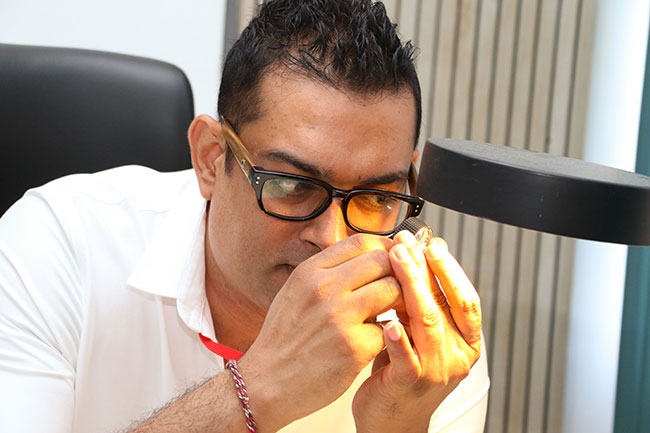
“The lab’s rapid growth is built on a foundation of total transparency. Unlike traditional setups, GRC employs a rigorous triple-blind screening process: three independent gemologists evaluate each specimen – from Sapphires, Ruby and Emeralds to semi-precious stones, polycrystals, rare meteorites, and even organic materials like natural Pearls, and rare coral species etc., used in high-end jewelry. By evaluating the stones without consulting one another, the three gemologists’ independent findings are then synthesised into a final, authoritative and error-free assessment,” he explained.
“As gemstone treatments become increasingly sophisticated – ranging from Beryllium diffusion to evolving heat and irradiation treatments – the need for advanced technology is paramount. GRC’s facility is equipped to identify the full spectrum of enhancements, ensuring the end consumer knows the exact “human intervention” history of their asset,” he further said.
The Indispensable Role of the Human Expert
However, Edirisinghe maintains that technology is a tool, not a replacement. When asked if AI could eventually handle the certification job alone, he noted:
“AI already assists our workflow to an extent, but a human gemologist remains an indispensable part of the process. Just as a surgeon uses advanced technology to enhance precision, they must still be present to execute the nuances of a complex operation. AI cannot truly ‘see,’ touch, or feel the soul of a stone.”
“AI can support our findings, but it cannot replace the gemologist’s ‘eye-view’ and the tactile senses that go a long way in issuing an accurate certification.”
Furthermore, GRC leverages an international expert network.
“If we encounter a complex inclusion, we utilize virtual screen-sharing with leading labs in Thailand for real-time peer review,” Edirisinghe explains. “Our conclusions are science-based facts, not just opinions.”
Economic Impact and Global Ambitions
Beyond technical excellence, GRC serves a vital economic purpose. Historically, local dealers spent thousands of dollars obtaining international certificates. GRC offers these world-class reports at a fraction of the cost, with detailed certificates starting from LKR 15,000 for full reports, a medium report at LKR 6,000, “memo cards” at LKR 1,500, and verbal opinions for LKR 500.
“By providing a credible, globally-recognised home-based laboratory, we are stemming the outflow of foreign currency to international labs,” said Edirisinghe.
With plans to participate in upcoming exhibitions in Dubai, Hong Kong, and the USA, GRC is positioning itself as a global contender. As the industry shifts toward “knowledgeable customers” who view jewellery as a liquid asset, GRC stands ready to provide the clarity and integrity the Sri Lankan gem industry deserves.
“If Sri Lanka produces the best stones in the world, it is only right that we also provide the world-class expertise to certify them. Our mission is to ensure that the ‘fatherhood’ of these precious stones remains in Sri Lanka, backed by a certificate that is respected from the USA to the European Union,” Edirisinghe said in conclusion.