Editor’s Note
European markets closed higher on Monday, shaking off early pressure from falling precious metals prices. Key indices in Paris, Frankfurt, and London all posted gains as investors turned their focus to a busy week of corporate earnings and economic data releases.
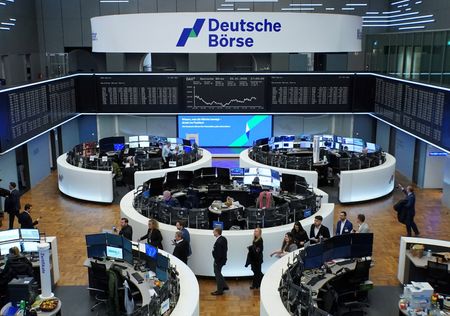
February 2 (Reuters) – European stock markets closed higher on Monday after being weighed down for much of the session by falling precious metals prices, as a new week rich in corporate earnings and economic data begins.
In Paris, the CAC 40 gained 0.67% to 8,181.17 points. In Frankfurt, the DAX advanced 1%, and in London, the FTSE 100 rose 1.15%.
The EuroStoxx 50 index gained 1%, the FTSEurofirst 300 progressed 1.09%, and the Stoxx 600 advanced 1.03%.
Gold and silver prices began to fall on Friday following the announcement of Kevin Warsh’s nomination as the future chairman of the Federal Reserve (Fed). The selling movement continued on Monday, fueled by the announcement from operator CME of an increase in margin requirements for its metals futures contracts.
This contributed to putting pressure on the entire financial markets, as investors operating with leverage were forced to sell other assets to cover margin calls on silver and gold.
Regarding geopolitics, Iran and the United States will resume their negotiations on Friday in Turkey, with both sides saying they are ready to discuss the nuclear dossier to dispel the specter of a new war in the Middle East.
On Ukraine, new talks under US auspices are scheduled for Wednesday and Thursday in Abu Dhabi.
Furthermore, the European Central Bank (ECB) and the Bank of England (BoE) meet on Thursday, but neither is expected to make changes to its monetary policy.
Spot gold fell more than 4% to $4,652 per ounce, after having dropped more than 9% on Friday – its largest daily decline since 1983.
Silver, for its part, is set to record its largest two-day drop since at least the 1980s. It fell 7.5% after already plunging 30% on Friday.
The European basic resources sector gained 0.76% after losing up to 3.4% during the session. Fresnillo lost 0.92% and Endeavour Mining 2.65%.
The plunge in precious metals prices, however, benefited jewelry makers. Pandora notably climbed 9.16%.
Energy stocks suffered with the decline in oil prices, as operators reacted to a possible easing of tensions between the United States and Iran.
TotalEnergies dropped 0.85%, and in London, Shell PLC fell 0.52%.
Eramet, whose board announced on Sunday that it had terminated the mandate of its CEO Paulo Castellari, citing differences over operations, plunged 9.69%.
At the time of the European close, the Dow Jones advanced 0.89%, the Standard & Poor’s 500 gained 0.56%, and the Nasdaq Composite rose 0.66%.
Walt Disney dropped 4% after the publication of its quarterly results, with investors penalizing the decline in international visitors to its theme parks in the United States and the lower results of its entertainment division, including film production and its streaming service.
The day was rich in economic data.
German retail sales rose 0.1% month-on-month in December, less than expected, data published on Monday by the Federal Statistical Office showed.
French manufacturing activity in January saw its strongest increase in production in nearly four years, aided by plans to increase defense and military spending in Europe, according to a survey of purchasing managers by S&P Global published on Monday.
The German manufacturing sector started 2026 on a positive note, with a return to production growth in January after a brief contraction in December, a survey published on Monday showed.
Manufacturing activity in the eurozone continued to contract in January for the third consecutive month, against a backdrop of persistent weakness in new orders, and despite the return to production growth, according to a survey published on Monday.
The UK manufacturing PMI index reached its highest level since August 2024 in January, with new order inflows seeing their strongest increase in nearly four years, reinforcing signs of recovery after a gloomy end to 2025.
The dollar held onto its gains as investors questioned the future trajectory of Fed monetary policy under Kevin Warsh’s leadership.
The dollar gained 0.57% against a basket of reference currencies.
The euro lost 0.35% to $1.1806.
Bond yields were trending higher with the turmoil in the precious metals market.
The yield on 10-year Treasuries rose 3.2 basis points to 4.2734%. The two-year gained 4.1 basis points to 3.5675%.
The yield on the German 10-year Bund gained 2.2 basis points to 2.8657%. The two-year advanced 2.8 basis points to 2.0949%.
Oil prices fell, as Iran and the United States prepared to resume negotiations, dispelling the specter of a new war in the Middle East.
Brent crude fell 4.77% to $66.01 per barrel and US light crude (West Texas Intermediate, WTI) retreated 5.08% to $61.90.
(Reporting by Mara Vîlcu, edited by Blandine Hénault)