Editor’s Note
This article examines the structural and chemical parallels between lab-grown and natural diamonds, referencing the ISO 18323 standard which confirms their identical fundamental properties.
According to the definition in the international standard ISO 18323, lab-grown diamonds possess essentially the same chemical structure, crystal structure, and physical (including optical) properties as natural diamonds. Under the current Hong Kong legislation, Cap. 362L “Trade Descriptions (Definition of Diamond) Regulation”, the physical properties of natural diamonds include:
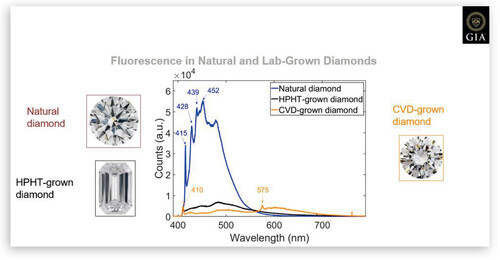
However, because the growth environments of lab-grown diamonds and natural diamonds are completely different, professional gemologists can still use highly sensitive instruments to detect unique atomic-level defects. These defects have unique reactions to light and can be analyzed using instruments such as ultraviolet-visible (UV-Vis) spectroscopy, Fourier-transform infrared (FTIR) spectroscopy, and photoluminescence (PL) spectroscopy. This allows for the distinction between lab-grown and natural diamonds without damaging the material.
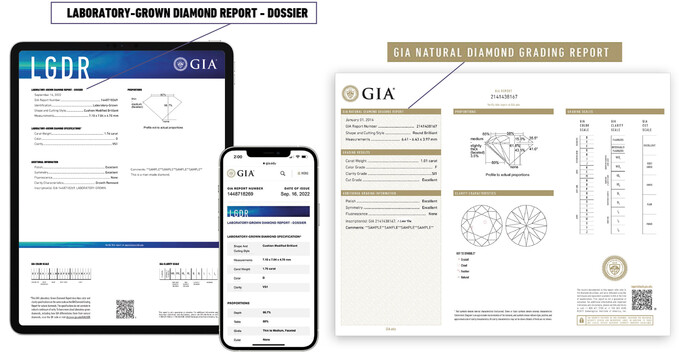
Consumers lacking professional knowledge in jewelry generally trust grading reports issued by internationally recognized laboratories, such as the Gemological Institute of America (GIA) or the International Gemological Institute (IGI). Both institutions grade and certify both natural and lab-grown diamonds, using the same grading criteria, the familiar “4Cs”: Carat weight, Colour, Clarity, and Cut, making it easier for general consumers to compare diamond quality. However, as commissioning internationally recognized laboratories for grading and issuing related “certificates” involves certain costs, for diamonds with lower weight (e.g., less than 30 points, or 0.3 carats) or relatively low prices, merchants may not provide grading reports for review due to cost considerations.
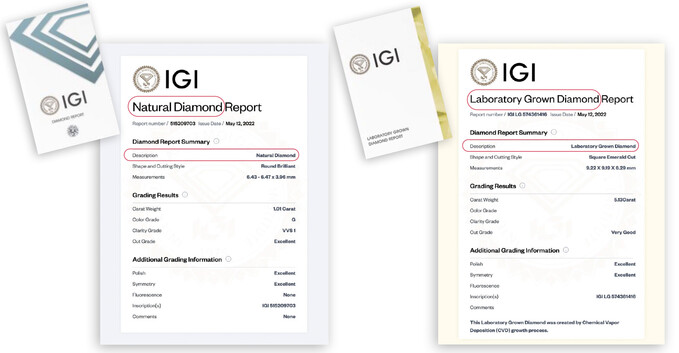
To help consumers more easily distinguish whether the diamond jewelry sold by merchants is natural or lab-grown, the grading reports issued by GIA and IGI for natural and lab-grown diamonds also differ in format and design. For example, GIA’s lab-grown diamond grading reports are only available in electronic format, with no physical paper version; natural diamond grading reports have a physical version. As for the grading reports issued by IGI for natural and lab-grown diamonds, different designs are also used. The cover of the natural diamond grading report is designed in blue, while the cover of the lab-grown diamond grading report is designed in yellow, helping consumers identify and distinguish.
In addition to visual differences, the “certificate” will also clearly state whether the graded gemstone is a natural diamond or a lab-grown diamond. When purchasing diamond jewelry, consumers should request the report from the merchant for review and pay extra attention to its layout and wording to avoid inadvertently purchasing a diamond product different from expectations.
Furthermore, when purchasing diamond jewelry, consumers can also use the grading report number to instantly verify the report on the official websites and/or mobile applications of the grading institutions GIA or IGI. This confirms whether the information listed for the diamond and in the “certificate” provided by the merchant matches the data in the grading institution’s database, enhancing personal protection. If, after correctly entering the grading report number, it is found that the official information from the grading institution significantly differs from the “certificate” provided by the merchant, consumers should be extra vigilant and reconfirm with the merchant to avoid falling into the trap of sellers misrepresenting goods.
When purchasing diamond jewelry, in addition to reviewing and verifying the diamond grading report provided by the merchant, consumers should also check the laser inscription on the diamond’s girdle to confirm whether the information in the “Inscription(s)” section of the grading report matches the desired natural or lab-grown diamond. Grading laboratories generally use a laser to inscribe the grading report number on the girdle of the graded diamond; if the graded diamond is lab-grown, words such as “LABORATORY-GROWN” or “LG” will be additionally inscribed for identification. However, it is difficult for consumers to read the laser inscription with the naked eye alone. It is recommended to borrow a magnifying tool from the merchant to compare the grading report with the words inscribed on the diamond.
Our staff recently visited 10 shops selling lab-grown diamonds in the market as ordinary consumers to understand and observe their sales methods and processes. Overall, the staff at the visited shops were willing to provide detailed introductions to lab-grown diamonds, explain the contents of grading reports, display products, and assist consumers in checking the laser inscriptions on the diamond girdles.
If consumers intend to visit their preferred shops to select lab-grown diamond jewelry, they can communicate with the merchant in advance to check if an appointment is needed to avoid an unnecessary trip.