Editor’s Note
This article provides a snapshot of Hong Kong’s half-day trading session on Lunar New Year’s Eve, highlighting a resilient close amid subdued activity. Key takeaways include the outperformance of AI and precious metals sectors, setting a thematic tone for the market entering the holiday period.
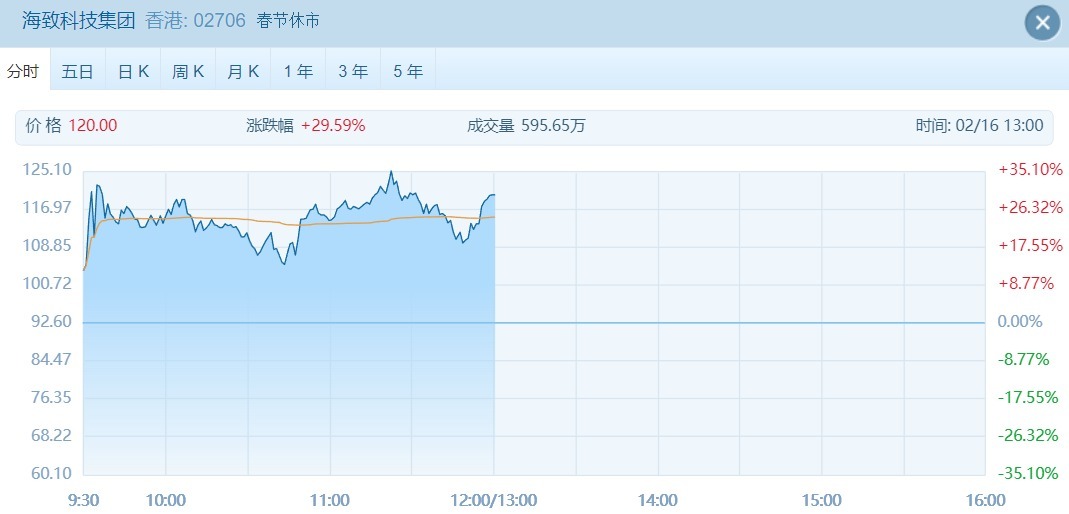
On February 16th (Lunar New Year’s Eve), the Hong Kong stock market held a half-day trading session (9:30 AM – 12:00 PM). The market opened lower but fluctuated and recovered during the session. Trading was relatively subdued due to the closure of the Stock Connect program. Most major indices closed higher, with significant sector divergence. AI concept stocks and the precious metals sector emerged as the biggest highlights of the day, providing a concluding note for the market ahead of the Spring Festival holiday.
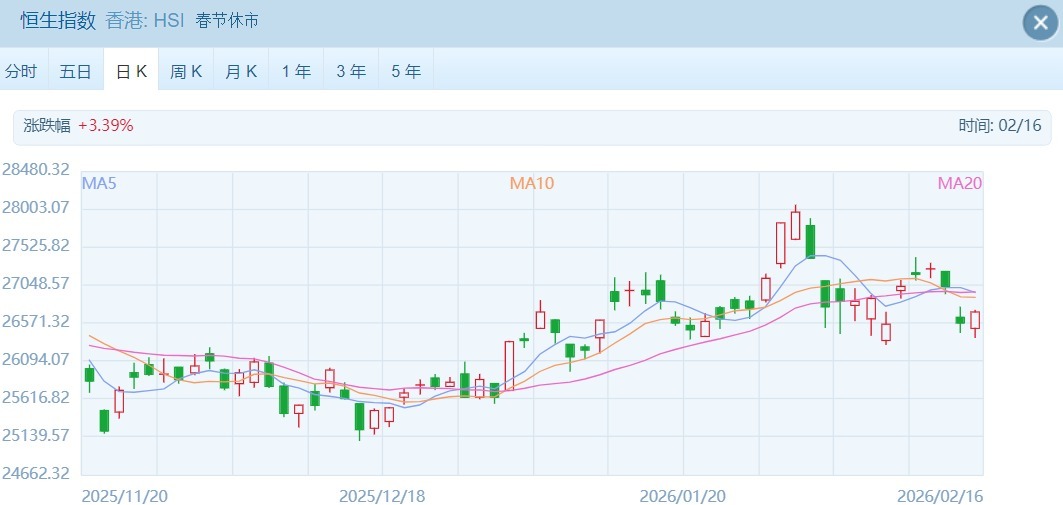
Major indices opened lower but closed higher collectively. The Hang Seng Index opened at 26,501.2 points, down 0.25%, fluctuated and recovered during the session, and closed at 26,705.94 points, up 0.52%.
The Hang Seng Tech Index performed relatively flat, opening down 0.19%, following the broader market’s fluctuations, and closed at 5,367.52 points, up 0.13%. The overall pattern was characterized by “blue-chip leadership and tech sector flatness.”
From a short-term perspective, the Hang Seng Index has gained 3.28% over the past three months. The performance during the pre-holiday half-day session was primarily influenced by holiday sentiment and short-term liquidity conditions.
Sector performance showed a clear distinction between strength and weakness, with popular sectors standing out.
Among the strong performers, AI concept stocks surged against the trend, becoming the focal point of the market.
This was primarily driven by multiple positive factors including breakthroughs in AI technology, accelerated commercialization, and policy support.
The precious metals sector also strengthened.
This was attributed to increased physical demand during the Spring Festival, geopolitical tensions, and institutional optimism about gold prices.
Additionally, the semiconductor sector showed localized strength.
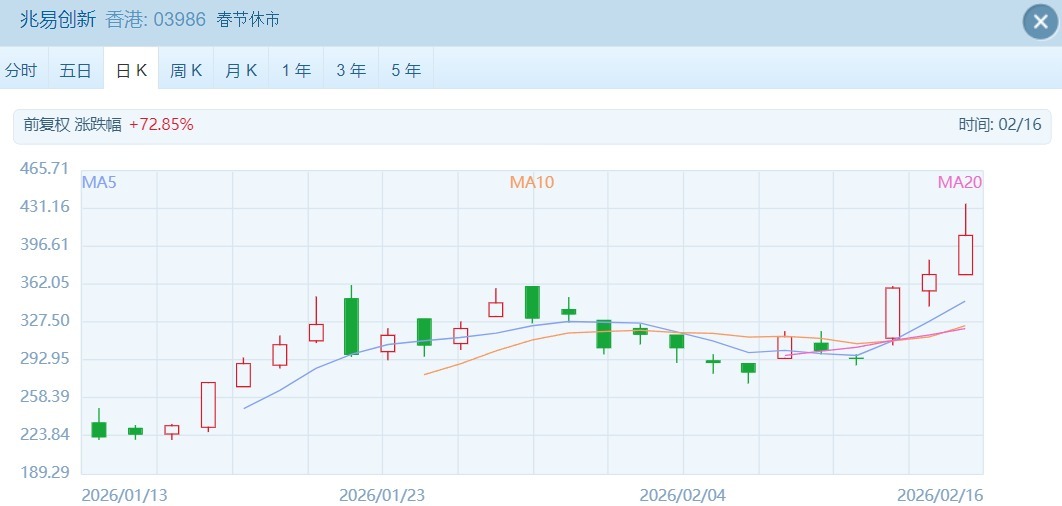
This was driven by the wave of memory chip price increases, boosting expectations for improved industry profitability.
Among weaker sectors, defense & aerospace, discretionary consumption, and hardware equipment underperformed. The real estate and financial sectors fluctuated without significant momentum. Internet giants showed mixed performance, with Baidu up over 1% and Alibaba down 0.45%.
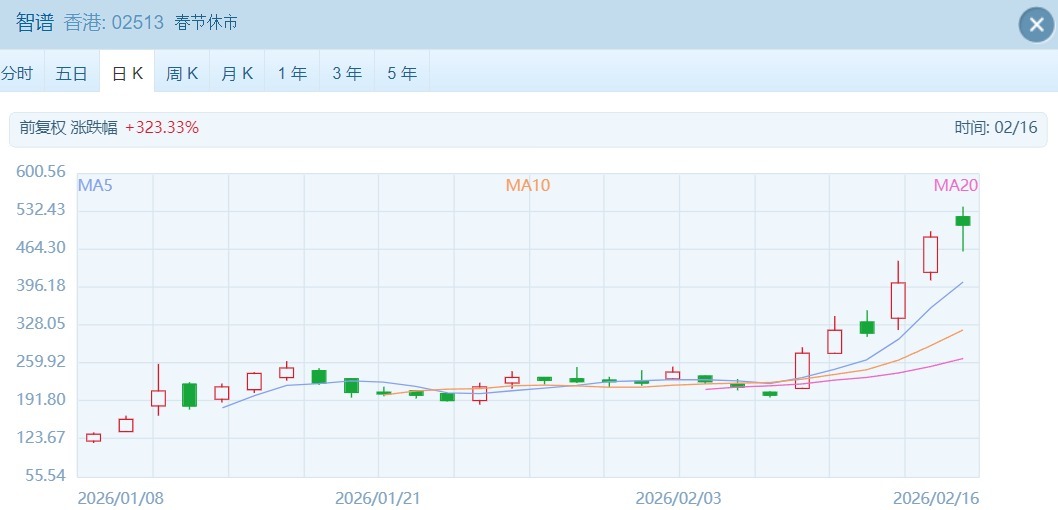
Among AI concept stocks, Zhipu AI, known as the “first domestic large model stock,” opened higher in the morning. Although its gains narrowed later, its stock price has doubled since the beginning of February, with a total market capitalization exceeding HKD 220 billion, making it the biggest highlight in the tech sector.
Overall, the Hong Kong stock market showed a trend of volatile recovery during the Lunar New Year’s Eve half-day session, with the strong performance of the AI and precious metals sectors injecting vitality into the market.
Looking ahead, as deflation improves and post-holiday work resumption accelerates, fundamental support for the stock market will strengthen. Considering that expectations for the post-holiday “Two Sessions” are likely to heat up, policy-related speculation will bring new catalysts, making “holding stocks over the holiday” a viable strategy.
Regarding sector allocation, it is recommended that investors adopt a balanced approach to reduce volatility. As the previously popular non-ferrous metals sector adjusts, the market is seeking new consensus. It is expected that post-holiday market themes will revolve around industrial upgrading and demand recovery. Overall, the Chinese economy is in a critical period of low-level recovery, and investors should patiently wait for post-holiday market themes to emerge and seize structural opportunities.