Editor’s Note
This article reports on the conclusion of discussions for the India-EU Free Trade Agreement, a significant development for India’s export strategy amid shifting global trade dynamics.
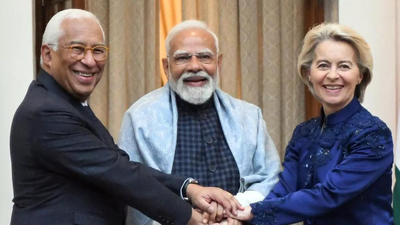
India and the European Union have successfully concluded discussions for the India-EU Free Trade Agreement (FTA). The move is a significant step forward for India’s exports at a time when it is looking to diversify away from the US in the wake of President Donald Trump’s 50% tariffs.
At the signing and exchange of the political declaration of the conclusion of negotiations of the India-EU Free Trade Agreement, PM Narendra Modi said.
The European Union ranks among India’s largest trading partners. The bilateral trade between the two in goods and services has risen steadily in recent years. In 2024–25, merchandise trade between the two sides stood at Rs 11.5 lakh crore or $136.54 billion, with Indian exports of Rs 6.4 lakh crore or $75.85 billion and imports worth Rs 5.1 lakh crore or $60.68 billion. Services trade between India and the EU reached Rs 7.2 lakh crore or $83.10 billion during the same period.
Together, India and the EU are the fourth- and second-largest economies globally, accounting for about 25% of global GDP and nearly one-third of world trade, positioning the agreement as a platform for unlocking significant trade and investment opportunities between two large and complementary economies.
The FTA delivers extensive market access for Indian exports – with over 99% of exports by trade value getting entry into the EU market. The India–EU trade agreement aims at deep tariff liberalisation on both sides, with the European Union opening 96.8% of its tariff lines and India 92.1%.
Labour-intensive industries are set to be among the major beneficiaries, with sectors such as textiles, apparel, leather, footwear, marine products, gems and jewellery, handicrafts, engineering goods and automobiles seeing tariffs of up to 10% eliminated on nearly $33 billion of exports upon the agreement’s entry into force. The resulting gains are expected to support workers, artisans, women, youth and MSMEs, while embedding Indian firms more firmly within global value chains and reinforcing India’s role as a dependable supplier in international trade.
Under the deal, India’s tariffs on EU goods will be reduced to zero for 93% of bilateral trade value over a 10-year period, while the EU will phase out tariffs on Indian goods over seven years, excluding sensitive sectors such as automobiles, steel and agriculture.
Beyond merchandise trade, the agreement aims to make substantial progress in services and puts in place a wide-ranging mobility framework. This is aimed at easing the cross-border movement of skilled Indian professionals.
India is expected to use the pact as a catalyst to create jobs, drive innovation, open up new opportunities across sectors and reinforce its position in global markets. The agreement also covers a broad sweep of trade disciplines, ranging from goods and services to trade remedies, rules of origin, customs processes and trade facilitation, while also extending to newer areas such as digital commerce and support for small and medium enterprises.
In automobiles, a calibrated, quota-linked liberalisation model will enable European carmakers to bring premium vehicles to India, while simultaneously encouraging local production and paving the way for exports from India in the future. Consumers are likely to gain from access to advanced technologies and stronger competition, and reciprocal entry into the EU market creates fresh opportunities for India-made vehicles.