Editor’s Note
This article outlines a mayoral candidate’s proposal to establish Jinju as a national hub for the aerospace and defense industries, framing it as a century-defining vision for the city’s future.
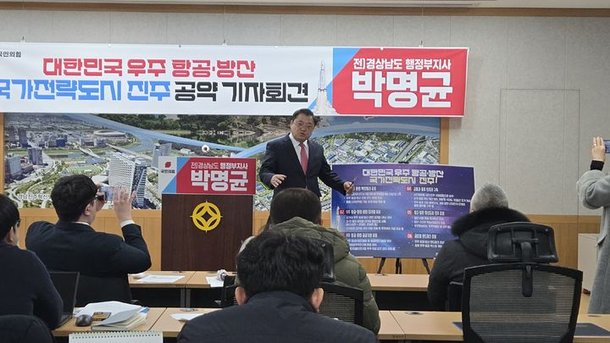
[Jinju=Newsis] Park Myung-kyun, a candidate for mayor of Jinju, South Gyeongsang Province, announced his core pledges and vision for building Jinju into a “National Strategic City for Aerospace and Defense,” which he described as the key vision to be responsible for Jinju’s future over the next 100 years.
Candidate Park emphasized at a briefing room in City Hall on the 29th, “As the axis of national competitiveness shifts to the aerospace and defense industries during this transitional period, Jinju must no longer remain on the periphery.” He then announced six major strategic pledges.
Candidate Park promised to transform Jinju into an “Aerospace Innovation Valley” centered around a national aerospace industrial complex. To this end, he plans to cluster public institutions, research institutes, and companies, and establish a “National Aerospace Certification Center” linked with the U.S. Federal Aviation Administration (FAA) and others—the first of its kind in Korea—to create an ecosystem that handles certification in a one-stop manner. He specifically presented figures, pledging to create a dedicated fund worth 1 trillion won to foster more than 10 strong small and medium-sized enterprises with annual sales exceeding 100 billion won within his term.
He stated that he would personally become the “No. 1 salesman” to attract large corporations and even push to change administrative district names after the companies, following public opinion gathering. He also plans to enact the nation’s first “Ordinance for Supporting Large Corporation Attraction and Investment Fund” to build an industrial ecosystem not inferior to Changwon’s.
As a third pledge, he proposed attracting key public institutions related to aerospace. He aims to attract the Aerospace Industry Promotion Agency, the Korea Institute of Aviation Safety Technology (KIAST), a branch of the Korea Aerospace Research Institute (KARI), and the Space & Satellite ICT Center of the Electronics and Telecommunications Research Institute (ETRI), while expanding the existing Space & Aviation Headquarters of the Korea Testing Laboratory (KTL).
Plans to expand logistics and transportation networks were also included. The strategy involves upgrading Sacheon Airport to “Sacheon-Jinju International Airport” and building super-wide-area transportation infrastructure connecting Jinju-Changwon-Busan double-track railways and the Jinju-Sacheon aerospace line to secure global export competitiveness.
Additionally, to overcome the crisis of population decline and aging, he promised to create specialized residential districts for youth and newlyweds, support rental factories and laboratories, and build a “Youth Startup Specialized Industrial Complex.”