Editor’s Note
This article examines silver’s volatile surge, highlighting its appeal to risk-tolerant investors driven by industrial demand, alongside its sharp recent corrections.

Silver is capturing investor interest with a higher dose of risk, although it finds support in strong industrial demand.
Silver bullion
Az Jackson (Getty Images)
Nuria Salobral
Madrid
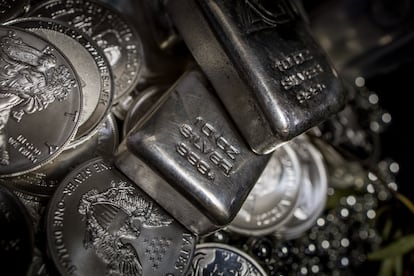
It is the metal for the riskiest, most leveraged investment bets. In parallel with the rise of gold, but with much greater intensity, silver has recorded a stratospheric revaluation in recent months, making its recent fall much harder. The metal has suffered, with barely four sessions’ difference, the two largest collapses ever seen in its price: the 26.36% drop on January 30 and the 19.57% drop on February 5. Its price is now stabilizing around $85 per ounce, although, as analysts assume, it promises to be very volatile in the coming months. In favor of calm, the positive expectations for the price of gold, from whose rise silver is catching, and the fact that the price of silver will continue to be supported by strong demand thanks to its industrial use are playing a role.
The reasons for silver’s rally are similar to those explaining gold’s rise. Investors are seeking an alternative to what have until now been classic safe-haven assets—the US dollar and US sovereign debt. Furthermore, in a context where interest rate cuts are expected, precious metals offer a more attractive store of value than bond yields. But, unlike gold, silver also offers a strong industrial component capable of putting a solid floor under its price collapse.
José Manuel Marín Cebrián, economist and founder of the financial services platform Fortuna SFP, agrees that demand for silver linked to technology, electrification, and the energy transition constitutes a fundamental support for the price of silver that does not disappear with a technical correction. But he also warns that “if gold is the thermometer of fear, silver is the thermometer of panic and industry. Its dual nature, as a monetary asset and industrial metal, makes it the preferred instrument for rapid risk adjustments. It is the metal of leverage.” In the face of market declines, the most leveraged investors are required to provide more collateral to cover their positions; in those cases, silver is one of the first assets sold to avoid greater losses and reduce risks.
Before the two historic collapses that silver has recorded in recent days, speculative positions on the metal had skyrocketed. As explained by Deutsche Bank, there was “fear of missing the buying opportunity.”
On January 30, when the price of silver plunged 26%, the 10-day volatility spiked to 186%. The day before, the metal had reached a record of $120 per ounce, a level four times higher than in January 2025.
Claudio Wewel, currency strategist at J. Safra Sarasin Sustainable AM, acknowledges that this physical supply deficit should support high silver prices in the short term and adds that the metal’s growing role as a store of value is also playing in its favor.
Thus, in Shanghai, buyers are paying a premium of around $10 per ounce over the London market price. Even so, Wewel also warns that silver tends to record much deeper corrections than gold after a prolonged rally, due to its higher volatility.
In fact, gold has not been dragged down by the intensity of silver’s correction and, although it has also purged the most speculative positions, it is trading again above $5,000 per ounce. The price of both metals continues to follow parallel trends in any case.
