Editor’s Note
This analysis examines China’s strategic response to U.S. trade pressures, arguing that Beijing is leveraging tariffs as a catalyst to diversify its economic partnerships and reduce long-term vulnerability.
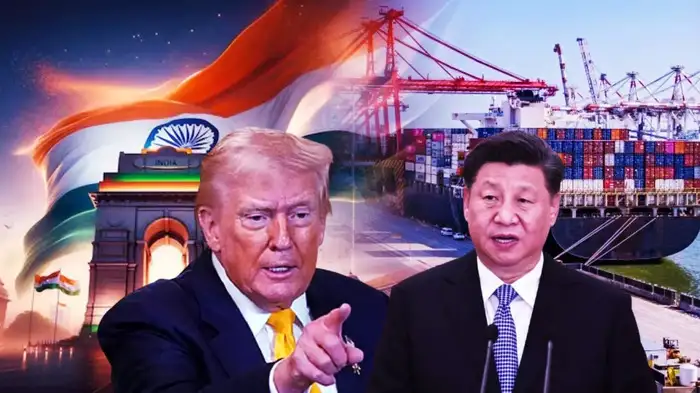
While US President Donald Trump has weighed the entire world on tariffs, and the chessboard may have been laid out by the US, China is playing the real game. The biggest twist is that China has begun to view tariffs as an unexpected opportunity. It is using this to reshape global trade and is also engaged in protecting its massive economy from future American pressure. Beijing wants to deepen economic ties with major global blocs like the European Union, Gulf countries, and members of the Trans-Pacific trade agreement. To do this, it is taking advantage of the uncertainty created by Trump’s trade policies. China is trying to finalize nearly 20 trade deals, many of which have been under discussion for years. This is a cause of tension for India. Beijing’s excessive dominance could harm its interests, potentially causing India to miss opportunities.
Chinese policymakers are carefully studying US trade strategy to understand Washington’s containment strategy and design ways to counter it. China is now putting these ideas into action.
During Canadian Prime Minister Mark Carney’s visit to Beijing, China struck a deal with Canada, reducing tariffs on Chinese electric vehicles. This deal is seen as the first of several agreements aimed at reducing American influence.
Insiders of Chinese policy are willing to accept short-term economic pain if it helps secure long-term dominance in global trade.
Two Western diplomats said that if China succeeds, it could reverse more than a decade of US trade policy and position itself at the center of a new China-led multilateral system.
China’s perspective has changed over the past year. Previously, Beijing used strong nationalist rhetoric. Now, Chinese diplomats are actively reaching out to global partners to defend multilateralism and open trade.
In January, China sent its top diplomat to Lesotho, a small African country on which Trump had imposed a 50% tariff. China promised development cooperation. State media later reported that China would remove tariffs on imports from 53 African countries.
Simultaneously, Beijing is promoting AI-powered customs systems in neighboring countries and is engaged in upgrading digital trade infrastructure. These steps are mentioned in Chinese policy papers, showing its target: to integrate China so deeply into global trade that other countries cannot sever ties under American pressure.
China is also accelerating trade talks with countries like Honduras, Panama, Peru, South Korea, and Switzerland.
Foreign Minister Wang Yi has also promoted deeper trade relations with Europe and the Gulf Cooperation Council. China is prioritizing joining the Comprehensive and Progressive Agreement for Trans-Pacific Partnership (CPTPP), an agreement originally designed to counter China before the US withdrew in 2017.
However, China’s large trade surplus remains a major concern. Its $1.2 trillion trade surplus has heightened fears that Chinese manufacturers could flood foreign markets with cheap goods. Domestic demand in China also remains weak.
A senior European trade diplomat described Beijing’s outreach as “pure Chinese propaganda,” saying Brussels has no plans for a free trade agreement (FTA).
Nevertheless, Chinese advisors remain confident. One advisor noted that China and the EU negotiated a major investment deal during Trump’s first term in 2020, though it was later suspended.
Chinese scholars argue that Beijing should learn how Washington has used global institutions to pressure China. Some advise taking advantage of Trump’s skepticism towards multilateral organizations like the WTO. Others suggest China should influence global standards in areas like intellectual property through initiatives such as the Belt and Road program and its role in the Regional Comprehensive Economic Partnership, which covers about 30% of global GDP.
China has already begun implementing these ideas. The recent upgrade of its trade deal with Southeast Asian countries placed heavy focus on digital trade and artificial intelligence (AI).
State media claims that at China’s “Friendship Port” on the Vietnam border, an AI system has reduced waiting times by 20%. Reuters could not independently verify this claim.
China’s growing exports have put many countries, including India, on edge.
Some analysts say closer ties with China will reduce dependence on the US. Stephen Nagy of the Macdonald-Laurier Institute suggested Canada’s deal with China might be aimed at gaining leverage ahead of negotiations on the US-Mexico-Canada Agreement (USMCA).