Editor’s Note
This dispatch from our correspondent offers a wry critique of the Louvre’s governance, framing it as a high-stakes administrative farce rather than a conventional crime story. The museum’s opaque operations, it suggests, have become a spectacle in their own right.
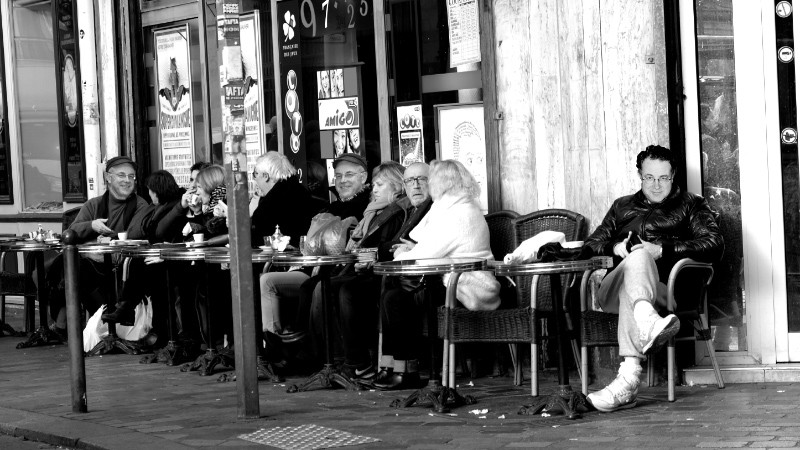
We know, we observe, we commission, we task, we consult and… Nothing! The governance of the Louvre Museum appears as a masterpiece of abstraction. From our correspondent, live from the Café du Commerce.
There are heists that belong to crime novels, others to farce. The one at the Louvre clearly belongs to a third category: a very high-budget administrative comedy, played before a stunned audience, with union intermissions and weekly press reviews. Because, after all, as much as we love art, sometimes you have to look at the frames rather than the paintings. And what the Louvre jewelry heist case reveals, week after week, is not so much the audacity of inspired thieves as the quiet perseverance of an institution in making sure to do absolutely nothing on time.
Private expertises, repeated warnings, detailed reports. Even a jeweler’s audit – Van Cleef & Arpels, no less – had noted that the museum’s security resembled more of a 20th-century legacy than a fortress for world heritage. One might have thought that an institution preserving priceless treasures would take this as a worrying compliment. Clearly not.
Then came the information published in *Le Monde*, dated January 23, 2026, which – at the Café du Commerce – makes people cough even in the back rooms: a report from the Paris Police Prefecture, transmitted to the Louvre’s management on August 29, 2025, bluntly stating that
IT, video surveillance, guarding: nothing is spared. Just six weeks before the heist on October 19!
In other words, the danger was identified, documented, stamped, archived — and then carefully ignored. Faced with this, the defense from the Louvre’s presidency boils down to one sentence: the report was requested by the museum itself. A decisive argument, which amounts to saying: we knew it wasn’t working, and we preferred to continue as if nothing was wrong. This is no longer a line of defense; it’s an admission of theoretical competence coupled with practical incapacity.
The governance, therefore, appears as a masterpiece of abstraction. We know, we observe, we commission, we task, we consult. But we don’t decide. Or rather, we decide to wait. Wait for what? The heist, apparently. The overseeing ministry, caught between two reshuffles, did appoint a security consultant, freshly arrived from the Notre-Dame reconstruction site. The idea is appealing: after all, he’s used to monuments. Rachida Dati, soon to depart, hinted that a
was a
Café du Commerce translation: we’re talking about it, but not today.
Meanwhile, the Louvre staff, for the fourth time on Monday, January 26, resumed their intermittent strike. They are not asking for the impossible or the exotic: simply working and security conditions worthy of the place. Here again, the institutional response is remarkably consistent: silence, scheduled meetings, postponed decisions.
And at the top of the state? The President of the Republic, magnanimous, declared his conviction that the jewels would soon be found. That’s reassuring. A bit like saying, after a fire, that you’re sure the smoke will eventually dissipate. Ultimately, what is striking in this affair is not so much the existence of flaws – no institution is exempt – but their quiet, acknowledged, documented accumulation, without ever triggering the expected shock. Everyone writes their report, everyone ticks their box, and the chaos continues.
A proper chaos, even. Organized, hierarchical, perfectly dysfunctional. A chaos where everything is known, except who decides. Where world heritage is protected with
systems, but with brand-new talking points. Where it is discovered, after the fact, that everyone was right too early.

The Louvre will remain the Louvre. The jewels, hopefully, will return. But in the meantime, one question remains, nagging, a nugget at the Café du Commerce: when everyone knew, who was supposed to act?
Let’s add that the prospect of entrusting this same governance with the project management of a €1.1 billion program, highlighted by the Court of Auditors, following the Louvre Renaissance architecture competition whose results are to be unveiled on February 13, now seems less like a cultural ambition than a life-size adventure.
A single entrance for the museum, a Mona Lisa finally placed in majesty: the intention is stated, the execution promises to be folkloric. Because by repeatedly proving that it can perfectly document its failures without ever correcting them, the Louvre’s management establishes itself as a serious candidate for the title of grand master of heritage chaos. One can already imagine the construction site managed by layers of contradictory reports, deadlines slipping elegantly, budgets
by discreet increments, and the Mona Lisa, protected by a device as reassuring as a “do not touch” sign.
If the jewelry affair has demonstrated one thing, it’s that here, inaction is not an accident but a method. At this pace, the Louvre Renaissance might well enter history not as a renewal, but as the ultimate contemporary installation: one billion euros to illustrate that governing is not only about knowing – it’s above all about deciding.
Jean-Claude Ribaut