Editor’s Note
This article examines the paradox of soaring retail prices for strawberries alongside reports of surplus crops being discarded at farms, highlighting the complex economic pressures within the supply chain that ultimately impact consumers.
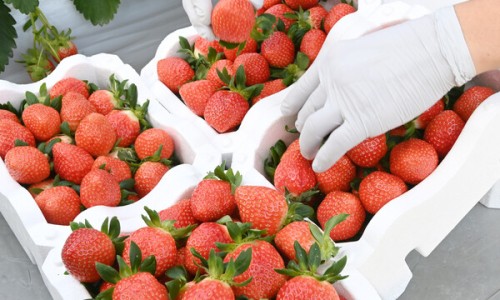
It’s the season for strawberries, the ‘red jewel’ and herald of winter. Adorning bakery cakes and gracing the lavish dessert buffets of hotels, strawberries are undoubtedly the most beloved winter fruit. However, the perspective on this year’s strawberry market is complex. While prices have soared to the point where picking up a pack at the supermarket feels daunting, news is emerging from producing farms that harvested strawberries are being plowed under in fields or piled up like mountains and discarded.
What is happening in the strawberry market, where the consumer’s cry of “It’s too expensive to eat!” coexists with the farmer’s tears of “There’s nowhere to sell them, so we throw them away”? Today, we provide an in-depth analysis of the bare face of the strawberry distribution structure and the root causes of the supply-demand mismatch.
First, let’s look at the market prices we feel. According to the latest data from the Korea Agro-Fisheries & Food Trade Corporation (aT), strawberry retail prices are maintaining a level about 16% higher than last year and a staggering 24% higher than the average year. The reality is that buying a pack (500g) of strawberries at a large supermarket requires paying around 15,000 to nearly 20,000 won.
Behind this price surge lies strong ‘dessert demand’. Recently, the popularity of hotel strawberry buffets, centered on the MZ generation, has caused reservation chaos despite high prices of up to 150,000 won per person. Furthermore, as desserts packed with strawberries, like Seongshimdang’s ‘Strawberry Sira’ cake, have become ‘essential items for the year-end and New Year season’, the battle among distributors and bakeries to secure strawberries has intensified even more.
[Table] Strawberry Price Trend (As of early January 2026)
| Category | Current Price (Average) | YoY Change | Vs. Average Year |
| :— | :— | :— | :— |
| Retail Price (100g) | 2,820 won | +16.0% | +24.0% |
| Wholesale Price (2kg) | 45,980 won | +36.3% | +41.2% |
Analysis Point: It’s crucial to note that wholesale prices have risen more sharply than retail prices. This suggests that strong downward price rigidity is at work in the intermediate distribution stages, and supply is not flowing smoothly to the retail market.
While consumers hesitate looking at expensive price tags in supermarkets, an unbelievable scene is unfolding in major strawberry-producing regions like Nonsan, South Chungcheong Province. Freshly harvested strawberries are heading to landfills by the truckload, or farms are giving up on harvesting altogether and plowing under their vinyl greenhouses, one after another.
The core of this absurd situation lies in the ‘qualitative change in demand’ and the ‘collapse of the processing market’.
Strawberry consumption in Korea is largely divided into ‘fresh consumption (supermarkets, gifts)’ and ‘processing (jam, juice, cake filling)’. The problem is the processing market. Recently, large bakery franchises and beverage companies are turning their eyes to imported frozen strawberries instead of domestic ones. This creates an overwhelming price competitiveness gap. The price of imported frozen strawberries is only about half that of domestic ones. Last year’s import volume of frozen strawberries for processing recorded 16,000 tons, an increase of over 30% compared to the previous year.
As processors choose imports for cost reduction, the sales channels for mid- to low-grade domestic strawberries, which were originally supposed to be supplied for processing, have been completely blocked. Merchants purchase strawberries from farms based on fixed contracts, but with no factories (processors) to buy them back, the vicious cycle of piling them up in warehouses and eventually discarding them repeats.
Readers might wonder: “If they don’t sell for processing, can’t they just sell them cheaply at supermarkets?” But reality is not that simple. Here, the chronic problems of South Korea’s agricultural product distribution structure are intertwined.
① Rigid Wholesale Market and Margin Structure
The journey of strawberries from farm to consumer’s table involves complex stages: ‘Producer → Local Collector → Wholesale Corporation → Intermediate Wholesaler → Retailer’. Each stage adds transportation costs, labor costs, and margins. The reason retail prices don’t drop immediately even when there’s a surplus at the production site is that intermediate distributors try to maintain the already high market price, or the structure is such that they cannot sell below a certain price due to high ‘fixed costs’ like transportation and labor.
② Soaring Production Costs
On the other hand, one fundamental reason for the declining price competitiveness of domestic strawberries is the production cost. The cost of nutrient solution (fertilizer), essential for strawberry farming, and labor costs, which rely on manual work, have skyrocketed in recent years. From the farmer’s perspective, selling below a certain price means taking a loss, leading to the tragic choice of plowing under the fields and preparing for next year’s crop as the economically ‘less damaging’ option.