Editor’s Note
This article discusses Richemont’s strong quarterly performance, which exceeded market expectations. The figures cited for the September-December 2025 period are forward-looking projections, not historical results.
Richemont, the Swiss luxury goods group (encompassing jewelry brands such as Cartier and Van Cleef & Arpels, and watchmakers like IWC, Jaeger-LeCoultre and Vacheron Constantin), has once again demonstrated its market position, surprising the market with results exceeding expectations for the September-December 2025 period.
Richemont’s sales during this period reached an impressive figure of 6.4 billion euros, representing an 11% increase at constant exchange rates, far surpassing analysts’ forecasts of just 7.4%.
The sales results exceeded market expectations thanks to strong global demand for jewelry and the continued economic recovery in China, the company’s second largest market and a benchmark in the luxury goods sector (China accounts for less than 20% of the company’s sales).
Recall that in recent years, China has been the main growth driver for the luxury market, but it is currently facing a crisis in the real estate market and a widespread weakness in consumer willingness to make discretionary purchases.
However, margins are currently tempering optimism around the company. According to Deutsche Bank analysts, the combination of record gold prices and the strength of the Swiss franc is likely to continue and could affect the group’s profit forecasts for the next fiscal year if not offset by new price increases. The question of how this will affect consumers remains uncertain. On one hand,
Sales at constant exchange rates: +11%, forecast +7.47%

Jewelry Maisons sales at fixed exchange rates: +14%, forecast +9.47%
Specialist Watchmakers sales at constant exchange rates: +7%, forecast -0.12%
Revenue in Europe at constant exchange rates: +8%, forecast +5.25%
Revenue in the Americas at constant exchange rates: +14%, forecast +9.83%
Revenue in the Asia-Pacific region at constant exchange rates: +6%, forecast +4.8%
Revenue in the Middle East and Africa at constant exchange rates: +20%, forecast +14%
Revenue in Japan at constant exchange rates: +17%, forecast +8.36%
Retail sales at constant exchange rates: +12%, forecast +7.5%
Sales: 6.4 billion euros, forecast 6.25 billion euros
Jewelry Maisons sales: 4.79 billion euros, forecast 4.68 billion euros
Specialist Watchmakers sales: 872 million euros, forecast 802.2 million euros
Sales in Europe: 1.55 billion euros, forecast 1.53 billion euros
Sales in the Asia-Pacific region: 1.87 billion euros, forecast 1.88 billion euros
Sales in the Americas: 1.74 billion euros, forecast 1.72 billion euros
Sales in Japan: 632 million euros, forecast 590.9 million euros
Revenue in the Middle East and Africa region: 607 million euros, forecast 587.5 million euros
Retail sales: 4.6 billion euros, forecast 4.55 billion euros
Richemont’s results provide positive indications for the luxury sector in 2026.

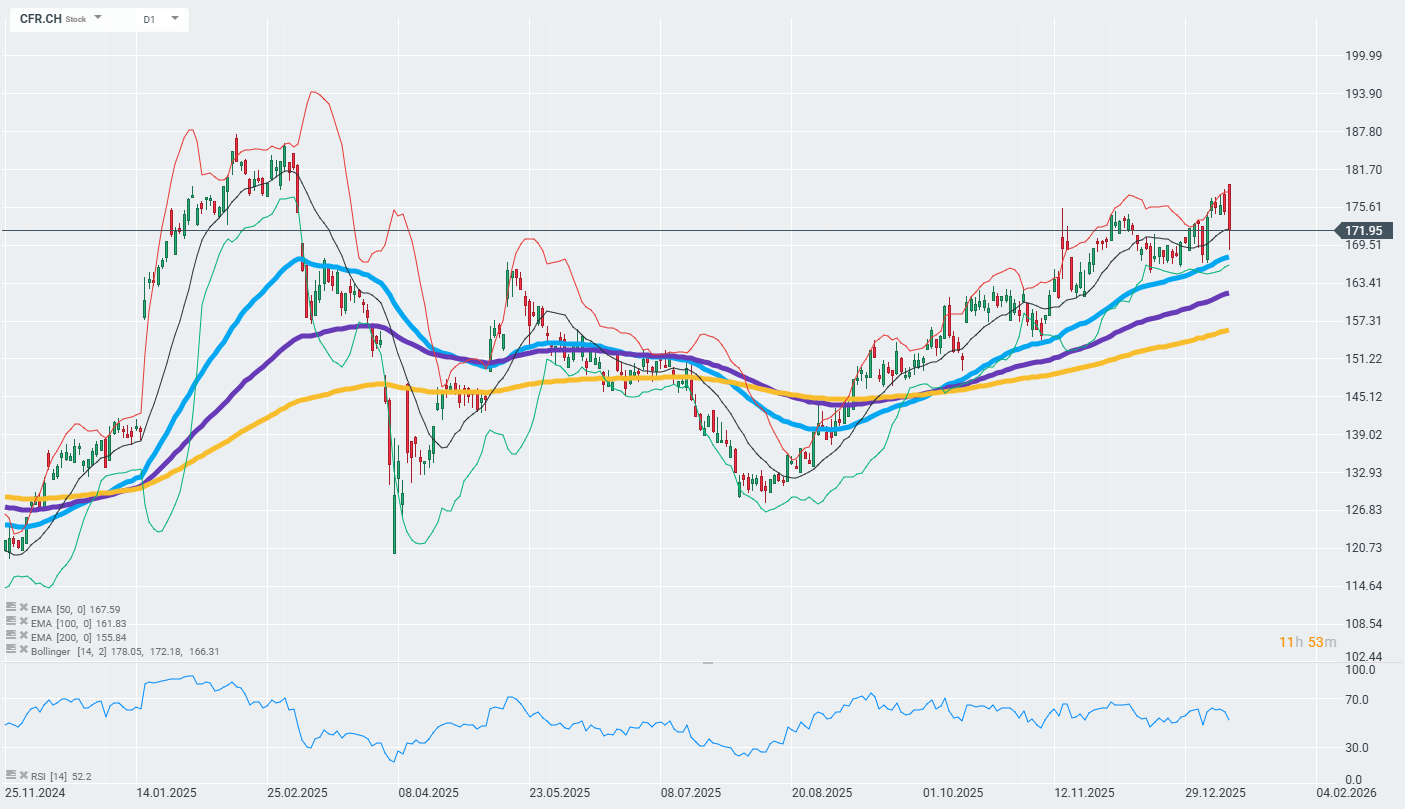
Richemont’s shares maintain a long-term upward trend, despite today’s significant drop in value. From a technical perspective, the key support level remains the 50-day exponential moving average (EMA) (blue curve on the chart), which supply has not tested again in almost six months.
Source: xStation