Editor’s Note
This article examines the market and legal implications of recent U.S. trade policy shifts, highlighting the resilience of precious metals amid dollar volatility and the enduring legal framework governing tariffs.
U.S. Dollar and Treasury Bonds Fall… Precious Metals Market Shows Strength
Trade Act Sections 122 and 301, IEEPA Seen as Difficult to Replace
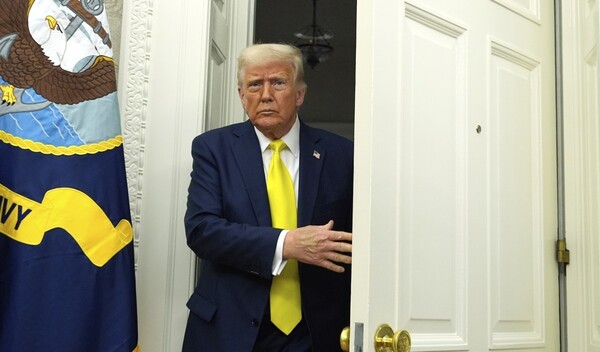
With the U.S. Supreme Court ruling reciprocal tariffs illegal and President Trump retaliating with new tariffs, the global economy faces new uncertainty. / Photo=Yonhap News.
| Seoul = Han’s Economy Reporter Shin Yeon-su | Although the U.S. Supreme Court put the brakes on the Donald Trump administration’s reciprocal tariffs on the 20th (local time), President Trump did not back down, plunging the global economy into new uncertainty.
The Supreme Court concluded that the reciprocal tariffs and fentanyl tariffs imposed under the International Emergency Economic Powers Act (IEEPA) were illegal. In immediate response, President Trump promptly signed an executive order imposing a 10% tariff on countries worldwide.
The consecutive announcements of the Supreme Court’s ruling and President Trump’s countermeasures caused turbulence in financial markets.
U.S. NBC News reported that on that day, just before the market close, major indices surged and plunged repeatedly within minutes after the ruling was announced.
U.S. Treasury yields, in particular, spiked sharply. The yield on the U.S. 10-year Treasury note rose to 4.09%, and the 30-year Treasury yield climbed to 4.7%. Bond yields typically move in the opposite direction of their prices.
According to MarketWatch, the U.S. Dollar Index (DXY), which measures the dollar’s value against six major currencies, closed at 97.79. The dollar, which had been on a four-day winning streak showing strength since February, turned to a decline.
As the value of U.S. Treasuries and the dollar reflects investor sentiment regarding U.S. stability, this can be interpreted as the market’s assessment that the U.S. situation is unstable.
On the other hand, the precious metals market, considered an alternative investment, showed strength.
Silver spot prices rose 5.8% to $82.92 per ounce, while platinum and palladium spot prices increased by 4.5% and 4.0%, respectively. Gold spot prices rose 1.5% to $5,071.48 per ounce.
For companies, tariff refunds have emerged as a new issue. While the ruling opened a path for companies that had already paid high tariffs under the Trump administration’s policies to receive refunds, the lack of detailed guidelines has increased uncertainty.
From the consumer’s perspective, while price reductions are expected, this also appears difficult due to tariff uncertainty.
Meanwhile, although President Trump has put forward Trade Act Sections 122 and 301 as alternative measures, observations suggest they are unlikely to be perfect replacements for IEEPA.
Tariffs based on Trade Act Section 122 have a 150-day time limit, and Section 301 requires an investigation finding that a foreign country has restricted U.S. commerce through discriminatory practices, which takes several months.