Editor’s Note
As spring arrives, Wuchuan’s aquaculture sector is already bustling with activity. This glimpse into a local pearl farm highlights the meticulous preparations underway for the new season, blending tradition with a new generation’s involvement.
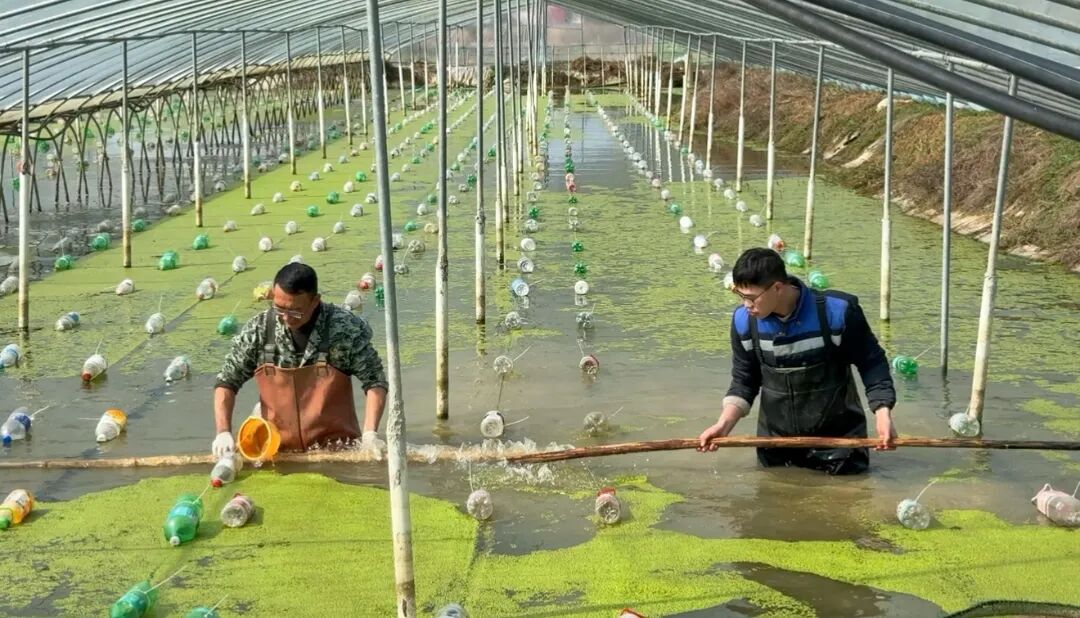
The rainy season has passed, and all things are sprouting. While the festive atmosphere of the Lunar New Year is still strong in Wuchuan, the prelude to “aquatic farming” has already begun in many breeding ponds. Recently, at the Shaohua Pearl Farm in Wangzhai Town, rows of breeding greenhouses are neatly arranged in the fields. The person in charge, Zhu Shaohua, along with his son Zhu Xinwei, wearing waders and holding tools, carefully cleaned the duckweed in the breeding ponds to create a clean and comfortable growth environment for the mother mussels.
These days, the father and son are seizing the fine weather to intensively carry out tasks such as pond cleaning, water pump maintenance, and greenhouse labeling, making all preparations before mussel seedling breeding. They are waiting for the temperature to rise to promptly start the implantation process, ensuring a good start for the new year’s pearl mussel seedling farming.

It is understood that Zhu Shaohua has been engaged in pearl mussel seedling breeding for over twenty years, with his farm producing 30 to 50 million mussel seedlings annually. In the past two years, the pearl jewelry market remained hot, driving up mussel seedling prices. Products were once in short supply, and the output value of mussel seedlings in the county even exceeded the 100 million yuan mark for two consecutive years.
As market enthusiasm gradually subsided, pearl prices declined in the first half of last year, leading to a phased adjustment in the industry. Mussel seedlings faced sluggish sales, and some farmers even adopted low-price competition strategies, putting considerable pressure on the entire industry’s development. It was not until the second half of the year that the pearl mussel seedling market gradually bottomed out and rebounded, with conditions warming up.
Facing market changes, Zhu Shaohua promptly shifted his development strategy.
He proactively conducted market research, precisely introducing popular varieties for cultivation. Simultaneously, he upgraded breeding equipment by introducing facilities such as boiler heating and air energy systems, effectively reducing the mortality rate of yellow catfish during the implantation process and exploring refined management models.

Zhu Shaohua’s son, Zhu Xinwei, who studied aquaculture at Shenyang Agricultural University, has now become a capable assistant on his father’s farming journey. He fully applies his professional knowledge, teaching his father how to use a microscope to observe algae in the water, assess the aquatic environment suitable for mother mussel growth, and help the farm scientifically regulate water quality and optimize the breeding environment, injecting new vitality into traditional farming through technology.
Since the introduction of freshwater pearl farming in the 1970s, the industry of expanding and breeding superior Hyriopsis cumingii (triangle sail mussel) varieties has developed rapidly in Wuchuan. Currently, the county has 96 mussel seedling breeding households and 28,000 breeding ponds. Mussel seedling output accounts for over 85% of the national industry total, making it a veritable core production area for mussel seedling breeding.
Moving forward, the county will further strengthen the cultivation of high-quality mussel breeds, continuously renovate and upgrade breeding site facilities, accelerate the construction of an integrated system for breeding, propagation, and promotion of superior varieties, and promote the transformation of the pearl mussel seedling industry from “relying on nature” to “increasing income through technology and efficiency through quality,” making the small mussel seedling a characteristic pillar for enriching the people, strengthening villages, and revitalizing the industry.