Editor’s Note
This analysis highlights robust growth projections for the global abrasive market, driven significantly by the Asia-Pacific region. The data underscores a key industrial trend with implications for manufacturing, construction, and materials sectors worldwide.

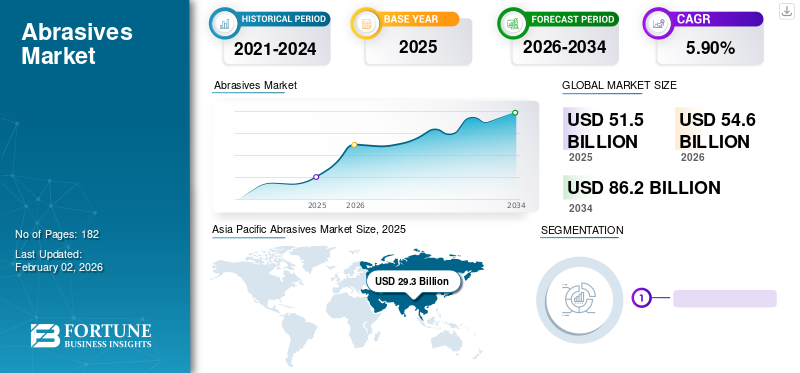
The Asia-Pacific region led the abrasive market, capturing a 56.80% market share in 2025. Furthermore, the U.S. abrasive market size is projected to reach USD 7.08 billion by 2032, driven by increasing demand from the electrical & electronics industry.
Increased product demand for grinding and polishing applications in end-use industries such as wood, concrete, ceramics, metalworking, automotive, electrical equipment (E&E), machinery, and electronics is expected to drive market expansion. In automotive component manufacturing, these products are essential for reducing noise levels, lowering CO2 emissions from high-performance engines, and adjusting operational parameters such as part machining.
Market Size and Forecast:
• Market Size 2025: USD 51.5 Billion
• Market Size 2026: USD 54.6 Billion
• Projected Market Size 2034: USD 86.2 Billion
• CAGR: 5.90% from 2026 to 2034
Market Share:
• The Asia-Pacific region held a 56.80% share of the abrasive market in 2025, driven by demand from the construction, metalworking, and automotive industries in China, India, and Japan.
• By product type, coated abrasives held the largest share in 2023, due to their extensive use in furniture, general machinery, and consumer goods sectors.
Highlights by Key Countries:
• United States: Projected to reach USD 7.08 billion by 2032, driven by demand expansion from the electrical & electronics industry and advancements in precision tool and automotive applications.
• China: Strong demand from metalworking, machinery manufacturing, and ongoing construction activities is driving rapid expansion in abrasive consumption.
• India & Japan: Urbanization and industrial growth are supporting increased product usage, particularly in the construction and electronics sectors.
• Europe: As a hub for automotive manufacturing, abrasive demand remains stable, especially for automotive maintenance and refinishing applications.
• Brazil & Mexico: Leading the Latin American market, supported by growth in automotive, aerospace, and furniture manufacturing industries.
• Middle East & Africa: Expanding construction activities, metal polishing, and processing operations in countries like the UAE and South Africa are driving regional demand.
Expanding Applications in Construction Activities Create Growth Opportunities
The construction sector is expected to be a major product application during the forecast period. Rapid urbanization and rising living standards are increasing construction activities. Economic growth and active renovation activities in developing countries are further boosting market development. These products are used in various applications within the construction industry, such as woodworking and processing, metalworking, and metal components. Growing countries like China, India, Japan, and other Asian nations are key countries witnessing growth in the construction industry. Population growth in these countries positively impacts product consumption through expanded residential construction. Furthermore, the significant shift of industrialization from Western regions to smaller countries is directly supporting the growth rate of the construction industry, which in turn contributes to the growth of the abrasive industry.
Increasing Demand from the Automotive Industry Drives Market Growth
This product is used for sizing engine components, vehicle body repairs, and cleaning interiors and exteriors. It is also used for cleaning pipe interiors, smoothing welds, and polishing edges and surfaces (for oiling, installation, grinding, and painting). Coated products and non-woven products are used for vehicle body refinishing, and grinding wheels are used for automotive parts. This high demand from diverse applications within the automotive industry directly supports industry growth.
Rising Demand from the Electrical & Electronics Industry Fuels Market Expansion
The abrasive market continues to experience increasing demand, primarily driven by the electrical & electronics (E&E) industry. The E&E industry is expanding rapidly, and with this expansion comes increased demand for abrasives used in various manufacturing processes. This industry is a major consumer of abrasives, and this trend is expected to continue in the coming years.
Raw Material Scarcity and Stringent Regulations Act as Market Inhibitors
The most common abrasive raw materials are aluminum oxide, silicon carbide, cubic boron nitride, and synthetic diamond. These raw materials are obtained from non-renewable resources like petroleum. The depletion of these resources reduces raw material availability and limits market growth. Furthermore, growing concerns about environmental protection and preventing pollution spread have led governments to impose strict regulations on the use of these products, which also hampers market growth.
Synthetic Segment Expected to Hold Major Share Due to Superior Properties
Synthetic abrasives are products processed from chemical precursors or raw materials. These include synthetic diamond, silicon carbide, and alumina. They offer diverse applications because the shape of abrasive particles can be changed as needed, purity can be adjusted, and the crystal structure within particles can be controlled. These customizable properties provide a positive outlook for segment growth.
Driven by increasing consumer preference for organic products, natural abrasives are widely used in a broad range of fields including household, industrial, and technical applications. Examples include corundum, diamond, and emery, which occur naturally and offer the advantage of less variability in use due to mining and processing. The increasing use of this product type in the automotive industry is one of the key factors driving market growth.
Coated Abrasives Segment Predicted to Generate Highest Revenue Due to Wide Applications
Based on product type, the market is segmented into bonded abrasives, coated abrasives, and super abrasives.
In 2023, the coated abrasives segment accounted for the majority of the abrasive market. Coated abrasives consist of abrasive grains, a substrate, and a binder. Each component gives the product unique properties, making it suitable for various applications. The use of coated abrasives in consumer goods, manufacturing, hand & power tools, general machinery, furniture, and surgical products drives the growth of this segment.
Metal Fabrication Segment to Exhibit Notable CAGR Driven by Rising Demand for Metal Equipment
By application, the market is segmented into automotive, electrical & electronics, metal fabrication, machinery, and others.
The metal fabrication segment is expected to see rapid expansion during the forecast period. This processing method is used to manufacture metal structures through bending, cutting, and assembly processes. The product is used as cutting saws (also called chop saws), equipped with abrasive discs for cutting steel, to cut metal into desired shapes. Other metal fabrication products include fiber discs and flap discs, primarily used for grinding metal and smoothing surfaces.
In automotive applications, they are mainly used as grinding wheels and grinding segments to smooth or roughen surfaces for grinding, installation, and painting. Expanding applications in cleaning, deburring, and repairing automotive parts drives segment growth.
The product is experiencing high demand from the machinery and electrical & electronics sectors. This is due to the availability of new and attractive materials for insulating and blending wiring in the electrical & electronics sector. It is also attributed to the expansion of the furniture industry.
The Middle East & Africa market is expected to show significant growth during the forecast period. Increasing demand for woodworking, solid surface grinding & polishing, and metal fabrication for the region’s construction industry is expected to support market growth in the coming years.