Editor’s Note
This article provides a concise overview of the rapidly growing demi-fine jewelry sector, highlighting key market valuations and the Asia-Pacific region’s dominant position.
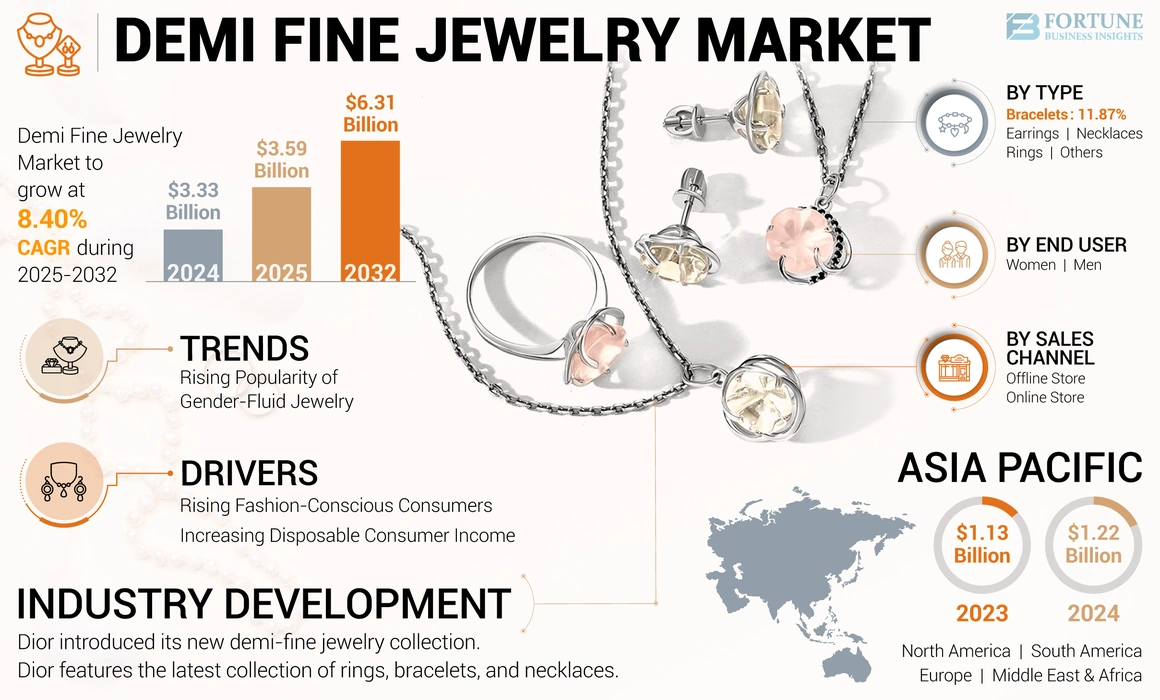
The global demi-fine jewelry market was valued at USD 3.33 billion in 2024. The market size is projected to reach USD 3.59 billion in 2025 and USD 6.31 billion by 2032, exhibiting a CAGR of 8.40% during the forecast period. The Asia-Pacific region led the demi-fine jewelry market, accounting for a 36.64% share in 2024.
Demi-fine jewelry refers to ornaments made from precious metals such as Vermeil Gold or Sterling Silver. This category sits between expensive, delicate jewelry items and affordable costume jewelry. This type of jewelry offers quality and attractive pricing, characterized by a thick layer of 18K gold vermeil over a strong sterling silver core.
Techniques like fine silver gold plating or rhodium plating of precious metals protect against scratches and tarnishing, enhancing product durability and contributing to demand. The global demi-fine jewelry market share is likely to increase significantly throughout the forecast period, considering rising consumer disposable income and growing product popularity as affordable luxury jewelry. The comparatively lower price point drives sales of demi-fine jewelry, particularly across Asian markets.
The COVID-19 pandemic impacted the growth of various industries worldwide in 2020. The crisis led to manufacturing disruptions and supply chain bottlenecks that adversely affected global demi-fine jewelry market trends in 2020. The pandemic reduced manufacturers’ profitability and negatively impacted the import and export of demi-fine jewelry.
In Japan, interest is growing in demi-fine jewelry that combines quality with everyday wearability. Globally, this category is gaining attention for its sophisticated design and use of sustainable materials. Domestically, the consumer segment seeking minimal and elegant styles is expanding, with a strengthening trend toward jewelry that balances durability and price. International brand strategies and the advancement of digital sales channels are further broadening growth opportunities in the Japanese market.
Market Size and Forecast:
2024 Market Size: USD 3.33 Billion
2025 Market Size: USD 3.59 Billion
2032 Forecast Market Size: USD 6.31 Billion
CAGR (2025-2032): 8.40%
Market Share:
The Asia-Pacific region led the global demi-fine jewelry market in 2024 with a 36.64% share, driven by increasing disposable income, rising popularity of affordable pricing, and high cultural demand for jewelry in countries such as China, India, and Japan.
By product type, earrings held the largest share in 2024, supported by growing demand for trendy, durable, and gender-fluid designs like hoops, studs, and drops among fashion-conscious consumers worldwide.
Key Country Highlights:
China: A strong urban middle class and gifting culture drive significant sales, especially during traditional events like the Lunar New Year.
India: Robust demand is supported by festivals like Diwali and Lohri, alongside rising disposable income and fashion-sensitive youth.
Japan: Traditional events and minimalist fashion trends support the adoption of demi-fine jewelry among young women.
United States: A key North American market driven by premiumization trends, technology-integrated designs, and celebrity-led brand collaborations.
United Kingdom: Growing demand for gender-neutral and customizable jewelry, enhanced by online sales and influencer marketing.
France and Germany: European consumers are drawn to fusion styles and personalized pieces incorporating semi-precious stones and contemporary craftsmanship.
Brazil and South Africa: Increasing e-commerce penetration and popularity of lightweight, contemporary jewelry styles fuel demand among young demographics.
Rising Popularity of Gender-Fluid Jewelry Fuels Market Growth
Gender fluidity is one of the latest and significant trends in the jewelry and fashion industry. Consumers typically purchase jewelry as gifts for special occasions and to showcase their individuality. In this regard, their attitudes toward gender are rapidly evolving to include inclusivity and acceptance. This positively impacts product sales and encourages industry players to create gender-fluid/genderless designs in demi-fine ornaments.
Gender-fluid jewelry is often promoted by internationally famous celebrities like Harry Styles, Pete Davidson, and Ranveer Singh, who wear genderless fashion. According to UK-based jewelry maker Taylor & Hart, online searches for gender-neutral jewelry increased by 228% between 2020 and 2021, highlighting the growing adoption of gender-fluid products. Therefore, increasing consumer demand for gender-neutral products will propel the growth of the demi-fine jewelry market in the coming years.
Increasing Disposable Consumer Income Accelerates Product Sales
Economic growth in developing countries leads to higher disposable income and consumer affordability. Consequently, consumers are increasingly willing to purchase items featuring demi-fine ornaments made with precious metals, positively impacting global demi-fine jewelry market trends. Furthermore, demand for jewelry worn during Indian festivals like Diwali and Lohri accelerates product adoption. Additionally, the tendency to gift valuable jewelry to friends and relatives, particularly among high-income consumers worldwide, promotes market growth.
North America and Europe are among the most urbanized regions globally, with emerging fashion trends, a vast consumer base, and distinct corporate lifestyles. Urbanized consumers in these regions typically spend a portion of their income on fashion and costume accessories, significantly contributing to product demand.
Rising Fashion-Conscious Consumers Increases Product Adoption Globally
Social media platforms like Instagram, Facebook, and Snapchat are increasingly popular for brands to communicate directly with consumers. The emergence of these platforms plays a key role in positively influencing consumer behavior and are influential promoters of the latest fashion trends. Moreover, growing consumer inclination toward trendy fashion jewelry through promotion via music videos, TV series, and movies is increasing product demand globally. The growing trend of customized jewelry due to the influence of social media platforms also complements market growth. On a macro level, the rise of fashion-conscious consumers and heightened perception of external beauty drives product demand worldwide.
As consumers increasingly perceive demi-fine jewelry as a symbol of self-expression and individuality, industry participants are likely to develop customized items as budget-friendly alternatives in the coming years. Industry players collaborate with celebrities to build brand reputation. For instance, in March 2024, Indian demi-fine jewelry startup Palmonas partnered with popular Bollywood actress Shraddha Kapoor to join the company as a co-founder. Such collaborations help startups penetrate the domestic market, especially through e-commerce platforms.
The rapidly evolving trend of accessible luxury within the jewelry category is driving global demand for demi-fine jewelry. Given improved product availability across retail stores and online channels, these items are becoming increasingly popular among young women in their late 20s to early 30s. While women in these age groups traditionally preferred shoes and handbags over jewelry, their focus is shifting toward demi-fine jewelry across countries, encouraging future industry participants and retailers to penetrate this high-potential jewelry category.
Increasing Stringent Government Regulations to Limit Market Growth
The European Union (EU) standard commercial policy targets all key measures affecting trade in products, goods, services, and all trade-related issues. For health reasons, the EU implemented a directive in 1994 limiting the use of nickel in jewelry products intended to come into contact with the skin, such as necklaces, bracelets, and rings.
Furthermore, the Fashion Jewelry & Accessories Trade Association (FJATA), a non-profit organization specializing in regulations for apparel, jewelry, and fashion accessories, implements the ASTM F2923-11 standard concerning cadmium use in children’s jewelry. According to this law, companies manufacturing jewelry are required to limit the use of cadmium. Such stringent regulations on material use and manufacturing will deter new players from entering the market in the coming years.
By Type Analysis
Growing trends in hoop and long-link designs drive demand for earrings.