Editor’s Note
This article explores the evolving definition of logistics, highlighting its transformation from simple transportation to a complex discipline managing the entire flow of goods, services, and information. It underscores how technology and global e-commerce are driving innovation across the supply chain.
Logistics is no longer just about moving goods from one point to another. It is the art and science of planning, implementing, and controlling the efficient flow and storage of goods, services, and information—from origin to final consumption. Today, logistics encompasses transportation, warehousing, inventory management, packaging, order fulfillment, reverse logistics, and end-to-end supply chain coordination.
From digital inventory management systems to robotics in sorting and packaging, logistics operations are being re-engineered to keep pace with online retail demand. Cross-border e-commerce has further intensified the need for efficient international transportation and customs handling.
E-commerce logistics focuses on the storage, handling, and delivery of online orders. The segment has expanded rapidly due to consumer demand for same-day or next-day delivery and convenient return policies. Companies are investing in fulfillment centers, automated packaging systems, and last-mile delivery networks. Reverse logistics, particularly for returns, has become a strategic priority, transforming traditional bulk shipping models into highly personalized parcel-based networks.
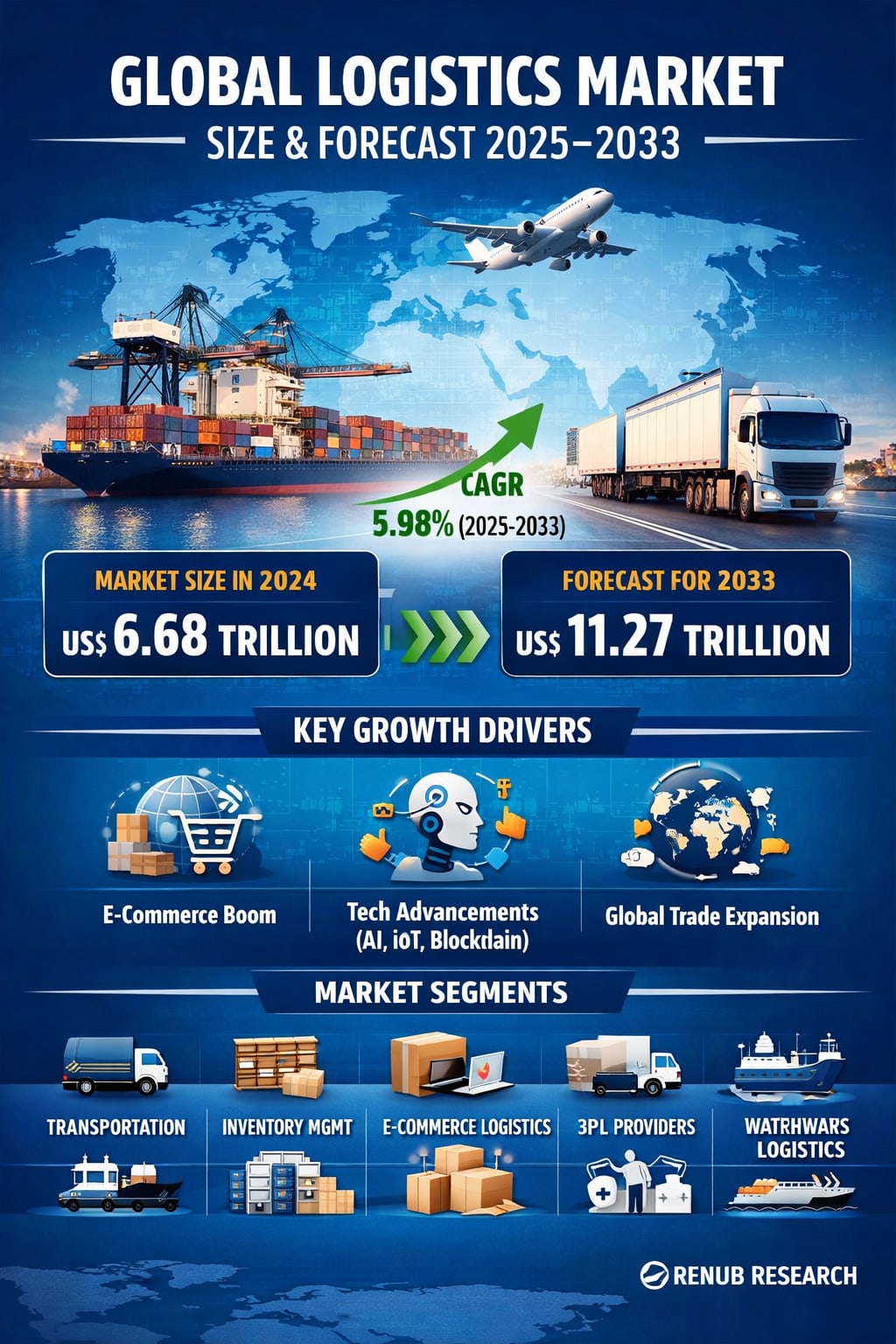
In 2024, the Global Logistics Market was valued at US$ 6.68 trillion and is projected to expand to US$ 11.27 trillion by 2033, growing at a CAGR of 5.98% during 2025–2033, according to Renub Research. This impressive growth trajectory highlights how logistics has become one of the most critical pillars of the modern global economy.
Across industries, logistics plays a decisive role. In e-commerce and retail, it ensures fast and reliable deliveries. In manufacturing, it supports just-in-time production systems. In healthcare, it enables the safe and timely distribution of pharmaceuticals, vaccines, and medical devices. In agriculture and food, it safeguards the rapid movement of perishables, while in construction and energy, it guarantees that critical materials arrive on schedule.

With globalization intensifying and digital commerce becoming mainstream, logistics has evolved into a strategic function rather than a back-end operation. Technologies such as artificial intelligence (AI), the Internet of Things (IoT), blockchain, automation, and advanced data analytics are reshaping how goods are tracked, stored, and delivered. These innovations are improving transparency, reducing costs, and enabling real-time decision-making, making logistics smarter, faster, and more resilient.
The explosive growth of global e-commerce has fundamentally reshaped the logistics landscape. Consumers today expect faster deliveries, real-time tracking, flexible delivery options, and easy returns. This shift has pushed logistics companies to invest heavily in fulfillment centers, last-mile delivery networks, and automated warehouses.
Technology is redefining logistics operations worldwide. AI-driven demand forecasting, IoT-based real-time tracking, blockchain-enabled transparency, and robotics-driven automation are helping companies optimize routes, reduce errors, and improve delivery accuracy.

As supply chains become more complex and customer expectations continue to rise, the adoption of smart logistics technologies is no longer optional—it is a competitive necessity.
Despite geopolitical uncertainties, global trade continues to expand, driven by diversified sourcing, free trade agreements, and growing consumption in emerging markets. This has increased the demand for reliable, cost-effective, and compliant cross-border logistics services.
The continued integration of global markets ensures sustained demand for multimodal transportation, freight forwarding, and international logistics services.