Editor’s Note
This article highlights a significant shift in the luxury sector, where sustainability is becoming integral to brand identity and production. It explores how the industry is adopting eco-friendly materials and responsible practices throughout the supply chain.
Sustainability trends are entering the luxury business, promoting the use of environmentally friendly raw materials and responsible utility. Plant-based leathers, such as those derived from pineapple and other natural materials, can be used to make jackets, footwear, and shoes.
Additionally, the emphasis is on using less electricity, less water, and safer raw materials to ensure sustainability across the supply chain. For example, the renowned fashion brand Junghans offers high-end solar watches made from sustainable recycled materials in the global market. Therefore, rising initiatives toward sustainable high-end goods production are likely to surge the demand for eco-friendly products.
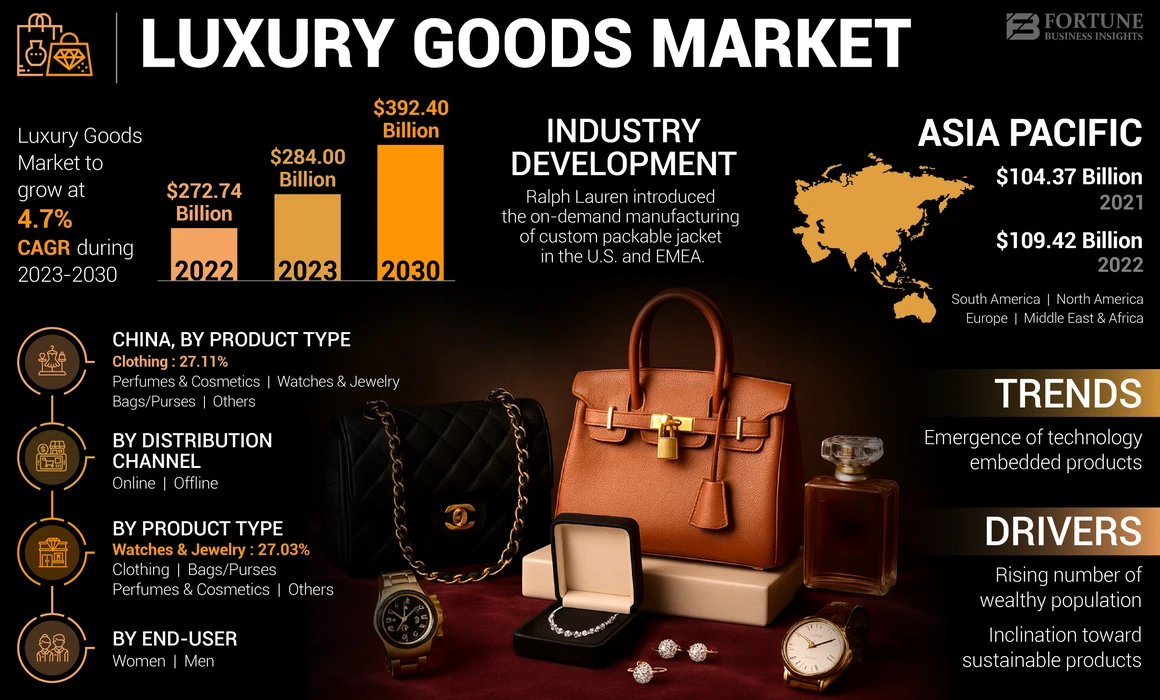
The global luxury goods market size was valued at USD 272.74 billion in 2022 and is projected to grow from USD 284.0 billion in 2023 to USD 392.4 billion by 2030, exhibiting a CAGR of 4.7% during the forecast period. Furthermore, the luxury goods market in the United States is projected to grow significantly, reaching USD 86.84 billion by 2032. Demand for high-end fashion, premium accessories, and exclusive brand experiences is driving market expansion. The Asia Pacific region dominated the luxury goods market with a 40.12% share in 2022.
Premium products are key entities that introduce the status symbol of the owner. The superior quality and high durability of such products are offered at the highest prices, affordable only to a minority of the world’s population. Therefore, companies typically target the affluent population with creative designs, as the product cost is not a criterion for such groups.
For instance, in April 2023, Bernhard H. Mayer, a Swiss personal fashion brand owned by QNET Ltd., launched the Mecanique collection, a collection of luxury watches with a unique mechanical design style for the Hong Kong market.
Thus, introducing new luxury designs will help the market grow rapidly during the 2023-2030 forecast period.
The emergence of technology-embedded products is a notable trend. Innovatively created fashion-forward goods combining technological elements, such as jewelry items, handbags, or goggles, can potentially enhance product demand. For example, in March 2023, innovation lab Cathy Hackl launched Verselux, a luxury, high-end gemstone equipped with a Chinese Near Field Communication (NFC) chip. Similarly, in April 2023, luxury apparel and accessories brand Coach launched Coachtopia, a line of luxury products including bags, wallets, footwear, and clothing equipped with NFC chips. These products are available in the US, Canada, UK, and Asian markets.

The luxury goods market experienced a sharp decline in product demand due to the COVID-19 impact. The lower-income segment of the population typically avoids investing in luxury items. As non-essential products, luxury goods experienced negative demand during the pandemic as people struggled to purchase daily necessities.
Job losses and salary reductions led to changes in income levels for the working group in 2020. Similarly, stay-at-home orders reduced the need to own such premium products. Lockdowns also led to the cancellation or postponement of several fashion-related events and celebrations, affecting individual demand for luxury goods. Furthermore, the cancellation of tours and travel also harmed the purchase of such products during travel, such as those bought at airport and cruise duty-free shops.
Consequently, the global personal goods industry could quickly gain momentum through online channels. This would further heighten market proliferation upon the release of lockdown restrictions.
Increasing Affluent Population to Boost Market Expansion
Luxury items, as the name suggests, are products primarily explored by the wealthy. The increasing number of high-income population groups is set to drive market growth.
Companies are targeting the millennial and Gen Z population using customized products to offer personalized items. For instance, Louis Vuitton allows customers to personalize handbags using hot stamping or hand painting. Therefore, increasing demand for high-end fashion products from the affluent population will support the growth of the personal luxury goods market.
Trend Toward Sustainable Products to Offer Market Growth Opportunities
Consumers are increasingly preferring sustainable materials, such as vegan leather for handbags, instead of leather products derived from animals. For example, in June 2020, luxury product retailer Vikki Jones launched a new eco-friendly tote bag made from 100% vegan leather, ensuring no animals were harmed in the manufacturing process.
Increasing Adoption of Pre-owned Branded Items to Hinder Demand
The growing trend of purchasing pre-owned branded products or renting luxury goods may hinder the market for original luxury products, as second-hand items are offered at a lower cost than the original price. Similarly, the growing counterfeit trend, where products resembling luxury brands are offered at lower prices, may further restrain market growth.
By Product Type Analysis
The market is segmented based on product type into watches & jewelry, perfumes & cosmetics, clothing, bags/wallets, and others.
The clothing segment is expected to hold a major share due to increasing demand from both male and female end-users and rapidly changing fashion trends. However, the bags segment is expected to grow rapidly due to increasing demand for leather-based products. Demand for fashionable and matching handbags is increasing from end-users, as they can be used for various applications such as office, party, and casual bags. For example, in February 2020, Loewe Luxury Brand launched the balloon bag, available in three sizes—small, medium, and large—according to customer requirements.
The Watches & Jewelry segment is expected to hold a considerable share due to increasing demand for smart luxury watches and various gemstone items.
Eyewear is expected to gain traction due to the introduction of new product designs in the market.
By End-user Analysis

The female segment holds the largest share, backed by a greater tendency toward beautification. Based on end-user, the market is segmented into male and female. Females are the leading segment as most luxury products, including cosmetics, fragrances, handbags, necklaces, earrings, and bracelets, are primarily used by female end-users.