Editor’s Note
This week’s market analysis highlights a period of unusual calm and consolidation across major asset classes. With key catalysts absent, trading volumes have dipped, leading to low-volatility, rotational price action as investors adopt a ‘wait and see’ approach.

This week, calm prevailed in the financial markets overall. Market conditions have shifted for most assets, and we are now seeing low-volatility rotational price action with limited volatility. The absence of the Lunar New Year in China and macroeconomic catalysts has reduced overall volume and put markets in a “wait and see” mode.
For example, gold and silver prices have seen their lowest volatility this year. Additionally, the Commitment of Traders report for gold futures has also shown a decline.
CME has reached another peak, which could be interpreted as a bullish signal, but it is more suitable for a medium-term perspective rather than a short-term one.
From a seasonal studies perspective, gold still has potential for gains in the first quarter, but as we approach March, momentum in the metals complex typically slows down. This is not a guarantee, and actual conditions may differ from statistical studies, but the current price action and volume distribution confirm a softer stance towards metals, which fits into the overall uptrend.
However, the main stir this week was not linked to economic publications. Special attention was paid this week to rising tensions between the US and Iran. The US is rapidly increasing its military presence in the Middle East – two aircraft carriers, fighter jets, refueling tankers – preparing itself for a potential large-scale strike against Iran. This has given Trump a solid military option, along with increased pressure on Tehran to compromise on its nuclear program.
This caused a spike in crude oil futures, although its impact on gold was limited. At the same time, gold buying continues, although it is not a FOMO (Fear Of Missing Out) situation.
The FOMC minutes released on Wednesday indicated a hawkish stance, strengthening expectations that the Fed will keep interest rates unchanged through its decisions. However, this adds nothing new to the situation, as US bond yields remain at lower levels due to the Fed’s bond purchases and the pressure of a growing balance sheet.

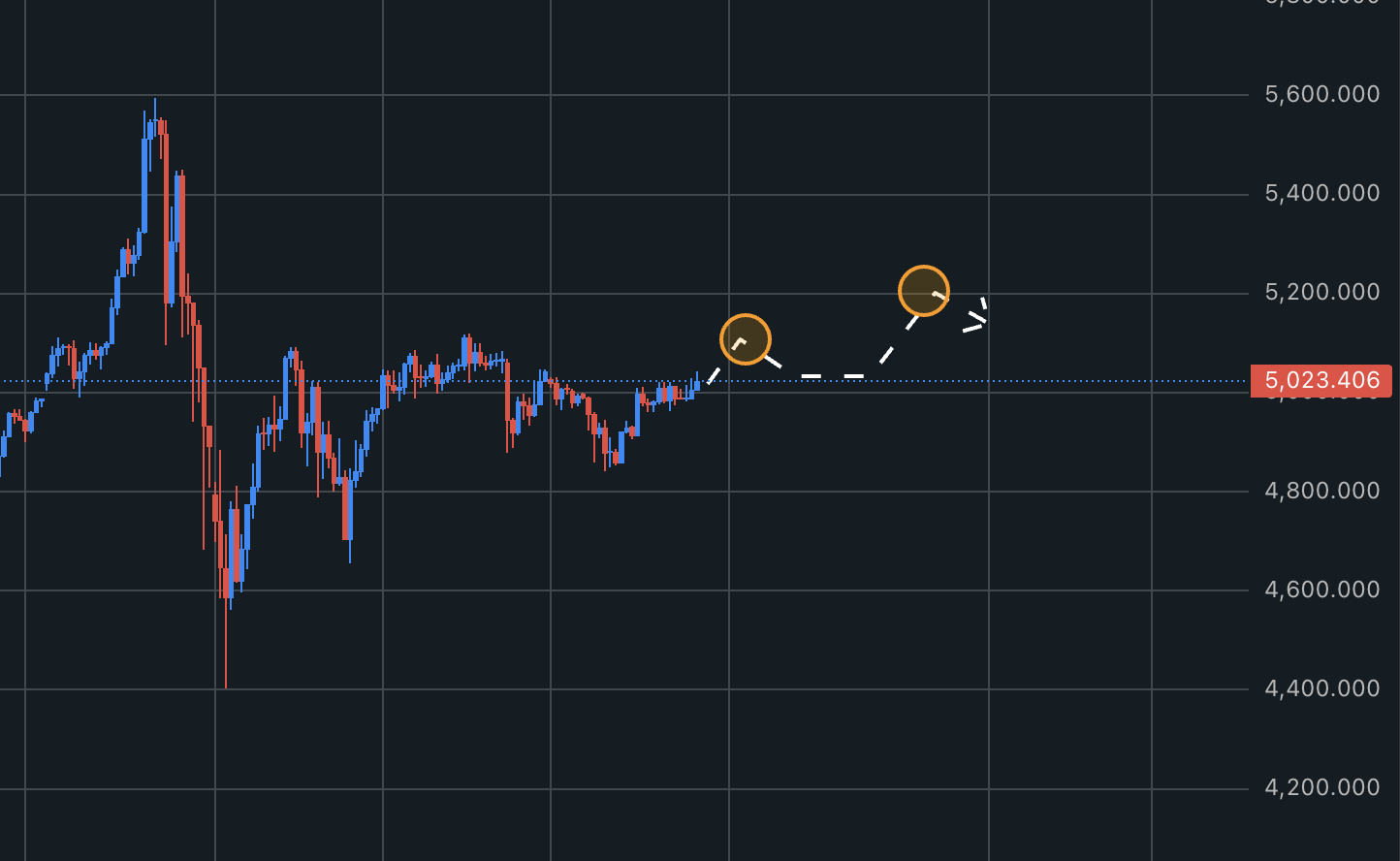
The market is slowly recovering from the dynamic support area (the area between the 20 and 50-day moving averages). The buying momentum is quite slow but steady, as the market seeks geopolitical hedging against potential escalating tensions between the US and Iran.
Instead of developing a strong bullish rally, it is more likely to move forward in a staircase-like trend with sporadic bullish fluctuations and long-term consolidation.
As shown in the chart, achieving the 5100 target within 1-3 days seems possible, after which the 5200 target could be reached within 1-2 weeks.
The euro has declined against the US dollar, mainly due to the Federal Reserve’s (FED) hawkish policy and the reversal of the “sell America” perception. However, bond markets are not yet supporting capital inflows into the US dollar, as yields are declining due to increasing investor interest in bonds.
From a technical perspective, the downtrend will continue for up to 8 days, and there is a high probability of it persisting in the short term, although the lower level of the Bollinger Bands indicator usually acts as a potential strong support level.

Given the current perspective, we can expect EURUSD to fall to the 1.16 area, after which buying pressure may be observed.