Editor’s Note
This article highlights the robust growth trajectory of the global retail logistics market, projected to expand at a CAGR of 13.1% through 2032. It underscores North America’s current market dominance and outlines the core functions of retail supply chains.
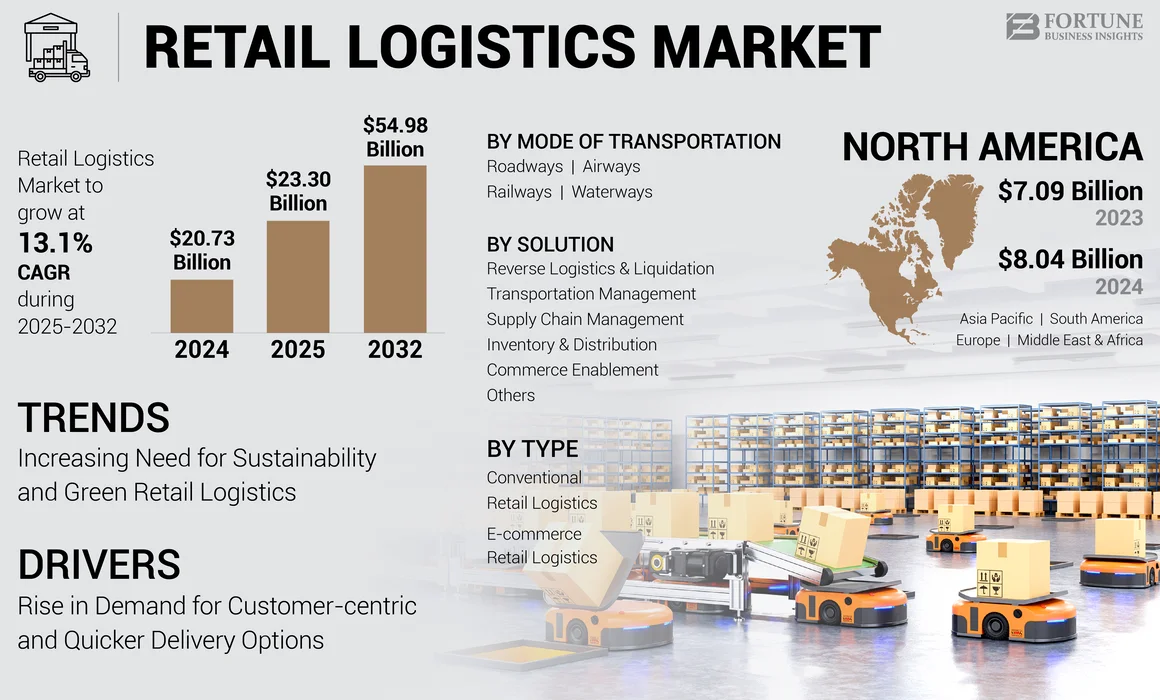
The global retail logistics market size was valued at USD 20.73 billion in 2024 and is projected to grow from USD 23.30 billion in 2025 to USD 54.98 billion in 2032, exhibiting a CAGR of 13.1% during the forecast period. North America dominated the retail logistics market with a market share of 38.78% in 2024.
Retail logistics refers to the management of the flow of goods from distributors to end consumers. It comprises the procedure of order processing, inventory management, transportation, warehousing, and distribution. It involves coordination among various individuals and departments, streamlining and optimizing progressions. It leverages technology to ensure products reach customers quickly, without spending significant financial capital.
The growing need for hyper-personalized supply chains, minimized inventory loss, the requirement to offer multiple delivery options, and improved reverse logistics enhancements contribute to the progress of the retail logistics market growth. Thus, various market players such as XPO Logistics, Inc., DSV, FedEx, among others, are advancing and developing retail logistics solutions in the market.
Furthermore, global e-commerce is intensifying beyond national borders at an exceptional rate. Consequently, the demand for cross-border deliveries is increasing. For example,
Advanced capabilities of generative AI to create diverse market opportunities.
Generative AI provides diverse capabilities, such as conversational AI, supplier performance benchmarking, enhanced training, and improved logistics management in retail. GenAI helps improve supply chain management by offering more accurate insights, enhanced operations, and empowering proactive decision-making.
GenAI also enhances the accuracy of inventory distribution by examining demand at the store level. Warehouse and floor managers gain access to real-time information on stock levels, along with recommendations to adjust orders based on changing sales patterns. Various innovations and developments integrated with GenAI capabilities are contributing to market progress. For example,
Growing need for sustainability and green retail logistics to drive market progress.