Editor’s Note
This article cites a market research report projecting explosive growth for the global space tourism sector, forecasting a leap from $732.5 million in 2023 to over $3.4 billion by 2030. The figures highlight the rapid commercialization of space and the significant economic potential being unlocked by private industry.
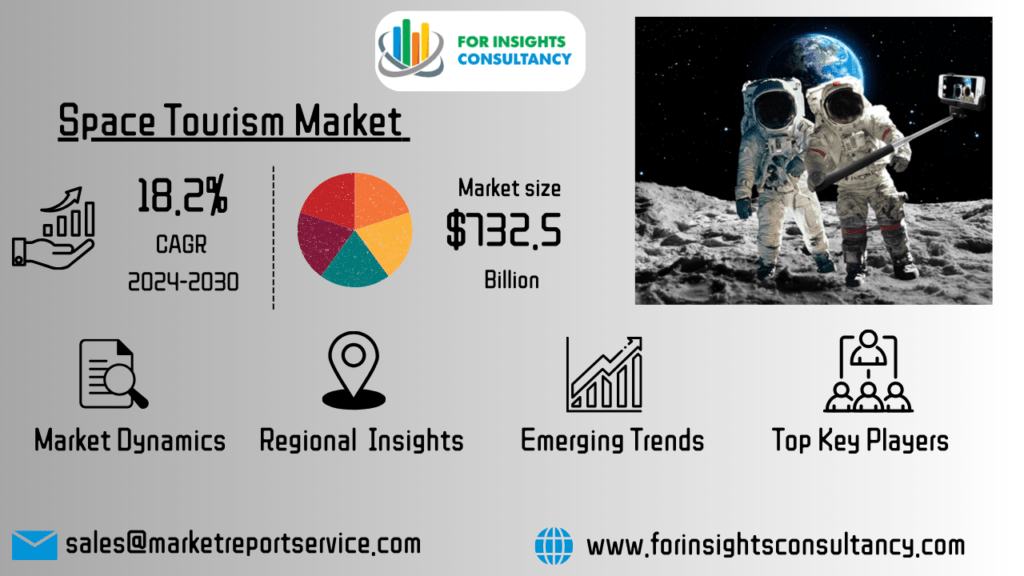
According to the latest study by For Insights Consultancy Research, the global space tourism market, whose size and market share were valued at $732.5 million in 2023, is projected to generate revenues of approximately $3,441.40 million by 2030. The report further indicates that the market exhibits a robust compound annual growth rate (CAGR) of 18.2% during the forecast period from 2024 to 2030.
The concept of space tourism has been one of the most fascinating for the public in recent years. As companies like SpaceX and Blue Origin approach commercial spaceflight, the possibility of a trip to space, whether for vacation or a visit, is becoming increasingly feasible. This article discusses the space tourism market: its current status, its prospects for the coming year, and who the drivers of this sector are.
SpaceX, the company founded by Elon Musk, a leader in the sector with innovative ideas, represents a key option in the space tourism market, with the vision of bringing space closer to a wider audience. Its Crew Dragon spacecraft has the capability to transport people to the International Space Station and has already been used in the final stages of astronaut missions, thus preparing for future commercial flights. Blue Origin, founded by Jeff Bezos, is working on developing short space travel and is taking significant steps towards future suborbital holiday flights with its New Shepard rocket. Similarly, Virgin Galactic, under the direction of Richard Branson, pursues the same goal with its VSS Unity spacecraft.
Next year, the space tourism industry will reach a new level thanks to continuous technological development and the entry of new players into the sector. In fact, SpaceX has planned its first fully civilian orbital mission, while Blue Origin is seeking viable routine suborbital flights, implying that demand for space tourism experiences will continue to rise. The industry’s growth is also driven by commercial space projects such as the construction of space hotels that will host more space tourism customers.
Although the space tourism market could be the best in history, it still faces difficulties. It is presented with problems such as regulations, high costs, and safety concerns. However, advances in reusable rockets and competition between companies are gradually solving these issues. This industry offers a great margin for growth and innovation and has the potential to become one of the most impactful revolutions in the history of human travel and outer space exploration.
The suborbital sector dominates the market, representing 49.1% of the market share in 2023 and experiencing a compound annual growth rate (CAGR) exceeding 35.8% during the projection period. This allows experiencing space without entering orbit, enabling manned spaceflights to reach the boundaries of space. Suborbital flights are conducted at lower speeds, lacking the necessary acceleration for orbital entry. These flights ascend to a specific altitude before descending back to Earth.
The orbital segment is projected to grow at a rate of 39.0% during the projected period, with orbital trips varying from days to weeks depending on the destination. SpaceX and Orion Span focus on orbital flights, while Virgin Galactic and Blue Origin focus on suborbital flights. The tourism industry is expected to experience a significant increase in interest in space flights between 2024 and 2030. In 2021, more than 500 people registered for suborbital space flights aboard the VSS Unity in New Mexico. NASA predicted that the International Space Station would open its doors to tourists in 2021, with an approximate cost of $65 million per trip.