Editor’s Note
This article highlights the projected growth of the volatile semiochemical pest control market, driven by key segments like sex pheromones and fruit & nut crops. The data underscores a shift toward sustainable agricultural solutions.
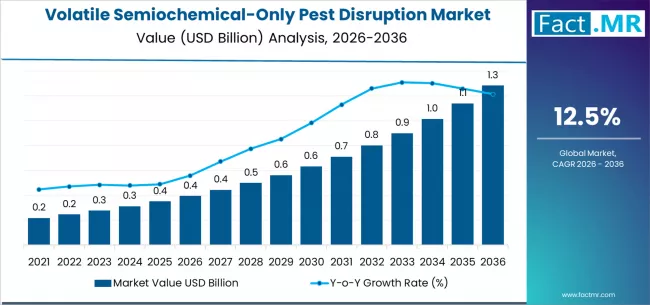
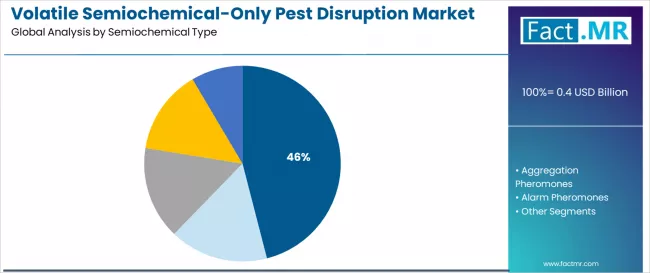
The global volatile semiochemical-only pest disruption market is projected to grow from USD 0.40 billion in 2026 to approximately USD 1.28 billion by 2036, recording a forecast CAGR of 12.5%. Sex pheromones lead the semiochemical type segment with a 46% share, dispensers & emitters dominate application format with 42%, and fruits & nuts command the crop type segment with a 38% market share.
- Market Value (2026): USD 0.40 billion
- Forecast Value (2036): USD 1.28 billion
- Forecast CAGR (2026 to 2036): 12.5%
- Leading Semiochemical Type: Sex Pheromones (46%)
- Leading Application Format: Dispensers & Emitters (42.0%)
- Leading Crop Type: Fruits & Nuts (38.00%)
- Key Growth Regions: North America, Latin America, Western Europe, Eastern Europe, East Asia, South Asia & Pacific, Middle East & Africa
- Key Players: Suterra LLC, ISCA Technologies, Shin-Etsu Chemical Co., Ltd., BASF SE, Russell IPM Ltd
This growth is driven by an accelerating global transition to residue-free pest management in response to stringent regulatory restrictions on broad-spectrum insecticides. These volatile compounds, which manipulate pest behavior through mating disruption or repellence, provide a species-specific tool that preserves beneficial insect populations and aligns with organic and Integrated Pest Management (IPM) protocols.
Advancements in controlled-release formulation technology and synthetic chemistry are enhancing the field longevity and cost-effectiveness of semiochemical products. The rising economic burden of insecticide resistance in key perennial and high-value annual crops is compelling growers to adopt these sustainable alternatives. Market expansion is further supported by the growing premium for certified residue-free produce in global supply chains, particularly within the European and North American markets.
The integration of semiochemical strategies with monitoring traps and decision-support software creates comprehensive pest management systems, increasing their value proposition. This confluence of regulatory pressure, resistance management needs, and consumer-driven market demands positions behavior-based disruption as a cornerstone of future sustainable agriculture.
Sex pheromones hold a commanding 46% market share as the most established and widely deployed semiochemical. Their primary use in mating disruption confuses male insects, preventing them from locating females and thereby suppressing pest populations over subsequent generations. This method offers unparalleled target specificity, affecting only the intended pest species.
Extensive research and decades of commercial use against major lepidopteran pests in orchards and vineyards have generated a robust body of efficacy data, building strong grower and regulator confidence. The long-term economic and environmental benefits of breaking the pest reproduction cycle, compared to repeated insecticide applications, solidify sex pheromones as the foundational technology in behavior-based pest control.
Dispensers and emitters are the leading application format with a 42% share, prized for providing consistent, long-lasting release of volatile compounds throughout a crop’s critical pest vulnerability period. These passive devices, such as twist-ties, clips, or sealed tubes, are easily deployed in perennial systems like orchards and vineyards at the beginning of the season. They offer operational simplicity, requiring minimal labor after initial placement, and demonstrate reliable performance unaffected by rainfall or irrigation.
Their controlled-release kinetics ensure a stable behavioral disruption effect over weeks or months, which is essential for managing pests with extended flight periods. This reliability and ease of integration into existing farm workflows secure their position as the preferred delivery method.
The fruits and nuts segment holds a dominant 38% market share. This is primarily due to the exceptionally high economic value and stringent cosmetic quality standards of these crops. Any pest damage directly translates to significant revenue loss. Volatile semiochemicals offer a residue-free solution that protects both yield and the premium appearance of the produce, which is critical for fresh market sales and export compliance.