Editor’s Note
This editor’s note introduces a review of *Costume Jewelry*, an illustrated book celebrating the creativity and history of fashion jewelry.
The illustrated book “Costume Jewelry” traces the history of fashion jewelry. Here’s why it’s a delight.
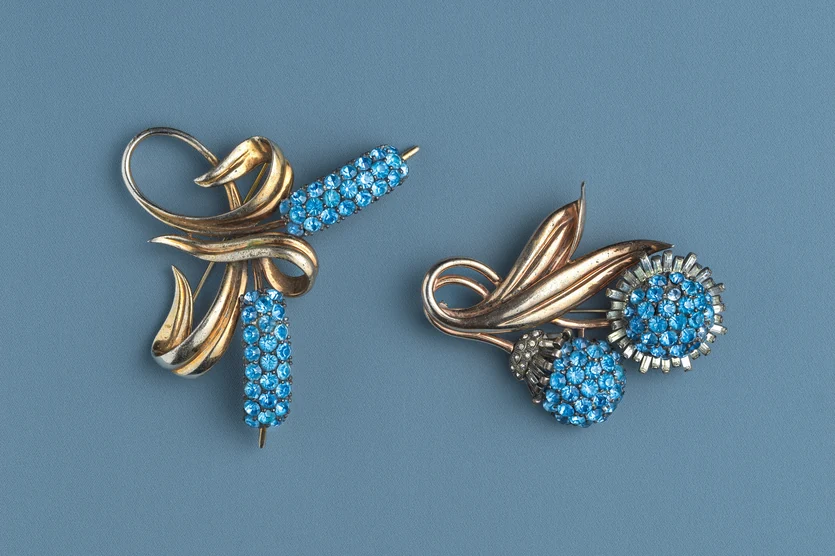
Made of crystals, rhinestones, and gold-plated sterling silver. Photo: Taschen
By Brigitte Werneburg
The greatest freedom is not always where the greatest resources are. Sometimes, modest means foster entirely immodest creativity. You just have to think of it. Like Coco Chanel, who asked herself: Does true chic really require real pearls? Wouldn’t fake ones do just as well? Especially since you can then wear ten strands at once!
Her demonstratively fake jewelry was arguably the most enduring of her revolutionary ideas. It catered not only to the desire for elegant yet affordable adornment but also for brilliant eccentricities.
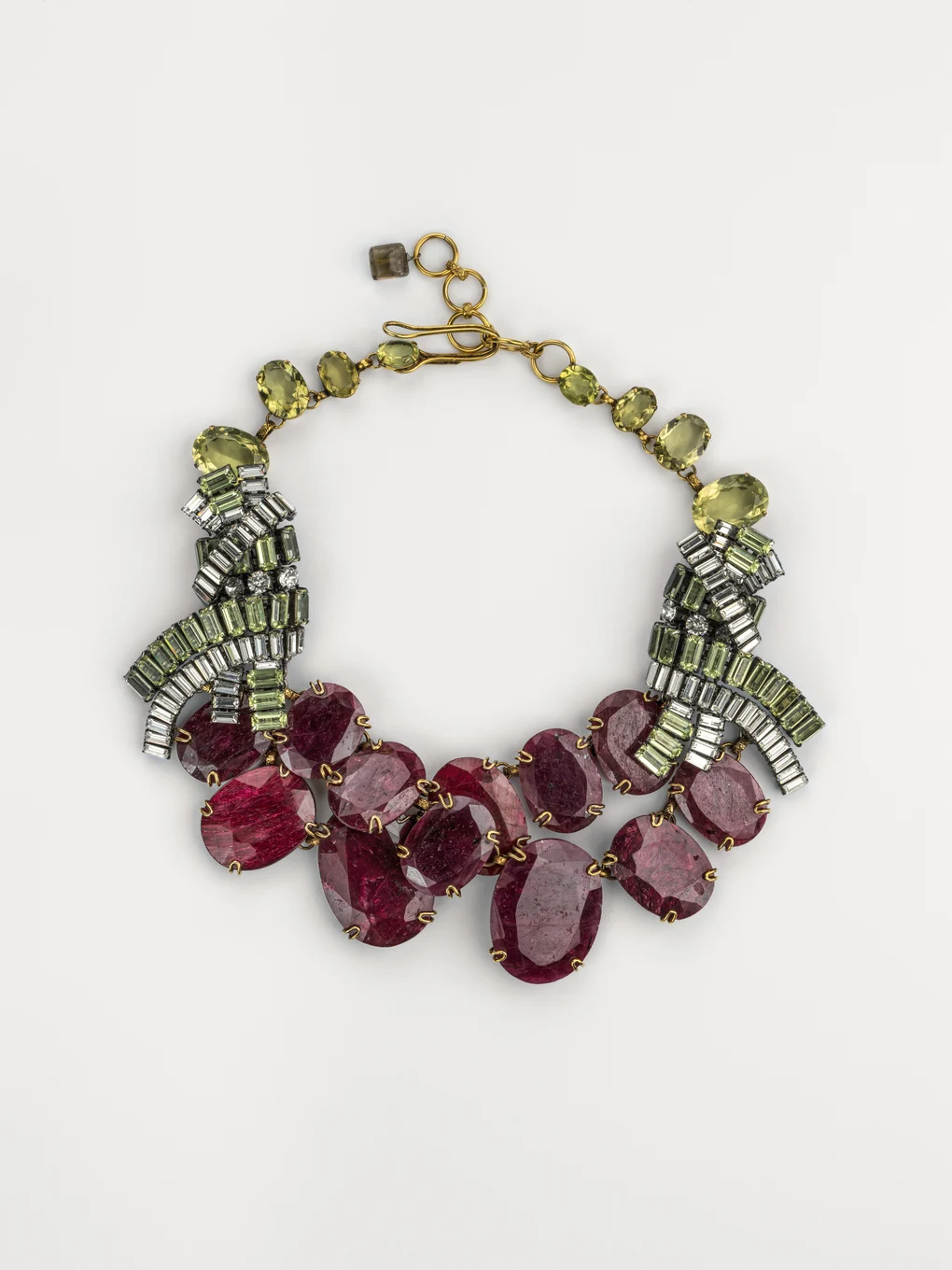
Made of magnificent rubies and citrines, set in gold-plated brass. Photo: Taschen
This and nearly 600 other caprices are featured in the magnificent volume “Costume Jewelry,” recently published by Taschen Verlag, showcasing fashion jewelry in all its facets, collected over many decades by art collector Patrizia Sandretto Re Rebaudengo.
The inside cover is adorned, among other things, with a pot-bellied golden fish blowing four white pearls from its mouth. It was launched in 1954 by the New York firm Trifari, one of the most famous brands among costume jewelry manufacturers, and may have later inspired Nina Hagen when she wrote Dadaist lyrics in 1978: “She wants to be a fish in the water / In the bottle-green, deep lake / She wants to get drunk on water / And let a few bubbles blubber.”
Who was the mind behind the then-unconventional design is not documented; as is often the case with costume jewelry, since it is essentially industrial goods. But the fish brooch was probably designed by Alfred Philippe, who had previously worked as a designer for Cartier and Van Cleef & Arpels – all big names, at least for insiders.
“Haute Joaillerie” thus forms the backdrop against which the development of costume jewelry in the USA, on which the collection focuses, takes place. And most exciting, alongside Coco Chanel’s fake pearls, are the diverse brooches.
Take, for example, the one shaped like a racing cyclist, launched around 1950, designer unknown. It demonstrates that the perfect imitation of jewels no longer counts, but rather the aesthetically refined idea and, not least, suitability for mass production. Unlike fine jewelry, which is cared for and inherited, these affordable baubles, thanks to high print runs, are laid to rest and forgotten as a design component of current fashion. Relatively few pieces survive, which predestines costume jewelry as a collector’s item.
Set with colored glass stones. Photo: Luciano Romano/Taschen
The most famous manufacturers were based in New York. Anthony Aquilino had come from Naples in the 1920s. His brooch featuring a cat sitting on a red crystal cushion trying to fish a goldfish out of its Lucite glass bowl achieved cult status. Lucite, a transparent, shatter-resistant acrylic resin that looks like a real gemstone, was discovered during the years of World War II as a great substitute for rhinestones and Swarovski stones from Europe.
What motifs did the artists and designers work with using these materials? And who were they anyway? These questions are answered by Carol Woolton, the editor of “Costume Jewelry,” in 26 entertaining and sparkling chapters. Among the most significant designers are Miriam Haskell, who still produces jewelry of exceptional quality today; the Belgian William de Lillo, who had worked for Tiffany and Cartier before founding his company with Robert F. Clark in 1967; and Joseff of Hollywood, who initially lent his jewelry pieces to film productions and later made copies that he distributed through major department stores.
Carol Woolton (Ed.): “Costume Jewelry.” Taschen Verlag, Cologne, 2025. 528 pages, 100 euros.
The illustrated book is bursting with fruits and flowers, masks, heads, and animals, and of course, the Christmas tree is also represented. Speaking of which: Although costume jewelry is usually bought by women and fashion aficionados themselves, while some men still believe in “Diamonds Are a Girl’s Best Friend” and like to give real jewelry as gifts – a fake sparkling jewel is always a good gift idea.