Editor’s Note
This article explores a collaborative journey in goldsmithing innovation, where materials like copra, plexiglass, and textiles were elevated to jewelry status. The authors pursued distinct paths—some crafting jewelry, others designing embellished buttons—before returning to their core passions.
As previously mentioned, the passion that united us was aimed at bringing an evolution to the design of our traditional goldsmithing. Thus, other materials also became subjects of formal research and experimentation, in the belief that any of these, used and paired correctly, could attain the dignity of jewelry. Copra, plexiglass (jokingly renamed by Vincenzo as Neolite), and textile products thus became objects of experimentation. In this process, each of us was interested in giving functional form to our own interests: Vincenzo and Angelino focused on creating jewelry, while I focused on constructing a clothing accessory, the button, even embellished with metals and precious stones. Once this experimentation ended, each returned to their primary interests: Vincenzo to jewelry creation, Angelino and I to painting.
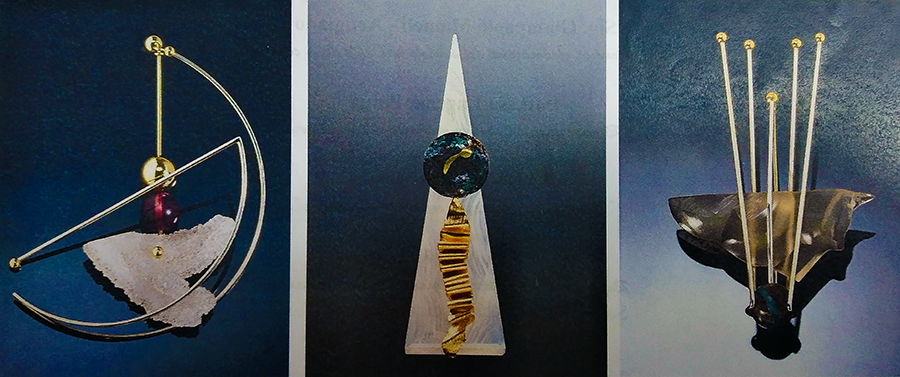
For nearly two years, the goldsmith Marini has decided, in agreement with the Almighty, to change his surroundings, curious about a better world. My collaboration with Vincenzo spanned over five years, born from a shared interest in creating jewelry that incorporated Sardinian stone: small stones collected on the beach, schist, granite, obsidian, tiny precious amethysts, and quartz. Common stones, plastically interpreted and combined with precious metals, generated precious objects, the result of skillful design and meticulous manual work: micro-sculptures in the form of jewelry.
Those were beautiful years, where the primary interest in jewelry design was combined with the search across the entire island for minerals to use. Equally important became an interest in cuisine, which, between research evenings and days spent discussing and organizing, was equally divided between lunches and dinners, with a preference for parago (sea bream) poached in Vernaccia wine and olives, baked, one of the best dishes at the TRE STELLE restaurant. The alternative usually consisted of memorable fish soups personally prepared by Vincenzo. Our common intent and project consisted of seeking an aesthetic modality that would overcome the production of artistic craftsmanship in traditional goldsmithing, while maintaining its preciousness and function intact.
We began by analyzing traditional jewelry, disassembling its elements and redesigning them with different combinations formally closer to contemporaneity, trying not to distort their function but elaborating their form in a different way. Belonging to that first period is a series of brooches where yellow gold, of a bleached and very bright yellow because alloyed with cadmium instead of the usual copper or silver, was embellished with tiny white river pearls that formally integrated them, highlighting the micro-granules soldered onto the gold filigree. The objects, though revisited in form, retained their flavor.
Thus, for the fish soup, where, as already noted, Vincenzo was an unmatched master, during a dinner rich in debate, he discovered, replacing the weak local white wine used to deglaze the fish, VILLA SOLAIS (a semi-dry aromatic white produced in the south of the island), introduced to us by our very dear mutual friend, Gianni Murtas, a historian and art critic, and, during his Sassari period, almost always present at our dinners. The result of the discovery, aided by an empty gas cylinder, turned into an unforgettable smoked soup, cooked on the embers of dried vine shoots and exquisitely flavored by the smoke of that ember.
I met Vincenzo during my early years at the State Art Institute of Sassari, where he had been teaching since 1965, chosen and wanted by Mauro Manca for his expertise and skill as a filigree artist. Meanwhile, Angelino Fiori, a painter always interested in experimentation and artistic development of craftsmanship in the textile sector and in the cultural promotion of his birthplace and residence, Osilo, had joined the partnership.
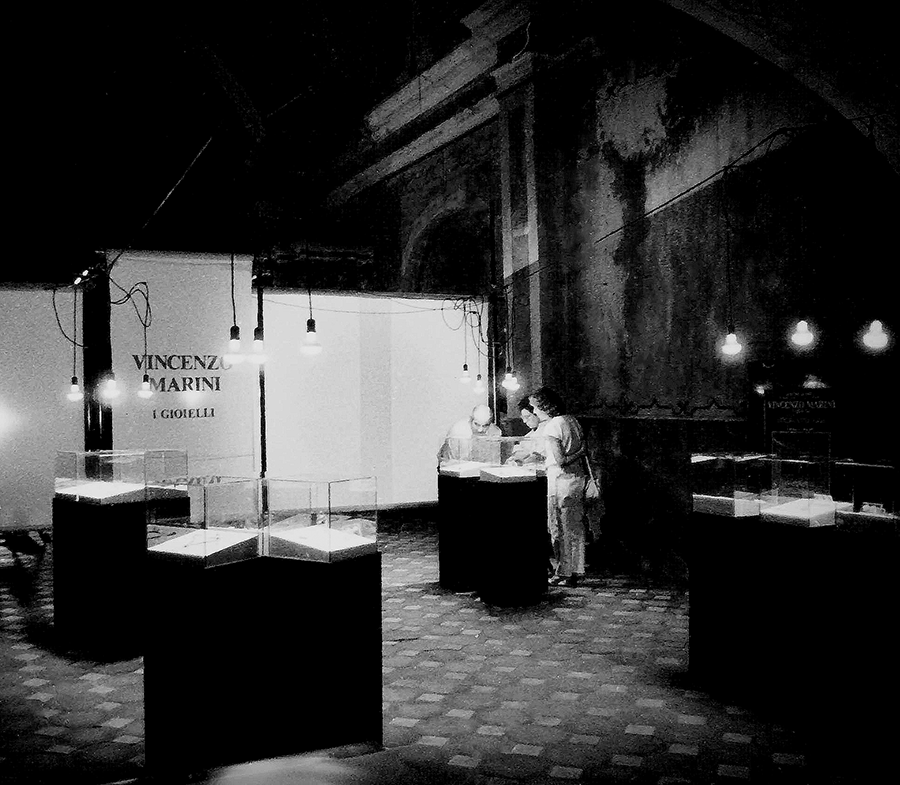
This three-person formula, seasoned with deep respect for each other’s work, had earned us a series of credits that originated several important initiatives for the period: exhibitions for Vincenzo Marini respectively at the PI GRECO gallery in Sassari, at DUCHAMP in Cagliari, a solo exhibition and a group exhibition of three with Roberto Puzzu and Angelino Fiori, in the Rosary Church in Osilo. The exhibitions were strongly desired and sponsored by the enlightened municipal administration of Paolo Pinna, who, with his characteristic attention to the territory, had favored our initiative for the creation of a real school for the working of hard stones in combination with precious metals, which Angelino Fiori directly handled for the design aspect and Vincenzo Marini for technical-laboratory learning for three years.
This heritage of experimentation and formal knowledge remained Vincenzo’s property, who used it wisely, elaborating it and making it his personal signature: architects La Pietra and Mangiarotti took an interest in his creations, appreciating his creativity and pushing him to enhance them. The beauty and originality of his creations earned him several important commissions, among them the original jewelry donated to Lady Diana, then consort of the current Charles III of England, during their visit to Sardinia. Tireless, almost obsessed with the desire to make his work known, he became his own promoter through a numerous series of conferences on the island and on the mainland.