Editor’s Note
**Editor’s Note:** This exclusive feature takes readers inside Bulgari’s green manufacturing facility in Valenza Po, where sustainability and craftsmanship converge. We explore the Roman Maison’s commitment to ethical luxury, five years into its journey.
A journey into the heart of the Roman Maison: AD exclusively visits the green manufacturing facility in Valenza Po, under the banner of sustainability and craftsmanship.
by Alessandra De Tommasi
Nestled in the hills of Monferrato, like a treasure chest reflecting light, the Bulgari manufacturing facility in Valenza Po (nicknamed “the city of gold” for its excellence in precious items) celebrates its first five years of existence.
The Roman Maison, which in the heart of the Capital hosts the Domus with its history and the stars who have populated it—from Liz Taylor to Anna Magnani—has created here a structure that combines tradition and innovation, focusing not only on Italian craftsmanship but also on an eco-sustainable headquarters. A symbolic bridge, in short, but also a physical one, for the two buildings suspended between past and future.
The headquarters is a historic site from the early 19th century, the Cascina dell’Orefice, renovated with a glass wing renamed the Glass House, featuring an internal courtyard inspired by the Roman domus. Built with full respect for the environment, it immediately obtained GOLD certification from the Green Building Council of the United States, an international body promoting sustainability in buildings. The manufacturing facility, in fact, was created to follow LEED (Leadership in Energy & Environmental Design) standards and represents a flagship for the entire area.

Attention to art in all its forms has also led to the birth of the Bulgari Jewellery Academy, a school to train the goldsmiths of tomorrow and pass on to new generations the richness of their roots without interrupting the region’s goldsmith tradition.
Some of the Maison’s historic lines come to life within these walls, from the classic Bvlgari-Bvlgari to the Diva, passing through the iconic Serpenti and Forever, all the way to the futuristic B.zero1.
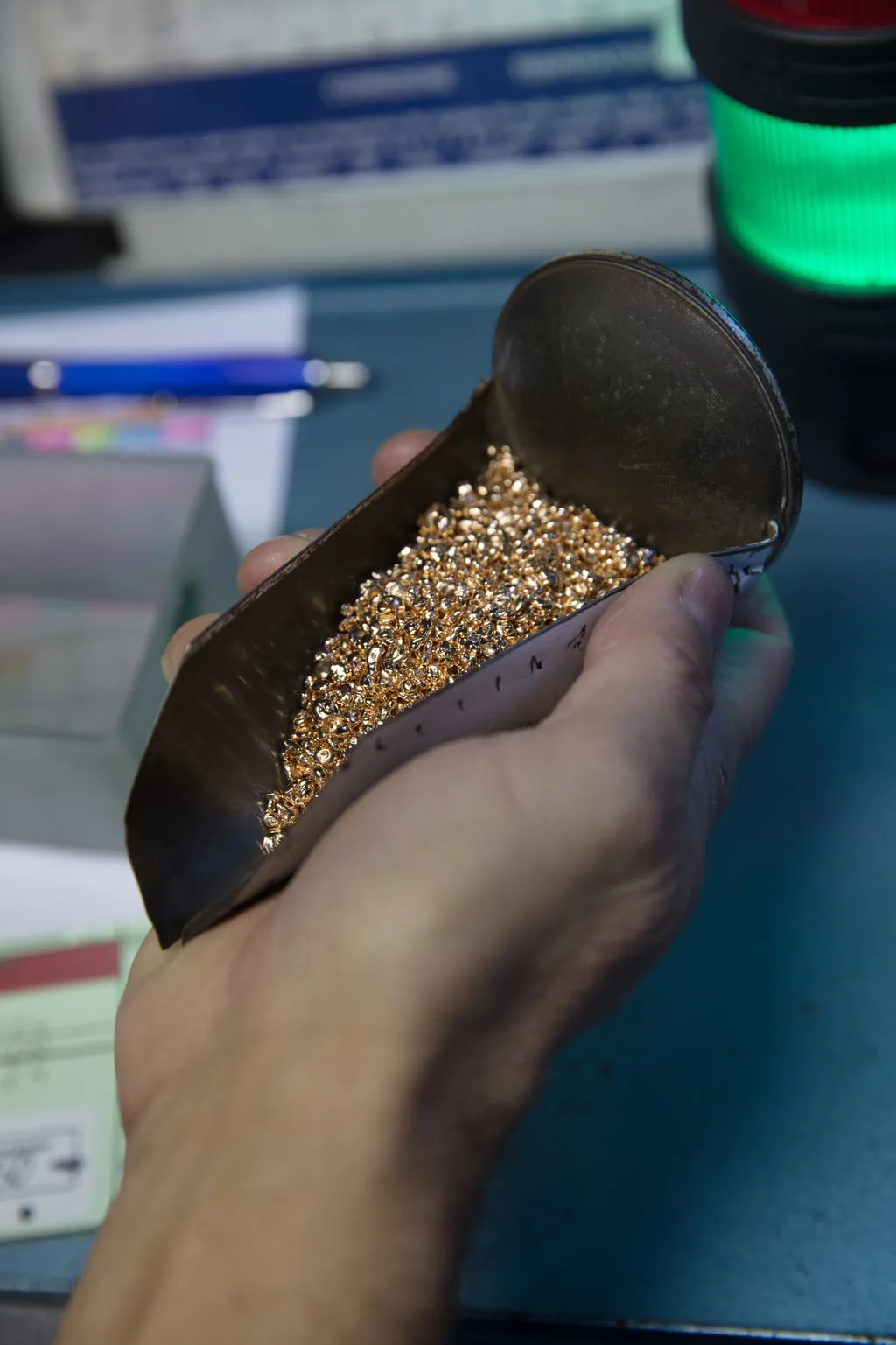
Architectural Digest had exclusive access to the Manufacturing Facility with a guided tour through the spaces that accompany all stages of jewelry creation, from the fusion of raw materials to the selection of stones, all the way to the final creation through setting perfected with surgical precision in various islands.
The welcome takes place in the “little trees” room, very thin stems that hold on their various branches gold of different colors and divided by fusion grades: here begins the journey of the petals or scales of the serpents, symbols of the Roman Maison.
Some procedures are standardized and handed down through centuries of knowledge, but one in particular was born from Bulgari’s artisans, who perfected the tubogas technique, which gives the jewelry both structure and elasticity. Only one machine in the world—present here in the manufacturing facility—has been able to refine the process of wrapping the copper wire that accompanies the jewelry in its early stages of creation.

So far, the Maison is the only one in the jewelry world to guarantee, starting this year, production that comes 100% from ethical and certified sources. Sustainability in the luxury sector, as explained by Jean-Christophe Babin, CEO, is a key requirement to ensure transparency and traceability, also regarding the origin of gemstones.
In this case, in short, the harmony and beauty of the architectural forms that guard the birth of these jewels go far beyond aesthetics and functionality, but are translated into real value to respect the environment and its inhabitants and encourage a virtuous circle.
– Diorissima: The new High Jewelry collection by Victoire de Castellane debuts in Venice. 141 creations intertwining abstraction and naturalism at the Palazzo del Casinò on the Lido.
– The 10 most beautiful homes seen on AD Italia in June: from Italy to Paris, Mexico City to Rio de Janeiro.

– The 12 most loved seaside homes of AD Italia: from Pantelleria to Salento.
– Blue Flag beaches 2026: the new map of the most desired sea and its iconic hotels.