Editor’s Note
This article highlights the steady growth projected for the Middle East and Africa jewelry market, driven by cultural significance and demand for precious materials.
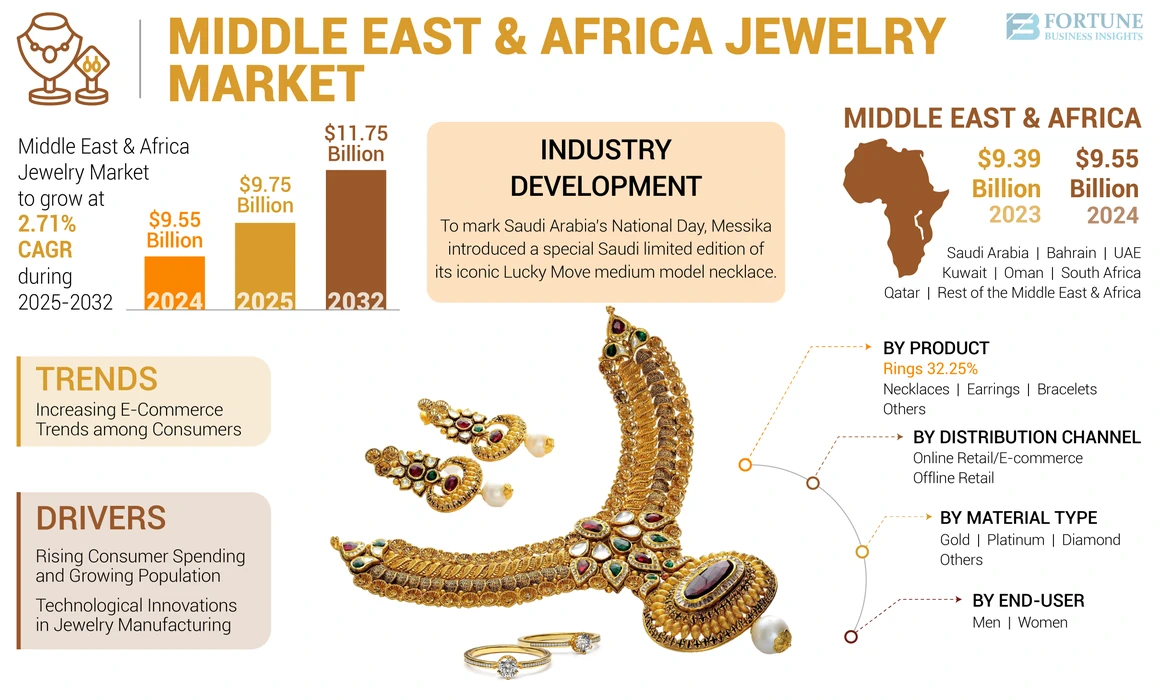
The Middle East and Africa jewelry market size was valued at USD 9.55 billion in 2024. The market is projected to grow from USD 9.75 billion in 2025 to USD 11.75 billion by 2032, exhibiting a compound annual growth rate (CAGR) of 2.71% during the forecast period.
Precious ornaments are considered fashionable in the Middle East region; therefore, diamonds and gemstones are in high demand. Gold is regarded as a sign of wealth and affluence in Middle Eastern culture, a significant factor driving product demand in the region. The increasing population, infrastructure growth alongside rising tourism, the growing spending power of tourists, and changing consumer preferences coupled with the demand for premium, high-end, and designer products will drive the growth of the Middle East and Africa jewelry market.
Product designers in the Middle East focus on creating modern jewelry with unique designs that reflect Arab history globally, favoring market expansion. Saudi Arabia, the UAE, and Bahrain are global shopping destinations for jewelry and electronic items. Recently, tourism in Middle Eastern countries has become one of the fastest-growing industries for leisure, social, or business purposes and is expected to grow significantly soon, increasing the demand for jewelry and gems in the region. According to the World Tourism Organization (UNWTO), in January, international arrivals to Middle Eastern destinations increased by 52% compared to the same month in 2021.
International brands, such as Chanel, Louis Vuitton, and Tiffany & Co., are focusing on launching premium products in the Middle East due to the growing demand for modern jewelry products. For example, in May 2020, Louis Vuitton, a France-based company, launched an exclusive piece from its B Blossom collection in the GCC region. The jewelry and gem pieces were found exclusively for the Ramadan season in the Middle East region.
Low Footfall in Stores Restricted Market Growth During the Pandemic
The global Covid-19 pandemic has been unprecedented and staggering, with the jewelry sector experiencing lower-than-anticipated demand across all Middle East and Africa (MEA) countries compared to pre-pandemic levels. The Covid-19 outbreak negatively impacted the global economy. The closure of offline retail stores in various parts of the Middle East region resulted in low footfall in jewelry gem stores in 2020. Sales of jewelry and gem products heavily relied on offline retail stores, and the lockdown resulted in a sharp decline in demand during the pandemic.
The rise of e-commerce trends among consumers is driving product demand.