Editor’s Note
This article explores the remarkable concentration of China’s gold and jewelry trade in the Shuibei district of Shenzhen. On less than one square kilometer, this specialized market has achieved a scale and influence that is rare nationwide, offering a compelling case study of industrial agglomeration.
In China, specialized markets are a common form of commercial and industrial agglomeration, ranging from village and town markets to wholesale markets, too numerous to list. However, few nationwide possess significant influence and pricing power.
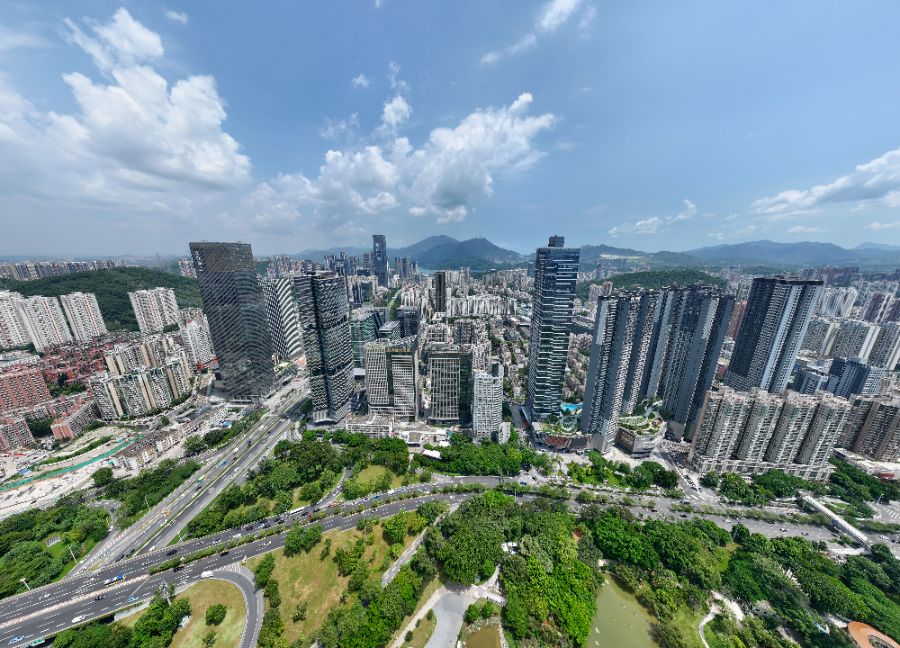
Shuibei, Shenzhen, on a mere 0.9 square kilometers of land, has given rise to over 20 professional gold and jewelry markets, gathering nearly 9,000 gold and jewelry enterprises, with more than 60,000 people engaged in related industries.
(Shuibei area; Photo/Shenzhen Luohu)
This area, known as “China’s Jewelry Capital · Shenzhen Shuibei,” lacks any natural precious metal or mineral resources and does not engage in artificial diamond cultivation. Yet, it holds a globally attractive force in the jewelry sector.
Every day, jewelry and gemstones from all corners of the globe, primarily gold, along with numerous categories like gemstones, pearls, silverware, and diamonds, are appraised, displayed, traded, and consumed here.
How did the “land without mines,” Shuibei, evolve from its initial gold processing factories into today’s jewelry distribution hub? Unlike the globally known Yiwu, the world’s largest small commodities wholesale market, or Anguo, the world’s largest traditional Chinese medicine trading center, Shuibei offers a new paradigm for specialized markets.
From a product distribution hub to an industrial cluster.
Luohu was one of the starting points for Shenzhen’s large-scale urban construction after China’s reform and opening-up. Leveraging advantages like the Luohu Bridge and Guangzhou-Shenzhen Railway, the “three supplies and one compensation” industrial model emerged here in the 1980s.
Initially, Shuibei was an industrial zone. In the 1980s, Dongfang Shou Shi Jewelry Processing Factory was established in Shuibei, handling OEM processing for Hong Kong jewelry companies. In the 1990s, Shuibei saw a scattered distribution of gold and jewelry processing workshops.
The turning point came in 2003. The People’s Bank of China abolished the gold purchase license; in October of the same year, Shenzhen swiftly introduced policies to promote the construction of a gold and jewelry industry cluster base in Shuibei. Old factory buildings were converted into industrial land, and within a year, over 300 upstream and downstream enterprises rapidly gathered.
In 2004, the Shuibei International Jewelry Trading Center commenced operations, becoming the nation’s first professional gold and jewelry procurement platform. This also signified that Shuibei began its rapid transformation from a “distribution hub” for jewelry commodity trade to a “cluster site” for the jewelry industry.
The early experience in OEM processing also cultivated a group of skilled craftsmen proficient in precious metal inlay techniques for Shuibei, giving rise to a cohort of production merchants adept in gold processing. The experience in wholesale and retail trade, combined with an online-offline integrated sales model, has allowed Shuibei to consistently account for 50% of the national gold jewelry wholesale market share.
Such advantages have attracted numerous non-gold jewelry merchants to choose Shuibei, making it one of the most concentrated and professional distribution markets outside of many jewelry origin locations.
It is understood that currently, about 10% of enterprises in the Luohu District’s gold and jewelry professional markets where Shuibei is located are engaged in production and processing like gold refining, jewelry inlay, and pearl polishing; over 85% are involved in related businesses like wholesale and retail; the remaining 5% engage in supporting business activities such as inspection and testing, training services, exhibition trading, or financial services.
Chen Minli, General Manager of Aokang Pearl, introduced to 21st Century Business Herald that in the Shuibei pearl circle, many brands source from China’s freshwater pearl origin—Zhuji, Zhejiang. Zhuji’s freshwater pearl trading scale is large and mature, but downstream, Shuibei can be considered one of the more comprehensive domestic pearl wholesale bases.
(Aokang products; Photo/Aokang Pearl)
Why has Shuibei, not a pearl origin, become such an important industrial cluster?
Chen Minli further analyzed that what Shuibei can offer brands goes far beyond sourcing advantages. It is a complete industrial ecosystem and one-stop supply chain capability. Here, not only are high-quality freshwater pearls from Zhuji, Zhejiang gathered, but also freshwater black pearls from Daisen, Japan, South Sea gold pearls, and Australian white pearls—all globally high-quality seawater pearls—are integrated. Coupled with abundant accessory resources and professional testing services, Shuibei possesses the full-chain advantage of creating everything from raw material procurement to finished product certification for brands.
Evidently, the accumulation and inheritance of history, combined with timely changes at key nodes, jointly contributed to the dazzling galaxy of Shuibei’s gold and jewelry industry today.
Mentioning gold jewelry, its name is often prefixed with its origin, including South African natural diamonds, Colombian emeralds, Myanmar jadeite, Zhuji freshwater pearls, Henan cultivated diamonds… These place names scattered around the world are pieced together to form a map of the jewelry world.
Yet, away from the origins, Shenzhen’s Shuibei also shares a deep and inseparable bond with the jewelry industry. In the places closest to consumers, Shuibei is always the quickest to sense new market trends. Cultured diamonds, African jade, Burmese pigeon’s blood ruby, and other trendy jewelry leaders can all find their traces in Shuibei.
Five years ago, by chance, Jiang Wei and friends went to Africa in search of a gemstone called “dragonite,” later known in the market as “African jade.” Although not previously in the gemstone business, as a native of Yunnan, Jiang Wei was very interested and quickly brought this gemstone back to Yunnan, found master craftsmen with decades of jade carving experience, and set up a production line.
In December 2024, the China Jewelry and Jade Jewelry Leading Industry Association approved and released the group standard “Identification and Classification of African Jade.” This ancient gemstone variety from Africa gained a common name and positioning in China’s jewelry circle. Around the same time, a group of purchasing merchants suddenly visited Jiang Wei’s African jade leading processing factory in Kunming, Yunnan. Upon inquiry, they all came from Shenzhen Shuibei.
Shuibei entered Jiang Wei’s vision at this moment. In May this year, Tengyun brand founder Jiang Wei brought products processed by Yunnan factory master craftsmen and officially joined Shuibei, renting several counters on the second floor of Telkin Gold and Silver, specializing in African jade.
Coming to Shuibei, the most direct and obvious change Jiang Wei felt was the broader customer base. He candidly told the 21st Century Business Herald reporter:
For new varieties, Shuibei has极强的 (extremely strong) inclusivity and receptivity. Like African jade, numerous “new” products make their way from here to all parts of the country and thousands of households.
Cultured diamonds are another classic case. The price of natural diamonds with scarcity has skyrocketed…