Editor’s Note
Starting October 1, GIA will implement a new assessment system for lab-grown diamonds, introducing “premium” or “standard” designations. Current grading services will remain available until September 30.
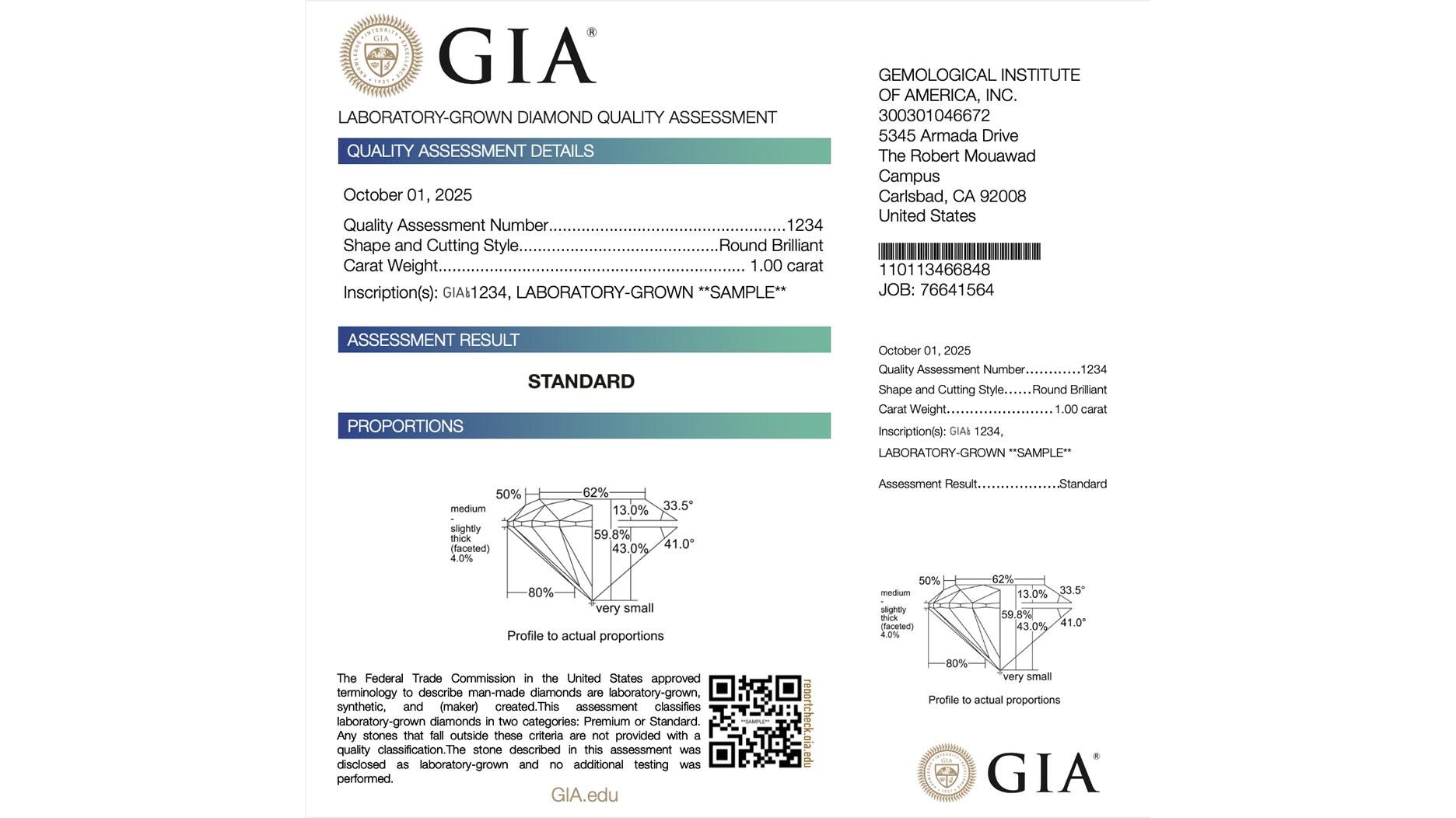
On Oct. 1, GIA will roll out its Laboratory-Grown Diamond Quality Assessment, which will include the new “premium” or “standard” designation for lab-grown diamonds. Current laboratory services for D-to-Z lab-grown diamonds will be available until Sept. 30, GIA noted.
Carlsbad, Calif.—After announcing plans to change the way it grades lab-grown diamonds (again), the Gemological Institute of America shared details on its new approach Tuesday.
Beginning Oct. 1, the lab will replace its digital-only lab-grown diamond grading reports, which evaluate the stones using the same color and clarity scale applied to natural diamonds, with a printed and much more general document called the GIA Laboratory-Grown Diamond Quality Assessment.
The assessment will be available only for lab-grown diamonds of a certain size (0.15 carats and up) and quality, with each stone being classified as either “premium” or “standard.”
In its press release announcing the pending change, GIA outlined the criteria for the two classifications.
To be deemed “premium,” lab-grown diamonds must be: D color; VVS clarity or higher; have “excellent” polish and symmetry; and, for round brilliant-cut diamonds, a cut grade of “excellent.”
Lab-grown diamonds that meet any combination of the “premium” criteria described above and the following minimum criteria will be classified as “standard.”
Those minimum criteria are: E to J color; VS clarity; “very good” polish; “very good” symmetry (or “good” for fancy shapes); and, for round brilliants only, a “very good” cut grade.
Lab-grown diamonds that do not meet the minimum criteria will not receive an assessment, GIA said.
The cost for the GIA Laboratory-Grown Diamond Quality Assessment will be $15/carat, with a minimum charge of $15.
That is half what the lab is currently charging for its more basic Laboratory-Grown Diamond Report Dossier for the smallest diamonds, 0.15-0.22 carats, according to the current fee schedule for lab-grown diamond grading reports on the GIA website.
The cost for a regular Laboratory Grown-Diamond Report starts at $60 for 0.15- to 0.22-carat stones.
Anyone who submits a diamond that does not qualify as “premium” or “standard” will still have to pay $5.
GIA will inscribe the girdle of each stone submitted and ultimately assessed with the words “Laboratory-Grown,” as well as the quality assessment number.

Tuesday’s news follows the announcement GIA made in early June during the Las Vegas jewelry shows about its intention to revert to more general terminology for lab-grown diamonds.
The updated language is actually less specific than what the lab used when it first started grading lab-grown diamonds in 2006.
Back then, the stones received a Synthetic Diamond Grading Report and were classified as either “colorless” (D, E, F) or “near colorless” (G, H, I), and assigned one of four clarity grades: VVS, VS, SI, or I.
In April 2019, following the release of the Federal Trade Commission’s revised Jewelry Guides, GIA announced it was changing the report’s name from the GIA Synthetic Diamond Grading Report to the GIA Laboratory-Grown Diamond Report.
The lab also began including the standard color, clarity, and cut grading scales used for natural diamonds on the reports, though it continued to grade lab-grown diamonds the same way, noting the scales were included for reference purposes only.
That changed in August 2020 when GIA announced that it would start using the same specific color and clarity grades for both natural and lab-grown diamonds, citing the “growing acceptance” of the product.
Five years later, the lab is altering its approach to lab-grown diamonds again, with current President and CEO Pritesh Patel echoing what Tom Moses told National Jeweler in a 2016 interview.