Editor’s Note
**Editor’s Note:** This article explores the groundbreaking exhibition at Toulouse’s Bemberg Foundation, which boldly confronts the long-standing taboo around forgeries in Renaissance jewelry. We invite readers to consider how the display of fakes reshapes our understanding of authenticity and artistry in historical artifacts.
In Toulouse, France’s First Exhibition Dedicated to Renaissance Jewelry Lifts the Taboo on Fakes
Arts and Exhibitions
By Céline Lefranc on 19.06.2025
Updated on 18.06.2025
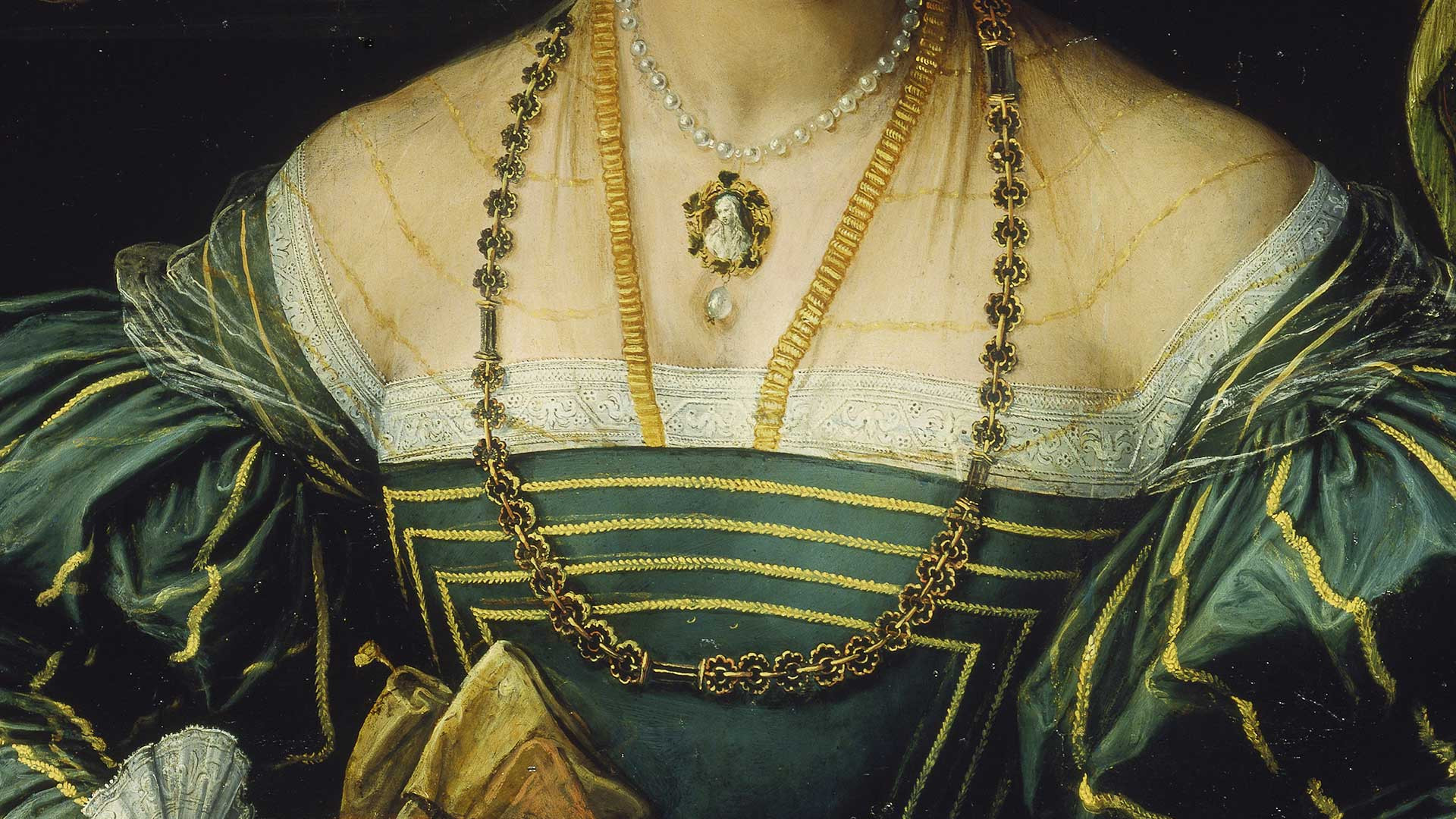
Attributed to Girolamo da Carpi, Portrait of a Lady (Renée de France?), circa 1530-1540, oil on wood, 113.7 x 79 cm, Frankfurt am Main, Städel Museum, inv. 946. Photo © 2025 Städel Museum, Frankfurt am Main
For its 30th anniversary, the Bemberg Foundation in Toulouse presents the first exhibition in France dedicated to Renaissance jewelry. Remarkably conceived, it sheds light on the historical, economic, and cultural context of the birth of these 16th-century treasures, and reveals the latest discoveries regarding fakes and pastiches.
Once in a while, the container is as beautiful as the content, and vice versa! It is in the magnificently restored Renaissance setting of the Hôtel d’Assézat that the Bemberg Foundation organizes, for its 30th anniversary, the first exhibition in France dedicated to Renaissance jewelry. Titled “D’or et d’éclat” (Of Gold and Splendor) and designed with the National Museum of the Renaissance in Écouen, it stems from ten years of research and addresses the subject comprehensively, covering the context of their creation, sources of inspiration, and their economic or symbolic value. In conclusion, it takes stock of the production of Renaissance-style jewelry at the end of the 19th century, whether made to deceive or not.

Also read:
Fashion, antique jewelry, design, decorative arts… the 11 most beautiful exhibitions to see in France in 2025
Why have 16th-century jewelry been so little studied in France? Mainly because they have come down to us in small numbers, explains the exhibition’s scientific curator Julie Rohou, curator in charge of the goldsmith collections at Écouen. From the Renaissance onward, jewelry, whose value depended essentially on the weight of the gold and the importance of the stones, were the first “liquid assets” to be parted with in times of war or economic hardship.
Diana and Actaeon, England or France (?), circa 1560-1580, enameled gold, diam. 3.5 cm, Stamford, Lincolnshire, Burghley House. Photo: © The Burghley House Collection
Moreover, these jewels are not hallmarked, making it very difficult to determine their geographical origin. Stylistically, they all resemble each other, as the dissemination of models across Europe accelerated in the 16th century through engraving. And as the end of the exhibition explains, more than half of the “Renaissance” jewelry preserved in museums actually date from the 19th century…
Yet the Renaissance was a golden age of jewelry, where form and creation prevailed over the preciousness of stones. This is understood from the first section of the exhibition, which presents the goldsmith’s craft. A large engraving from the Louvre, donated by the Rothschilds, depicts the interior of a workshop in Augsburg in 1576, the tools used, and the meticulous work of artisans who sculpt and cast the settings.

View of the exhibition “D’or et d’éclat”, Bemberg Foundation, Toulouse. Photo: © Fondation Bemberg / Antoine Heusse, 2025
Lead models of German jewelry highlight the main source of inspiration: Antiquity, notably rediscovered at the end of the 15th century with the unearthing of Nero’s Domus Aurea in Rome. These lead models also testify to the Mannerism from Italy, with their mythological figures featuring long silhouettes and pronounced hip sways. Interlacing and grotesque motifs are found on a beautiful drawing by Hans I Collaert. Or on the jewelry mold used by Bernard Palissy to decorate a ceramic cup intended for Catherine de’ Medici’s grotto, both found during excavations around the Louvre in 1985-90.
Hans I Collaert, Factitious collection of plates of ornaments and pendants, Antwerp, 1581, printed, 17.2 x 12 cm, Écouen, National Museum of the Renaissance. Photo: © GrandPalaisRmn (Museum of the Renaissance, Château d’Écouen) / Mathieu Rabeau
The taste for antiquity and formal experimentation are at the heart of the next section, “The Renaissance of Adornment.” Visitors are greeted by a Portrait of a Lady attributed to Girolamo da Carpi, a true ode to jewelry. The beautiful woman, who could be Renée de France, wears a cameo depicting Venus or an antique heroine, suspended from a pearl necklace, the pearl once symbolizing “chaste fertility.”
Attributed to Girolamo da Carpi, Portrait of a Lady (Renée de France?), circa 1530-1540, oil on wood, 113.7 x 79 cm, Frankfurt am Main, Städel Museum. Photo: © Städel Museum, Frankfurt am Main, 2025
Since antique cameos often arrived incomplete, Renaissance goldsmiths created “commesso,” composite objects that insert these cameos into custom-made, fashionable settings. The exhibition features three of these. Further on, we discover the Livre de bijouterie (Book of Jewelry) by Pierre Milan or René Boyvin, which includes about twenty engraved plates of highly inventive models for pendants, earrings, bracelets, and necklaces, enriched with motifs of leather, cherubs, trophies…
Model of pendants, collection of burin engravings by Pierre Milan or René Boyvin, circa 1540, INHA library, Paris. © Connaissance des Arts / Céline Lefranc
