Editor’s Note
**Editor’s Note:** This article examines how Guangzhou-based manufacturer S&J is capitalizing on the rising global demand for stainless steel fine jewelry by advancing customization capabilities and setting new quality benchmarks for brand partnerships.
How a Guangzhou-based manufacturer is setting the benchmark for quality, customization, and brand partnership in stainless steel jewelry production.
In a global jewelry market growing faster than most accessories categories, one material is quietly outpacing the rest. Stainless steel – once considered a budget alternative to precious metals – has become the material of choice for a new generation of jewelry brands that compete on quality, consistency, and durability rather than on the prestige of silver or gold alone.
At the center of this shift is S&J Jewellery, a vertically integrated manufacturer based in Guangzhou, China, whose end-to-end customization model has made it a trusted production partner for independent labels, established fashion brands, and international retail chains. From initial concept to finished product, S&J’s services cover the full production journey – removing the fragmentation, inconsistency, and coordination overhead that have long frustrated brands working with multiple suppliers.
The rise of stainless steel in fine jewelry is not a trend driven by cost-cutting. It is driven by consumer demand for products that actually last. Shoppers – particularly those purchasing through direct-to-consumer channels – have become increasingly vocal about jewelry that tarnishes within weeks, leaves skin discoloration, or fails to hold its finish through daily wear. Stainless steel addresses each of these concerns directly.
It is corrosion-resistant, biocompatible, and dimensionally stable across a wide range of environmental conditions. It holds up against sweat, water, cosmetics, and chlorides without losing its surface integrity. For brands building a quality narrative, it is a material that earns its claims rather than requiring them to be carefully worded around known weaknesses.
Sustainability is an additional factor. Stainless steel is fully recyclable, lending material honesty to the environmental story that modern brands are increasingly expected to tell. As consumers scrutinize supply chain claims more carefully, the ability to make a credible durability and sustainability case – rooted in the material itself – has become a meaningful brand asset.
Not all stainless steel performs equally in jewelry applications. Grade selection matters significantly, both for end-product performance and for meeting the biocompatibility expectations of international markets. As a specialized 316L stainless steel jewelry manufacturer, S&J selects 316L grade for its fine jewelry production. The properties of 316L make it particularly well-suited to daily-wear jewelry. Its resistance to chlorides and oxidizing agents ensures that finishes remain intact even under sustained contact with skin, water, and cosmetic products. Its biocompatibility makes it appropriate for sensitive skin and nickel-reactive consumers – a segment brands can now serve confidently, rather than qualify around in their product descriptions.
316L also accepts a broad range of surface treatments with exceptional durability. Mirror polish, brushed finishes, matte textures, and PVD color coatings – in 18K gold, rose gold, gunmetal, and IP black – all adhere to the 316L substrate with a longevity that conventional electroplating on brass or silver cannot match. For brands, this means finish durability becomes a genuine product promise rather than a carefully managed expectation.
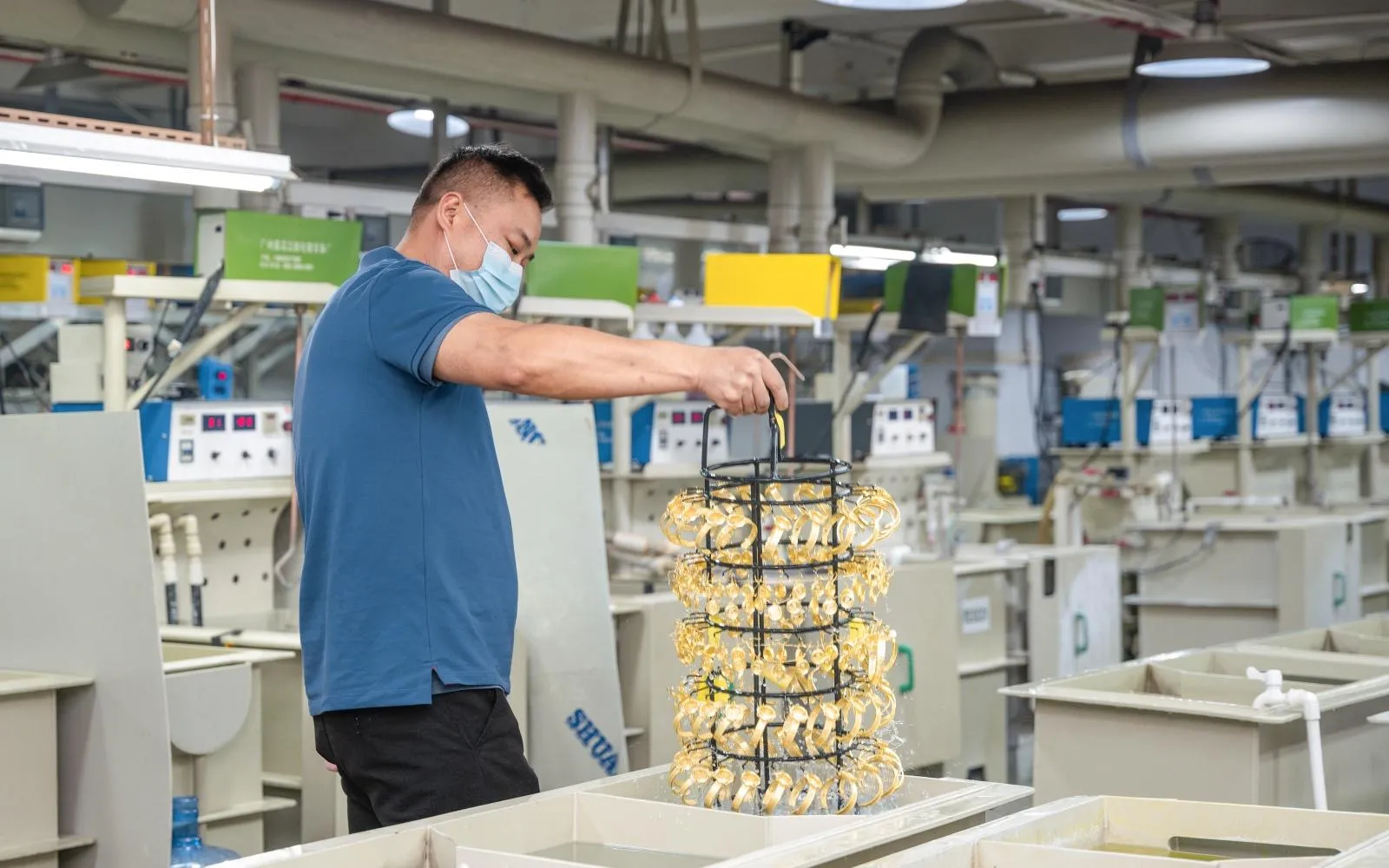
Surface finish is where stainless steel jewelry transitions from functional to desirable. Physical Vapor Deposition – PVD – is the technology that makes this possible at a quality level traditional plating has never been able to sustain. In PVD coating, ultra-thin ceramic or metallic films are bonded to the stainless steel substrate at the molecular level under vacuum conditions, creating a surface layer that is exponentially harder and more adhesion-resistant than electroplated alternatives.
The practical result for brands is a finished product whose color and surface texture remain consistent across the lifespan of the piece – not just for the first few weeks of wear. Gold-toned pieces retain their warmth. Black IP finishes hold their depth. Rose gold maintains its distinction from standard yellow gold. These are qualities that matter to the end consumer, and they are qualities that a brand can confidently communicate and stand behind.
S&J’s in-house PVD capability means that finish quality is managed within the same production environment as every other stage of manufacturing, ensuring that the color and texture a brand approves in a sample is replicated consistently across every unit in a production run.
Under the OEM model, S&J produces jewelry to a brand’s existing designs and specifications. This track is designed for brands that have a defined aesthetic, an established design team, and a clear production brief – and who need a manufacturing partner capable of executing that brief with precision and consistency at scale.
Under the ODM model, S&J’s in-house design team works directly with brand founders and creative directors to develop new collections from concept through to production-ready sample. Using CAD software and rapid prototyping equipment, the team compresses the distance between initial brief and physical prototype, enabling brands to move from idea to market faster than traditional development timelines allow.
Both tracks converge on the same integrated production pathway: metal forming, surface finishing, gemstone setting where applicable, multi-stage quality control, and branded packaging – all managed within a single facility, under a single point of accountability. The operational simplicity this provides is not incidental. For brand founders managing remote supply chains, it is one of the most valuable things a manufacturing partner can offer.