Editor’s Note
**Editor’s Note:** This article reports the closure of Rio Tinto’s Diavik diamond mine in Canada, marking the end of a 23-year operation that produced over 150 million carats of rough diamonds.
Rio Tinto Hauls Last Load from Diavik
Mar 30, 2026
Production has ceased at the Canadian diamond mine, which has yielded more than 150 million carats of rough diamonds in its 23-year run.
Lauren McLemore
[email protected]
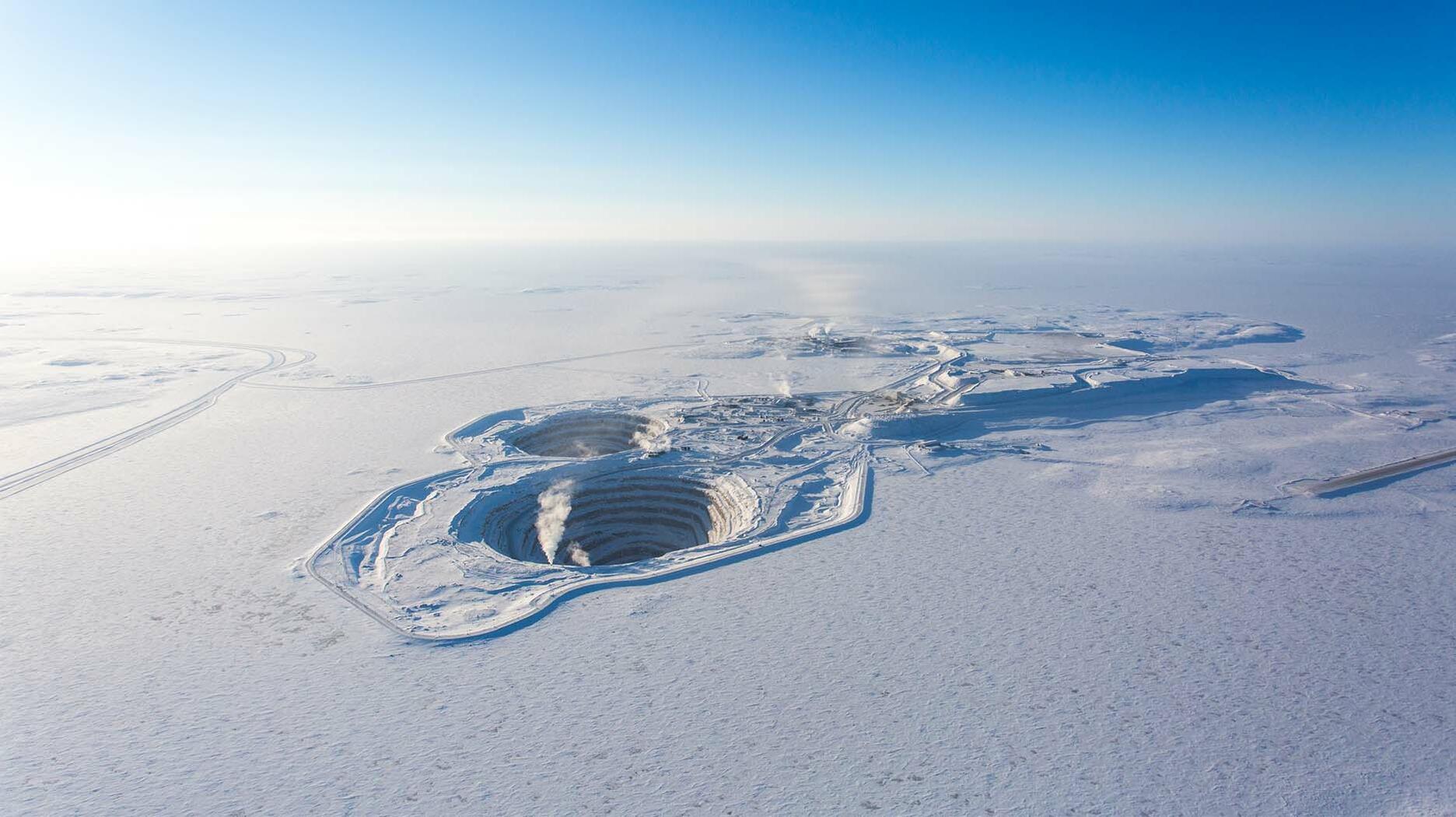
The Diavik mine, which is closing after more than two decades in operation, was discovered in 1991 beneath a frozen lake in the sub-arctic tundra of the Northwest Territories of Canada.
Yellowknife, Canada—Rio Tinto delivered its final production of ore from the Diavik diamond mine in the Northwest Territories (NWT) of Canada on March 24, marking the beginning of the end for the 23-year-old mine.
The mine, located in a remote area less than 150 miles south of the Arctic Circle, produced more than 150 million carats of rough diamonds while in operation and became a major economic pillar of the region.

Indigenous government organizations, government representatives, and other stakeholders attended a celebration at the mine, formally marking the completion of production.
Closure activities will extend to 2029, followed by a period of post-closure monitoring, said Rio Tinto, the mine’s sole owner since 2021.
The final production of rough diamonds will be polished and sold through 2026 and beyond by Rio Tinto’s international network of customers and its Select Diamantaires.
Related stories will be right here …
Excluding Diavik, there are two active diamond mines in Canada—Ekati (owned by Burgundy Diamond Mines) and Gahcho Kué (owned by De Beers Group).
Diavik, comprising four pipes, was discovered in 1991 beneath Lac de Gras, a lake in the sub-arctic tundra of Canada, about 190 miles northeast of Yellowknife.

Mining began in 2003.
Utilizing both open pit and underground mining methods, Diavik produced predominantly white gem-quality diamonds, a small proportion of yellow diamonds, and a handful of pink stones.
In a remarkably rare instance last summer, it yielded a violet diamond.
Among the most noteworthy discoveries is a 552.74-carat yellow diamond recovered in 2018, which holds the title for the largest diamond ever found in North America.
The Government of Northwest Territories has called Diavik “a pillar of the NWT economy.”
In addition to producing more than 150 million carats of rough diamonds, the operation has supported more than 1,100 jobs annually and contributed nearly 10 percent of territorial GDP.
Though its original life-of-mine was forecast for 2025, the transition of its A21 pipe to underground mining in late 2024 extended Diavik’s life into the first quarter of 2026.
Planning for the mine’s closure, however, commenced before the mine even began production, Rio Tinto said, with considerations for safety, land use, landforms, water, biodiversity, community capacity, and resource development.

The buildings on site are designed to be demolished and disposed of safely, according to its website.