Editor’s Note
**Editor’s Note:** This article explores the return of stacking jewelry and introduces the J.U.N.E. Diamonds line—offering gold and diamond pieces at accessible prices.
The J.U.N.E. Diamonds line, which stands for “Jewelry You Never Experienced,” offers pieces made from gold and diamonds at accessible prices.
Stacking jewelry is making a strong comeback; here’s how to adopt it without overdoing it.
by Malvine Sevrin
Photographer: Rosalie Bartolotti
Published: 27/07/2018
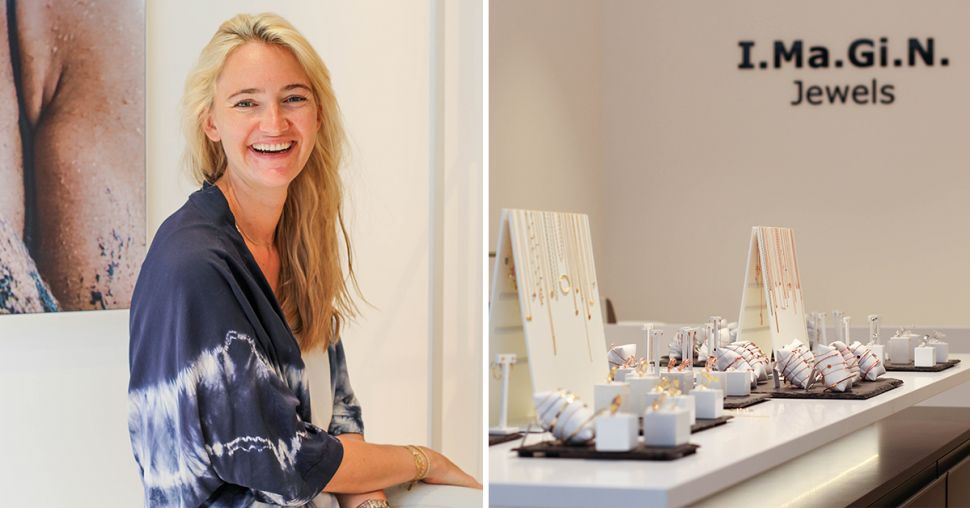
Born in the diamond city, I.Ma.Gi.N Jewels has combined jewelry spirit with accessible prices since 2013. A meeting with Margaux Spruyt, the brand’s creator.
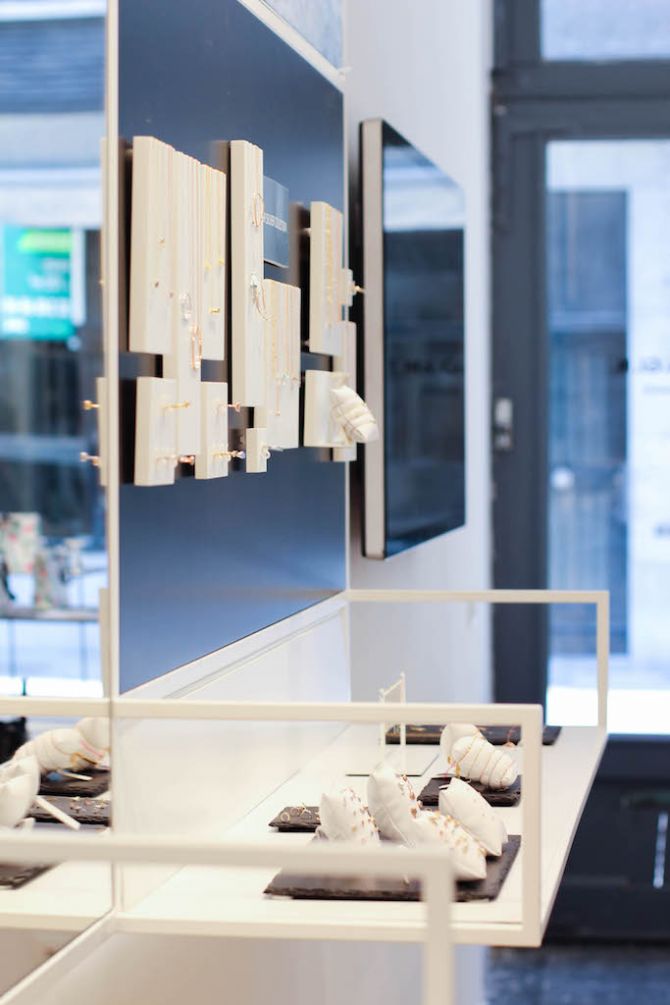
We met Margaux in her newly renovated boutique in Antwerp. A modern and minimalist space, reflecting her creations where costume jewelry and exceptional pieces coexist. Between the very accessible main line (from €9 to €99) and the J.U.N.E. Diamonds line made from gold and diamonds (€150 to €300), everyone can find the jewelry that suits them, whatever the occasion or budget.
The brand bears the name of its two creators: in I.Ma.Gi.N, there is my first name, Margaux, and that of Gilles, my partner. We created the brand together in 2013. At the time, Gilles was a diamond cutter, cutting diamonds in the workshop, and I had launched my own jewelry brand under the name “4U by Margaux Spruyt.” I only did home sales, where the client invited her friends to her home to discover the collection. Then I met Gilles and we said to ourselves,
because we felt that together we could do more. Coming from a family of diamond dealers, I dreamed of offering jewelry that looks like fine jewelry but remains affordable. And quite quickly we opened our first boutique…
The Antwerp boutique, the brand’s first address, has just been renovated.
From my family. On my maternal grandparents’ side, my grandfather was a diamond dealer and my grandmother was a jewelry wholesaler. My mother also worked in that business for a long time. I grew up in this world, surrounded by jewelry. And for Gilles, it’s the same; his father was also a diamond dealer. Today, we are happy to continue this family story in our own way.
Jewelry that looks like fine jewelry but remains accessible to the greatest number.
No. I started making small beaded jewelry at age 12, but it was just a hobby. After secondary school, I began studying psychology, but I quickly realized it wasn’t for me! I decided to stop in the middle of the year and launched my own brand. Since I wasn’t going to school for the rest of the year, I took evening classes in goldsmithing. I really enjoyed it and wanted to confirm my desire to work in this field. So I went to live in Italy for more advanced goldsmith training, where I learned the creation of a piece of jewelry from A to Z, setting, technical drawing, etc. I was supposed to stay for a year, but I stayed for three because I loved what I was learning so much.
We first think about what we want to create according to the season. In summer, creations are often more colorful, and in winter we work more with semi-precious stones. For example, for next winter we chose to work with colored stones, so we traveled to India to select them. Then we draw the models. We make a prototype, run several tests before finally launching production. Our costume jewelry is made in Italy, and the gold and diamond pieces from the J.U.N.E. Diamonds line are made here in Antwerp.
Everywhere! We live in such a beautiful world… It can come from fashion trends, runway shows, our personal travels. For this summer’s exotic collection, we were on vacation drinking a coconut and thought it would be nice to have that motif in our collection. Our clientele is also a source of inspiration. We listen carefully to feedback from our clients who submit ideas; we make sure to satisfy them while adding our personal touch.
Fine, delicate, trendy… and if I can add a fourth, I’d say “at an affordable price”!
Coconut, palm tree, seashell… A summer 2018 collection that smells like vacation.
I wear a lot! Around my neck, I wear two necklaces from the JUNE Diamonds collection, and on my wrist, four colorful enamel bracelets for summer. I also wear a medallion that never leaves me; it’s engraved with the initials of my partner and my son. Even if I change jewelry each season, I always have my favorites from each collection. I don’t leave them for very long, yet I have the luxury of being able to change jewelry every day if I want! (laughs)
Clients can now personalize their jewelry by having it engraved directly in the boutique and leave with a unique piece that reflects them. Yellow gold, rose gold, silver, necklace or bracelet… Everything is possible to create a personalized piece.