Editor’s Note
This article explores stone paper, an innovative packaging material made from calcium carbonate and resin. As a durable, water-resistant, and tree-free alternative to traditional paper, it offers significant environmental benefits, including reduced deforestation and lower water usage.
Stone paper is an innovative, eco-friendly material gaining traction across various industries due to its durability, sustainability, and water resistance. Made primarily from calcium carbonate and resin, it offers a tree-free alternative to traditional paper, reducing deforestation and water consumption. Its tear-resistant and smooth texture makes it ideal for printing, packaging, and stationery applications. Additionally, stone paper is recyclable, photodegradable, and highly resistant to moisture, making it suitable for outdoor and high-humidity environments. With growing environmental concerns and demand for sustainable packaging and printing solutions, stone paper is emerging as a key player in the global paper industry, attracting interest from publishers, packaging manufacturers, and eco-conscious brands.
The global stone paper market is driven by several key factors. The increasing demand for sustainable and eco-friendly alternatives to traditional paper has significantly boosted market growth, particularly in regions with stringent environmental regulations. Stone paper’s durability, water resistance, and recyclability make it an attractive choice for various applications, including packaging, printing, and labelling. Additionally, its role in reducing deforestation and water consumption aligns with global sustainability goals, further driving adoption. Advancements in production technologies, including improved mineral-based formulations and energy-efficient manufacturing processes, have enhanced product quality, cost-effectiveness, and environmental impact. As industries and consumers shift toward greener solutions, stone paper continues to gain traction as a viable alternative, supporting sustainable packaging, publishing, and stationery markets worldwide.
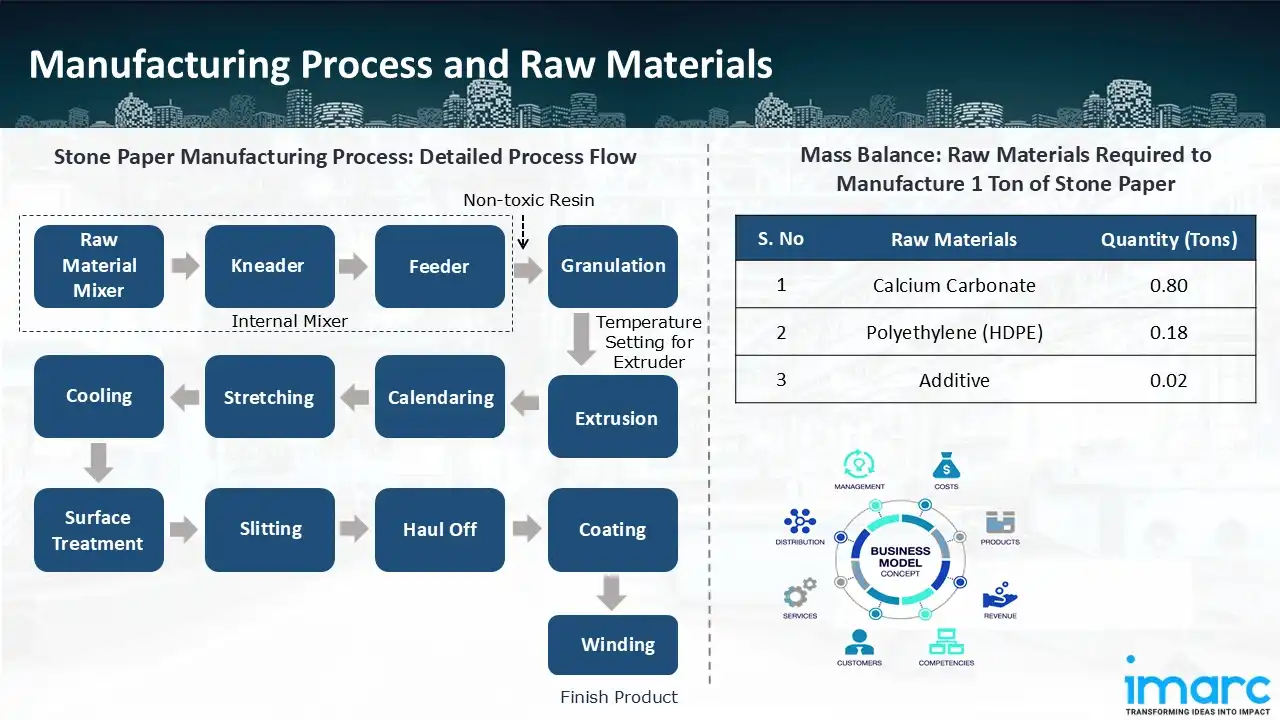
Stone paper production involves pelletizing and extrusion processes. It begins with internal mixing, where raw materials, auxiliaries, and additives are blended in a high-temperature, high-pressure kneader to ensure uniform dispersion. The mixed material is then granulated into pellets, making it suitable for extrusion. During extrusion, the granules are fed into an extruder with a screw and barrel system, where they are heated to 160°C and combined with molten PE. The molten material is then extruded through an O-shaped die, forming a cylindrical tube. Compressed air blows this into a stable film bubble, which is calendared through a three-roller system to achieve the desired thickness. Next, the material undergoes stretching and cooling for structural stability. Surface treatment, such as corona treatment, improves ink adhesion for printing. Slitting trims the edges to customer specifications, followed by coating for enhanced durability. Finally, the stone paper is wound into rolls for various applications.
In October 2023, Shenzhen Stone Paper Enterprise Ltd. unveiled its wholesale stone powder synthetic paper as a sustainable and flexible solution for vegetable packaging in the printing and packaging industry.
In January 2023, Taiwan Longmeng Composite Materials Co., Ltd. responded to the growing e-commerce waste problem by developing a new recycling system for environmentally friendly packaging materials. The company reported that Taiwan’s online shopping sector consumes over 100 million packing boxes and bags annually, generating approximately 18,000 tons of packaging waste. To combat this issue, they have introduced corrugated cardboard made from stone paper composite material. This innovation is particularly useful for cold-chain logistics, where traditional corrugated cardboard boxes can be replaced with stone-paper-based saury boxes, significantly reducing packaging waste.
In December 2021, A KEMAS developed Limex Pellet, an injection-molding-grade material that is both highly recyclable and environmentally friendly. This advanced material aims to reduce greenhouse gas emissions while conserving critical natural resources. Limex Pellet offers a sustainable alternative to conventional plastic, reinforcing the company’s commitment to eco-friendly manufacturing solutions.