Editor’s Note
Jacob & Co. made headlines at its 2023 Geneva Watch & Jewelry Show with the unveiling of the world’s first ¥2.7 billion timepiece, drawing global attention from enthusiasts and industry insiders alike.
Jacob & Co. | Jacob & Co.
From March 27 to April 2, 2023, Jacob & Co. held its new product launch event, ‘Jacob & Co. GENEVA WATCH & JEWELRY SHOW 2023,’ on the 2nd floor of the Four Seasons Hotel des Bergues in Geneva, Switzerland. The event attracted a large number of Jacob & Co. fans, watch industry professionals, and media representatives from around the world.
At the ‘Jacob & Co. GENEVA WATCH & JEWELRY SHOW 2023,’ the brand showcased new models that embody Jacob & Co.’s creativity and spirit of challenge, including:
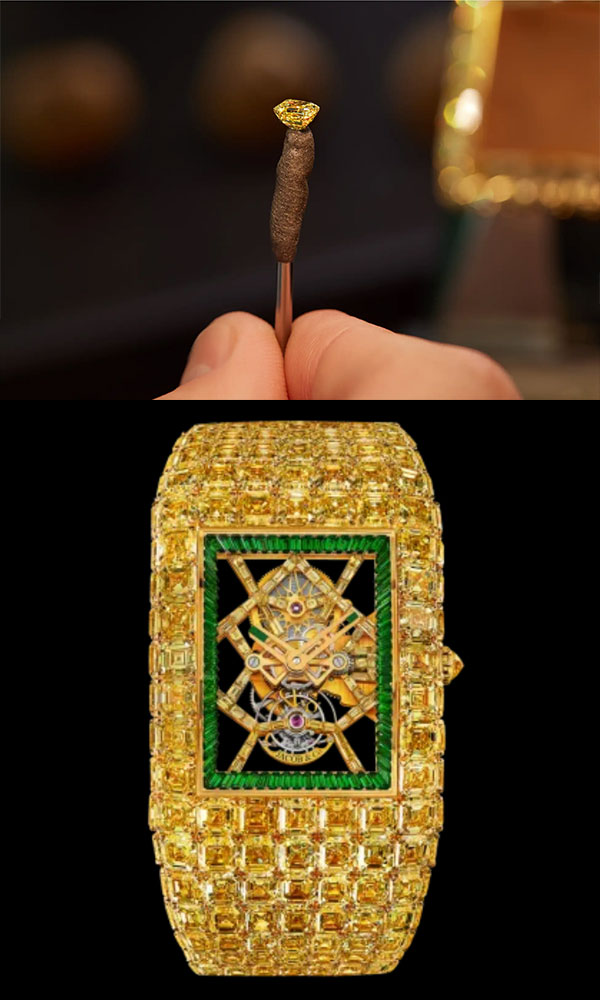
– The ‘Billionaire Timeless Treasure,’ the world’s most expensive watch at ¥2.7 billion, which required 3.5 years to source its gemstones.
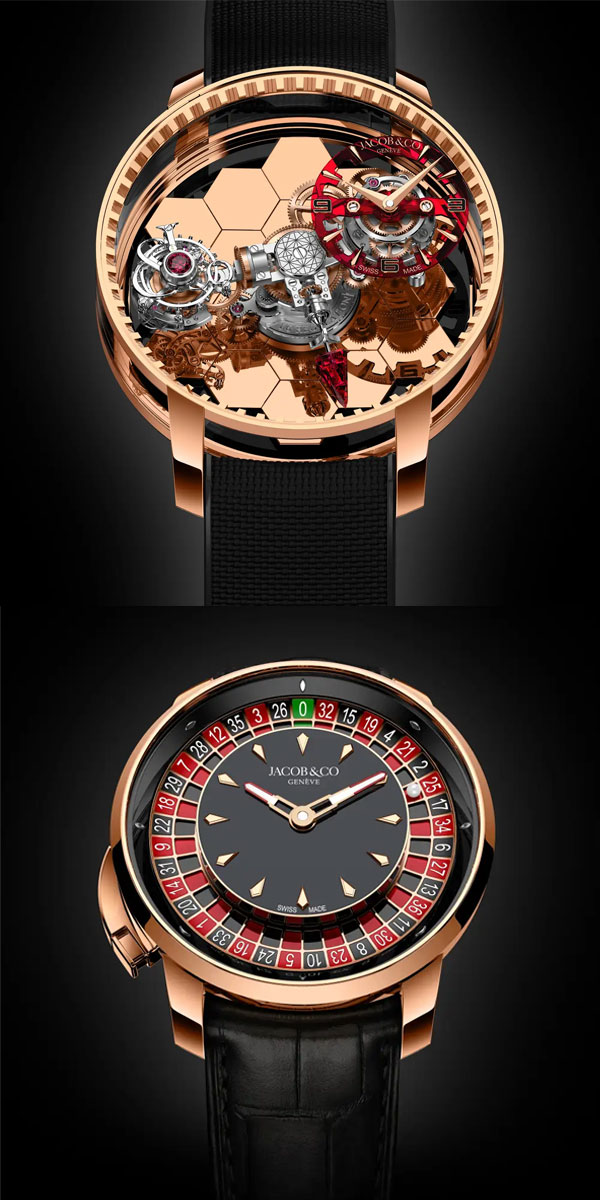
– The ‘Astronomia Revolution,’ featuring the world’s first mechanism where the movement rotates at high speed across the dial in one minute, developed over 7 years.
– The ‘Casino Tourbillon,’ which incorporates a tourbillon in the case back and offers a luxurious roulette game experience.
This exceptional watch, the ‘Billionaire Timeless Treasure,’ extensively uses the extremely rare 216.89-carat yellow diamonds, employing advanced and complex processing techniques and watchmaking craftsmanship.
Yellow diamonds occur at a rate of one in every 10,000 white diamonds, making them inherently rare and valuable. Jacob & Co.’s gemology manager, Selina Wicht, stated:
The challenge was acquiring so many stones of such rare color and size. Additionally, all approximately 880 carats of rough stones before cutting had to meet Jacob & Co.’s quality standards. Furthermore, maintaining color uniformity after cutting and precisely cutting and setting each stone was necessary.
The first-ever colored Billionaire combines absolute color uniformity and quality, the brightest brilliance, gem-setting techniques, and watchmaking craftsmanship, resulting in the world’s most expensive wristwatch at ¥2.7 billion.
Jacob & Co.’s CEO, Benjamin Arabov, commented:
He described the watch as an adventure in pursuit of the impossible, a treasure hunt that required years of patience.
Ref: BL130.50.AA.UA.A
Case Size: 52.2 × 43.5 mm
Case Thickness: 12.0 mm
Case Material: 18K yellow gold, 46 Asscher-cut yellow diamonds (55.15 carats)
Strap: 18K yellow gold, 18K yellow gold deployment buckle, 378 Asscher-cut yellow diamonds (159.62 carats)
Water Resistance: 30 m
Movement: Manual winding, Cal. JCAM39, 72-hour power reserve, 21,600 vibrations per hour (3 Hz), 19 jewels, 57 baguette-cut yellow diamonds (1.55 carats)
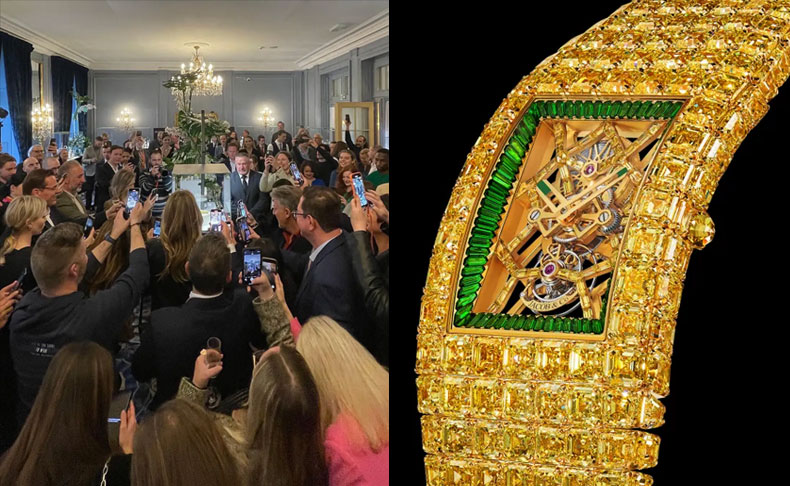
Specifications: Hours and minutes display, tourbillon, sapphire crystal case back, one rose-cut yellow diamond on the crown (0.57 carats), skeleton dial with 76 kite-cut and emerald-cut tsavorites (3.59 carats) set in a flange setting
Limited Edition: Unique piece
Price: ¥2,970,000,000 (tax included)
After 7 years of development, Jacob & Co. completed the ‘Astronomia Revolution,’ a watch featuring the world’s first complex mechanism.
The Astronomia collection draws inspiration from the universe and celestial bodies, creating timepieces that allow wearers to travel through technology, space, and time. The Astronomia Revolution takes this concept further, incorporating the most advanced technology. Three arms rotate at high speed around a central axis in one minute, each equipped with sophisticated functions.
The first Astronomia, launched 7 years ago, was the world’s first model with a movement rotating over the base dial in 20 minutes. Since then, the rotation time has been reduced to 10 minutes, then 5 minutes, achieving the astonishing speed of one rotation per minute. Because the movement rotates over the base dial in one minute, it effectively serves as the second hand, making it a work of art that delights every time you glance at your wrist.
Rotating the movement in one minute posed the challenge of requiring immense power, but the introduction of a constant force mechanism enables a 36-hour power reserve.
The base dial is made of 18K red gold, polished to the extreme and slightly tilted at a very precise angle. This honeycomb-like mirror surface pays homage to space exploration and serves as a tool to appreciate the beauty of the rotating satellites (arms).
The ‘Casino Tourbillon’ features the roulette wheel function characteristic of the popular ‘Astronomia Casino’ and combines it with a flying tourbillon, creating a playful, gambling-themed timepiece. The case size has been reduced from 47 mm in the traditional Astronomia Casino to 44 mm. Additionally, pressing the pusher at the 8 o’clock position allows you to enjoy the roulette game while simultaneously winding the power reserve.
The dial is made from a single piece of black onyx, adorned with gold kite-shaped hour markers.
The simple display does not obstruct the view of the rotating roulette wheel, providing an excellent roulette playing experience.
Event Period: March 27, 2023 – April 2, 2023, 9:00 AM – 9:00 PM
Venue: Four Seasons Hotel des Bergues, 2nd Floor
33 Quai des Bergues, 1201 Geneva, Switzerland
Case Diameter: 50.00 mm
Case Thickness: 25.45 mm
Case Material: 18K rose gold
Specifications: Hours and minutes display, dual-axis tourbillon, hand-engraved and hand-painted dragon on 18K rose gold with yellow citrine cabochon eyes, white diamonds Jacob Cut (288 facets / 1 carat), natural yellow diamonds Jacob Cut (288 facets / 4.57 carats)
Limited Edition: Unique piece
Case Size: 54 × 40 mm
Case Material: 18K white gold
Strap: Interchangeable blue alligator strap and full diamond-set 18K white gold bracelet
Specifications: Equipped with the newly developed double tourbillon movement JCAM50, 77 diamonds (39 ct) set on the case, 504 diamonds (95 ct) set on the bracelet
Limited Edition: 18 pieces
*Information as of April 2023. Please note that details may have changed since the time of publication.
BRAND NEWS
Jacob & Co. Brand News
2024 New Works: The Traditional Regulator Mechanism Enters the 3D World in the 21st Century: Jacob & Co. ‘Astronomia Regulator’
2024/05/02
2023 New Works: Unique Dial Layout and Vibrant Marine Blue Highlight Individuality: Jacob & Co. ‘The World Is Yours Dual Time Zone’
2023/08/31
2023 New Works: Jacob & Co. Unveils World’s First ¥2.7 Billion Model at ‘Jacob & Co. GENEVA WATCH & JEWELRY SHOW 2023’
2023/04/14
View More Jacob & Co. Brand News
INFORMATION
For inquiries about Jacob & Co.:
JACOB&CO. Japan
〒104-0061 Tokyo, Chuo-ku, Ginza 8-5-1 Plaza G 1F C
TEL: 03-6281-4777
List of Gressive Listed Stores
Official Website

View Jacob & Co. Brand Page
Search Keywords: Gemstone Sourcing