Editor’s Note
**Editor’s Note:** This report exposes a widespread fraud in the silver jewelry market, where up to 70% of ornaments sold to low-income buyers are counterfeit, often made with aluminum instead of silver.
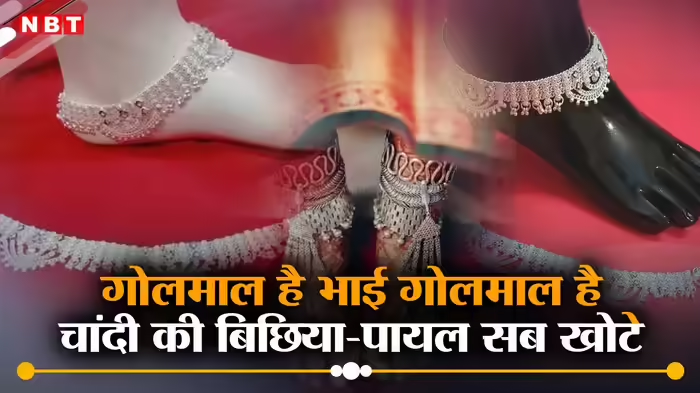
New Delhi: While the wealthy buy and wear gold jewelry, the poor save every penny to purchase small silver ornaments like anklets and toe rings. With limited income and access, they often buy from local goldsmiths in their villages or towns. Those who buy such silver jewelry will be shocked to learn that millions of rupees of their savings are being cheated daily. In fact, up to 70% of such silver jewelry is fake. Some jewelers are selling gilt as silver. These ornaments shine not with silver but with aluminum.
The dark truth about white silver was brought to light by the Dainik Bhaskar newspaper. According to a report published in this newspaper, silver jewelry from various cities and towns was brought to the lab of the Jaipur Sarafa Traders Committee for purity testing over one year. A total of 12,306 silver items—including anklets, rings, bangles, chains, ghunghroo (anklet bells), toe rings, and necklaces—were examined. The lab report will shake you.
According to the lab report, some of the jewelry brought in contained not even a single percent of silver. 90% of the tested ornaments were found to be substandard, meaning they were impure and adulterated. According to the newspaper, 66% of silver jewelry currently sold in markets contains 60-70% adulteration with zinc and aluminum. Some jewelers are even selling gilt ornaments as silver. About 70% of the jewelry brought to the lab showed the shine of gilt and aluminum.
Silver mangalsutras, bangles, laung (nose pins), payals (anklets), chains, and anklets brought from Agra, Mathura, Nathdwara, and Rajkot were also tested. They too were fake. If you try to sell these ornaments later, you won’t get even half the money you invested. People often buy these ornaments from local jewelers out of trust, but they only realize the fraud when they try to sell them.
While hallmarking can be trusted for purity testing, the Bureau of Indian Standards (BIS) only checks the purity of jewelry from jewelers licensed for silver hallmarking. It does not check jewelry from unlicensed jewelers. The Bureau advises buying only hallmarked silver jewelry to ensure full purity.
Most of the fake silver jewelry caught at the Jaipur lab came from Agra, Mathura, Nathdwara, and Rajkot. Goldsmiths in Jaipur say that these cities are the source of counterfeit silver ornaments, which is tarnishing the reputation of all goldsmiths.
Estimates suggest that in Rajasthan alone, an average of 1,000 kg of silver jewelry is sold daily. The estimated value, including making charges, is around 10 crore rupees. Of this, 70% of the jewelry has only 10-80% purity. This means that daily, women are being cheated out of 3-4 crore rupees of their savings through the sale of adulterated silver jewelry.
Currently, there is no government system in place to stop the trade of adulterated silver jewelry. Officials from the Weights and Measures Department occasionally visit jewelers’ shops, but their checks are limited to weighing scales. They check the scales and leave. They never take samples of the jewelry, nor has any such system been established. However, customers can get jewelry tested at BIS hallmarking centers if they wish.
Goldsmiths say that good jewelry is sold as sterling silver. Such ornaments contain 92.5% silver, so they are stamped with .925 or 925. Pure silver is soft, so copper, zinc, or nickel is added for strength, but it should not exceed 7.5%.