Editor’s Note
**Editor’s Note:** This article examines the growing shift toward lab-grown diamonds as the natural diamond supply chain faces unprecedented instability, highlighting how technological advances and ethical consumer values are reshaping the global jewelry industry.
The global jewelry industry is at a historic turning point. Amid ongoing instability in the natural diamond supply chain due to recent world events, the jewelry supply network demands greater reliability than ever before.
In this context, technological innovations have enabled lab-grown (synthetic) diamonds to achieve brilliance comparable to natural diamonds, along with stable supply of larger stones. Driven by changing ethical values, especially among younger generations, lab-grown diamonds are gaining global attention as a next-generation choice.
This exhibition brings together both “natural stones,” whose enduring value is being reaffirmed through rarity, and rapidly popularizing “synthetic diamonds (lab-grown diamonds)” and “synthetic moissanite.” It offers a prime opportunity to experience the forefront of the jewelry industry where traditional beauty and new values coexist.
Recent global developments have also affected major diamond processing hubs and distribution centers, prompting a worldwide restructuring of supply chains. Under these circumstances, natural diamonds are being re-recognized as a “limited resource,” with their rarity and asset value drawing renewed attention.
Adding further trust to the rarity of natural diamonds is the ongoing establishment of “traceability.” Utilizing the latest digital technologies, clearly documenting “where the stone originated and the path it took to reach the consumer” has become a new form of quality certification for modern natural stones.
At the venue, you can hear real voices from domestic buyers and wholesalers who provide top-quality brilliance with assured peace of mind.
Amid changing supply systems and values, the “lab-grown diamond” market is expanding at an astonishing pace. While synthetic diamonds were once strongly associated with industrial use, in recent years the jewelry market for them has grown rapidly as “sustainable and high-quality gemstones.”
Background of the Rapid Growth of the Synthetic (Lab-Grown) Market:
- Shift from ‘Expensive Natural’ to ‘Clean-Background Synthetic’: Especially among Gen Z and millennials, the criteria for choosing gemstones are shifting from traditional rarity to a new evaluation axis that emphasizes the production process—”what background the stone comes from and how it reached the consumer.”
- Overwhelming Cost Performance: While possessing the same chemical and physical properties as natural diamonds, lab-grown diamonds allow consumers to enjoy maximum volume and brilliance even on a low budget, even amid recent price hikes. They are becoming a “smart choice” not only in fashion but also in bridal scenes.
Some Synthetic (Lab-Grown) Products Exhibited at This Fair:
- Lab-Grown Diamonds: Ethical and fashionable lineup of lab-grown diamonds, from single-stone necklaces to highly designed rings. Company: Zara Corporation (Ltd.)
- Synthetic Gray Moissanite: “Synthetic moissanite” is often cited as a simulant in diamond identification. Differences in light reflection, rainbow brilliance (dispersion), and refractive index can be compared with diamonds. Company: Toyo Loose
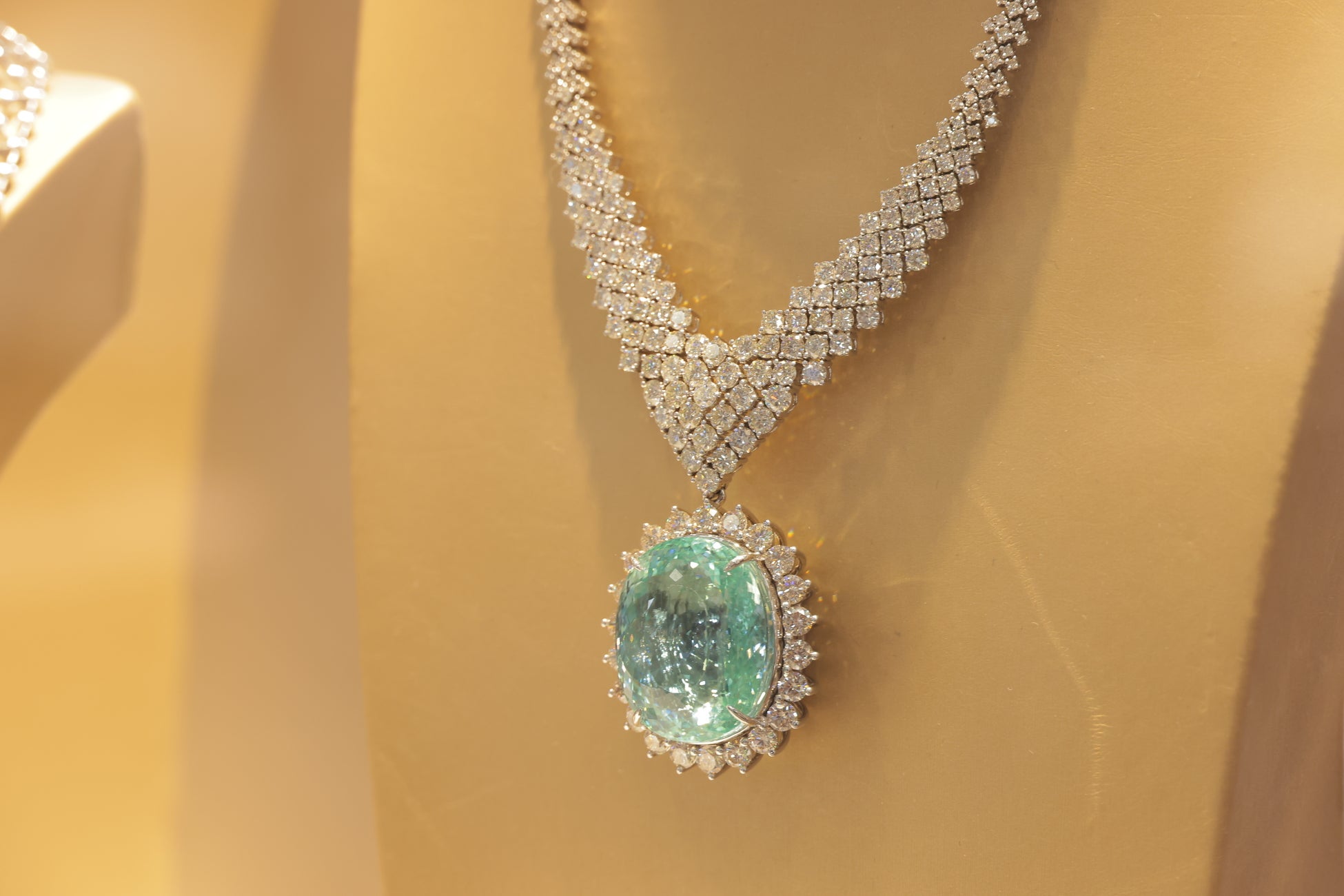
- Lab-Grown Paraiba Tourmaline: Inspired by the vivid neon brilliance of Paraiba tourmaline, this “lab-grown gem” is manufactured by combining garnet with a certain proportion of blue sapphire, achieving a beautiful neon blue reminiscent of high-quality Paraiba tourmaline. It has the same chemical composition as the natural stone, preserving the original color, ethically realized through lab-grown technology. Company: APPLE GREEN DIAMOND INC.
- Platinum Lab-Grown Diamond 1.00ct Pave Ring: A classic three-row diamond ring balancing luxury and delicacy, with finely set diamonds. The interior features a honeycomb structure for both strength and lightness, embodying architectural wisdom for a lifetime of brilliance. Company: T’s 40 (Ltd.)
- Crystal Trio: A lab-grown diamond jewelry brand from Vancouver. This notable brand combines modern design with the highest quality lab-grown diamonds. The “18K Gold Three-Stone Lab-Grown Diamond Ring” features a 3ct large marquise cut in the center, flanked by two 0.5ct pear-shaped cuts for a luxurious look. Company: Gwen’s Grow Jewelry Co., Ltd.
In addition to lab-grown products, the exhibition will feature an AI-integrated automatic synthetic diamond identification machine and the world’s first handheld diamond identification device, available for on-site experience.
About 10 years after lab-grown diamonds arrived in Japan, the global diamond business has evolved dramatically beyond the binary opposition of “natural vs. lab,” entering a new era of values and market structure.
This lecture will provide an overview of the paradigm shift facing the global diamond market, discussing the current state of the Japanese market and the future “new diamond era” with industry experts. It is a session to decipher the future of the diamond industry at this turning point.
For press registration, please visit: https://www.ijt.jp/hub/ja-jp/press.html
Feel free to contact us for inquiries. We can arrange interview subjects and themes in advance upon request. Coverage on the day before the event (May 13) may also be possible with schedule coordination. On-site inquiries during the event will be accommodated as much as possible.
Coverage Content: Venue photography, exhibitor booth interviews, visitor interviews, organizer comments, etc.
- Exhibition Name: 30th Kobe International Jewelry Fair (IJK 2026)
- Dates: May 14 (Thu) – May 16 (Sat), 2026
- Venue: Kobe International Exhibition Hall
- Organizer: RX Japan LLC
- Number of Exhibitors: 480 (planned)
- Expected Visitors: Approximately 14,000
- Official Website: https://www.ijt.jp/kobe/ja-jp.html