Editor’s Note
**Editor’s Note:** Overnight Mountings is evolving from a wholesale jewelry manufacturer into a tech-enabled operational partner with the launch of its Ring Builder platform. The B2B tool aims to help retailers meet rising demands for customization, digital sales, and speed.
Overnight Mountings is expanding from a wholesale jewelry manufacturer into a technology-enabled operational partner for jewelry retailers through its Ring Builder platform.
New Hyde Park, N.Y.—Overnight Mountings, a New York-based jewelry manufacturer, has launched its Ring Builder platform.
The fully integrated B2B jewelry platform was designed to help retailers compete in a rapidly evolving retail landscape shaped by customization, digital selling, and faster consumer expectations, it said.
Overnight Mountings said the launch of its Ring Builder platform signals a broader transformation underway at the company as it expands from the traditional role of wholesale jewelry manufacturer into a technology-enabled operational partner for jewelry retailers.
The company is now building on that foundation with digital tools designed to help retailers simplify customization, accelerate sales, and reduce operational friction between customer inquiry and finished product delivery.
Overnight Mountings Launches Ring Builder Platform
Jun 08, 2026
Overnight Mountings Launches Ring Builder Platform
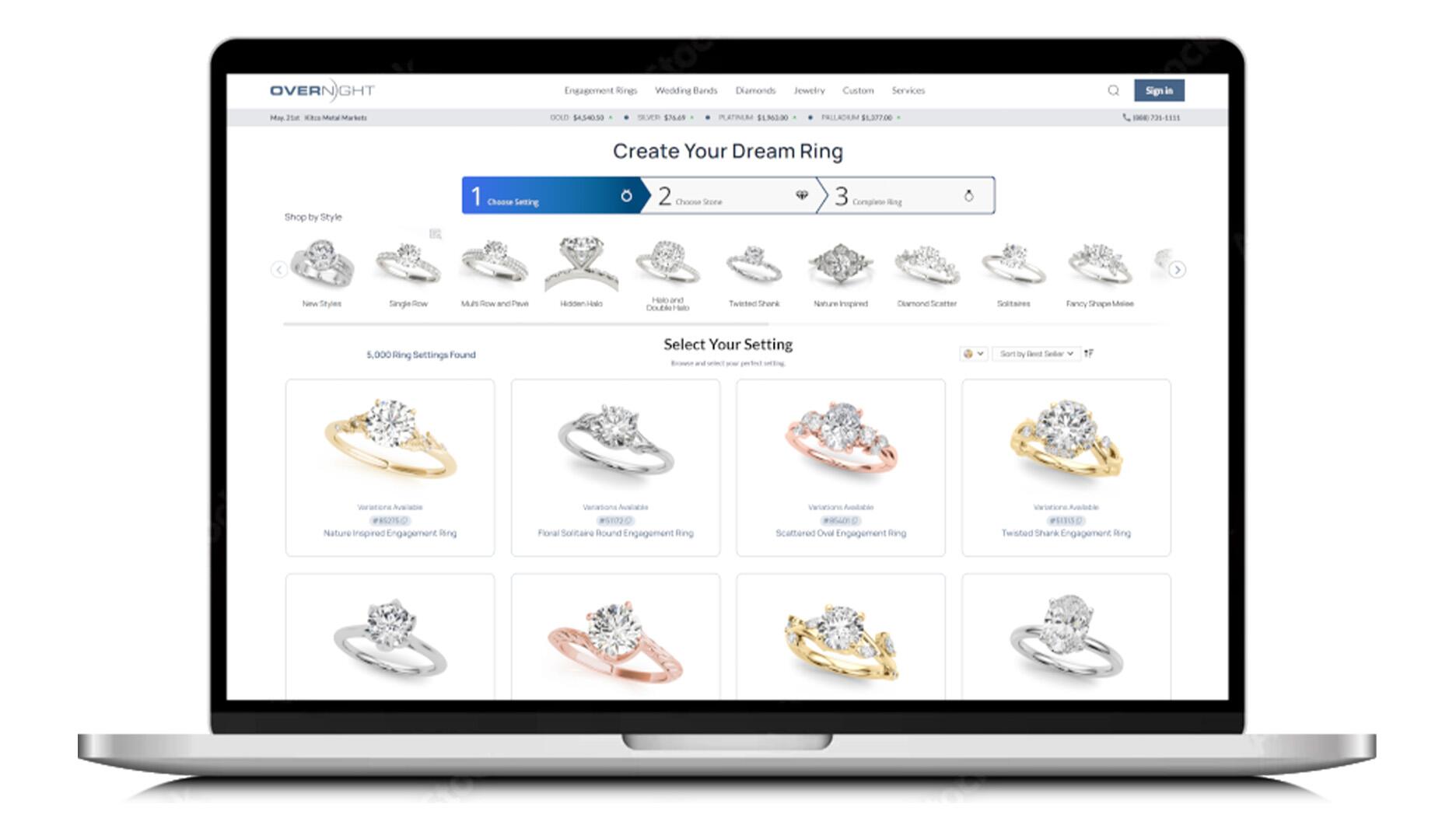
The platform allows retailers to guide clients through a customizable engagement ring buying experience in a branded interface.
Natalie Francisco
[email protected]
The Ring Builder platform is a retailer-focused technology system that combines engagement ring customization, CAD development, rendering services, pricing workflows, and manufacturing executions into one connected experience.
Through the platform, retailers can guide customers through a customizable engagement ring buying experience using retailer-branded interfaces that support both in-store and online sales environments.
Customers can explore mounting styles, center stone options, design variations, setting combinations, and made-to-order configurations that maintain direct alignment with manufacturing capabilities and production workflow.
Overnight Mountings said its new platform was intentionally designed around retailer usability.
Overnight Mountings operates its own domestic manufacturing infrastructure in New York, which allows it to integrate production directly into the digital ordering process.
It is known for its bridal mounting selection, domestic manufacturing capabilities, CAD support, and fast-turn production.
The manufacturer said the move is due to the industry facing increasing pressure from changing consumer behavior and a rapidly evolving retail environment.
Along with the launch of the Ring Builder platform at JCK, it is also currently developing additional AI-assisted automation systems.
This technology is being designed to support faster quoting, improved rendering workflows, structured custom intakes, and more efficient communication between retailers and manufacturing teams.

Portions of the AI-assisted automation systems are slated to begin rolling out this year.
For wholesale inquiries, contact Overnight Mountings at 888-731-1111 or email [email protected].