Editor’s Note
**Editor’s Note:** This article details the remarkable rediscovery of the legendary Florentine Diamond and other Habsburg jewels, hidden in a Canadian bank vault since World War II. Archduke Karl von Habsburg’s revelation ends decades of speculation about the fate of these historic treasures.
Archduke Karl von Habsburg, the Head of the House of Habsburg, has revealed that the legendary Florentine Diamond and fifteen other historic jewels of the House of Habsburg, long thought sold, stolen or lost, have been hidden for decades in a bank vault in Canada, since Empress Zita found refuge there during the Second World War.
His grandmother Zita, the widow of Charles I, brought the jewels there decades ago in a small brown leather suitcase. The hiding place is in the French-speaking province of Quebec.
In 2024, two of his cousins contacted him. There was something to discuss. His grandmother Zita had decreed that the whereabouts of the giant diamond and the other jewels must remain secret, at least until the 100th anniversary of the death of Emperor Karl I. He died in exile on Madeira on April 1, 1922. Only two male members of the family were allowed to know the secret. These were, most recently, the two cousins.

Towards the end of the First World War and the abolition of the Austria-Hungarian Empire, Court Chamberlain Count Bechthold went to the Imperial Treasury at the Hofburg Palace in Vienna, where he retrieved jewellery privately owned by the Imperial Family, which were then transported to Switzerland and deposited in the Swiss National Bank in Zurich. The transportation of the jewellery caused a furore and the nationalization of the property of the House of Habsburg. Not long afterwards, Emperor Karl and Empress Zita were swindled by a former financial advisor who stole many of the jewels.
The collection includes a number of other items of jewelry, including a diamond-encrusted Order of the Golden Fleece, the house order of the Hapsburg family. Some of the pieces in the collection were crafted, added to, or modified by his own ancestors. He shows a photograph of a clock, set within a large, pear-shaped emerald with another emerald as a cover, polished to a wafer-thin finish. Maria Theresa gave it to the future French queen, her daughter Marie Antoinette, who would later meet her end under the guillotine.
Karl von Habsburg-Lothringen, 64, a grandson of Charles I, said in an interview that the secret had been kept out of respect for Charles’s wife, the Empress Zita. She told only two people — her sons Robert and Rodolphe — about the diamond’s location, he said, and asked that, as a security precaution, it be kept undisclosed for 100 years after Charles’s death in 1922. Before they died, the brothers passed the information to their own sons, according to the family.

But now, with the vow fulfilled, the family wants to display the Florentine Diamond and other jewels in Canada to thank the country for taking in the empress and her children.
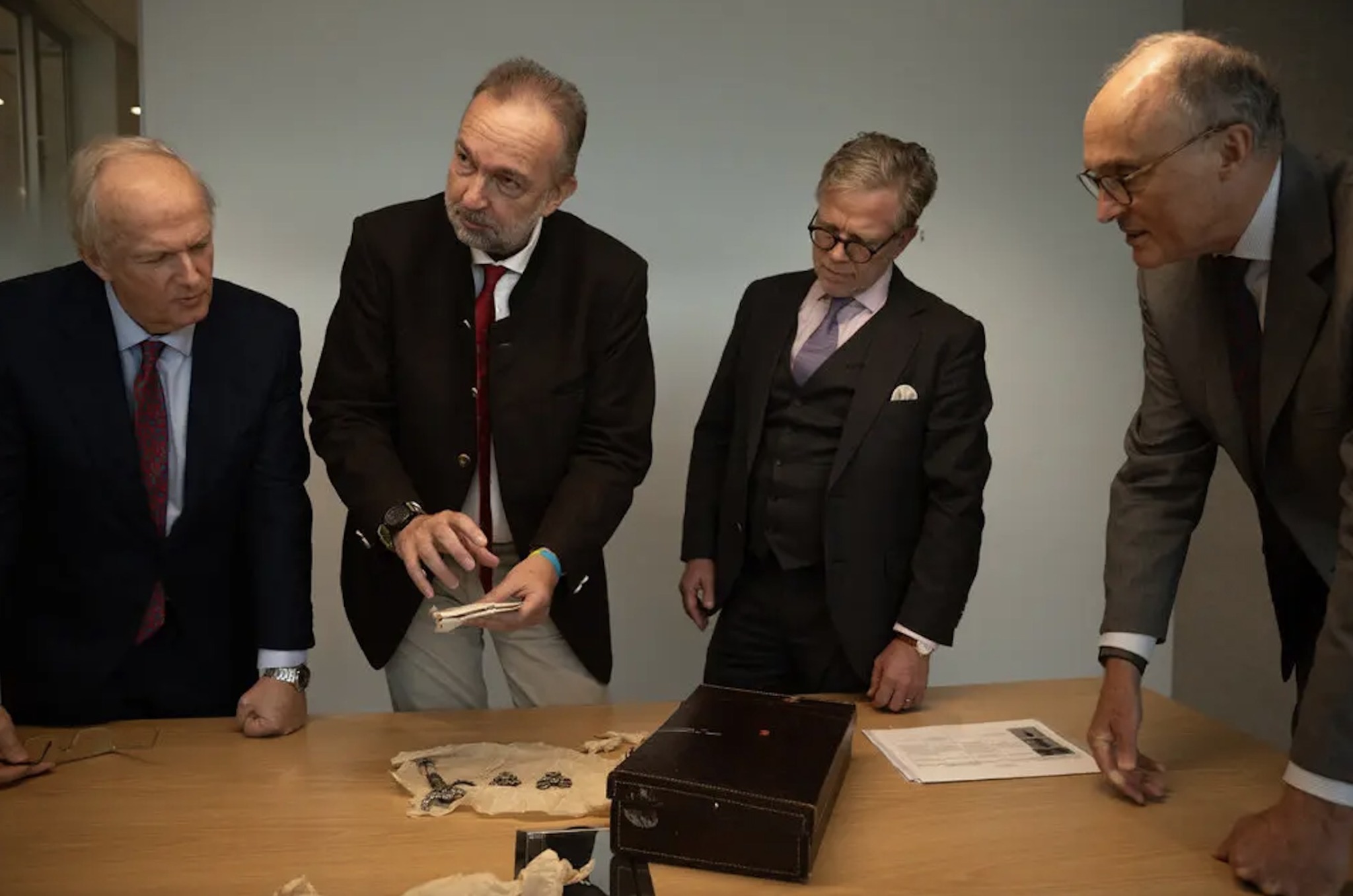
On a recent rainy afternoon, the family gathered at the bank in Canada where the jewels have long resided in a vault. Standing with his two cousins around a table, Mr. Habsburg-Lothringen slowly opened the battered suitcase put before them. Gingerly, he removed the yellowed paper in which each jewel was wrapped, eventually coming to the diamond itself, still glittering and arresting.
All three men now live in Europe, and this was the first time they had actually viewed the diamonds. The Florentine Diamond was wrapped separately from the others, but it could be set into a large, jeweled brooch that was among the items.
Christoph Köchert of A.E. Köchert jewelers, once Austria’s imperial court jewelers, examined the diamond and attested to its authenticity.
Karl Habsburg says the jewelry should be exhibited; however, not initially in Austria, but in Canada.

Before Köchert flew to Canada to see the Florentine and the other pieces of jewelry, they made a list at his shop, based on a 1918 treasury catalog.