Editor’s Note
**Editor’s Note:** India’s gold market is experiencing a buying frenzy after a sharp hike in import duties. Consumers are rushing to purchase physical gold, ETFs, and digital units, driven by price sensitivity and pre-wedding demand. With 90% of the country’s annual consumption reliant on imports, this surge underscores the immediate impact of fiscal policy on consumer behavior.
Overview: Import Duty Surge Triggers Gold Buying Frenzy
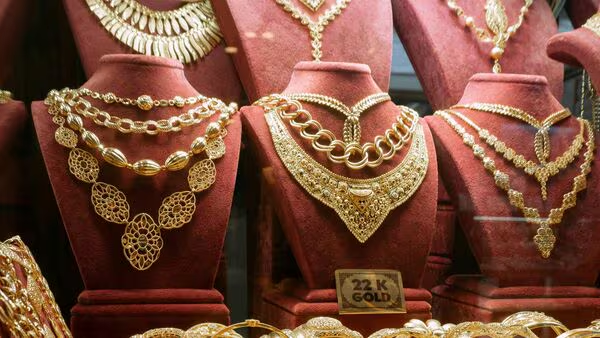
Indians thronged jewellery shops, rushed to purchase exchange traded funds (ETF) and bought digital gold units through e-commerce platforms, jewellers and refiners, following a near doubling of import duty and associated cess on gold purchases. The buying spree spanned both physical and electronic forms of gold, driven by price sensitivity, low availability, and pre-wedding purchases. India consumes 700-800 tonnes of gold yearly — 90% is imported, making gold the country’s second most imported item. This leads to a 9% drain on the exchequer, totaling $72 billion during the financial year 2025-26.
“Gold and jewellery are deeply connected with India’s economy, traditions, and savings culture,” says Avinash Gupta, Vice Chairman, All India Gems and Jewellery Domestic Council. While there is no major auspicious festival to purchase gold in May, the import duty raise became a demand event.
If you purchased gold, how did the import duty change affect your local purchase? The import duty is included by the jeweller in the gold prices, which also fluctuate based on other conditions. One does not separately pay the import duty over and above the price of gold paid for jewellery or gold coins in physical form.
The price rise in the yellow metal is also reinforcing gold as a good investment option and raising investment demand.
“The duty revision may lift retail jewellery prices in the near term, and customers — particularly first-time and investment-led buyers — will take a moment to recalibrate,” says M P Ahammad, Chairman, Malabar Group.
Shift Towards Lightweight Jewellery
However, affordability is a challenge given high prices. Hence, jewellers anticipate near-term moderation in discretionary purchases and a shift towards lighter jewellery.
“The durability and resale value of lower karatage pieces differ from 22k or 24k jewellery, so buyers should ensure proper hallmarking and certification to safeguard their investment,” says Rajesh Rokde, Chairman, All India Gem and Jewellery Domestic Council.
Even though the jewellery is lightweight, it should still be functional and not give way.
“Customers should check the structural integrity of the piece—clasps, prongs, and links must be sturdy. It’s also important to ensure that the design suits long-term wear and that the finishing is of high quality. A well-crafted lightweight piece should feel as reliable as a heavier one,” says Neil Sonawala, Managing Director of Zen Diamond India.
While exchange of old gold for new jewellery will become the dominant mode of purchase, don’t just head to any jeweller without the mandatory documents for selling old gold.
“For resale or buyback, jewellery typically needs to meet certain conditions—original invoices, certificates, and the piece being in good condition are key requirements. The purity of gold and authenticity of diamonds also play a major role. Most jewellers have clearly defined buyback terms, which may include deductions on making charges and current market rates,” says Sonawala.
Caution Advised on Diamond Jewellery
During festive and wedding purchase periods, jewellers have been offering hefty discounts on diamond jewellery compared to gold. Often there are zero making charge options on diamond jewellery as well.
“Diamond jewellery allows for more flexibility in pricing because the overall cost includes design, craftsmanship and not just the metal. Pure gold jewellery is closely tied to daily gold rates, leaving limited scope for discounts without affecting margins,” explains Sonawala.
However, the better “making charge” discount should not be considered a good bait to purchase diamond jewellery. One should be cautious as the exchange value of gold and diamonds are different. With mandatory hallmarking, though jewellers in 280+ districts are now comfortable exchanging and buying back pure gold jewellery, the same is not applicable for diamond jewellery.
“Jewellery containing a mix of natural and lab-grown diamonds may not always be eligible for standard buyback, or the valuation may differ significantly,” says Sonawala.
But when one sells old gold jewellery to convert into a new purchase, don’t take into account the entire appreciation in metal prices as your own. There is a significant tax implication, whether one sells old gold jewellery or ETF units to convert into physical gold jewellery.
“Selling inherited or long-held gold jewellery and coins can trigger a capital gains tax liability that many taxpayers overlook entirely. If the asset has been held for more than 24 months, the gain qualifies as a Long-Term Capital Gain and is taxed at 12.5% without the benefit of indexation — a change brought in by the Finance Act, 2024, which significantly altered the calculus for gold held prior to July 23, 2024,” says Paras Savla, Partner at KPB and Associates.
“Those owning only one residential property can reinvest the entire net sale consideration from the gold in purchase of a residential house property within two years, or construct a house within three years of the sale of gold jewellery — then the entire long-term capital gain stands exempt,” says Savla. However, there is an overall cap.