Editor’s Note
**Editor’s Note:** Damiani marks its return to Dubai with a new boutique in the Dubai Mall, inaugurated by Oscar-winning actress Jessica Chastain. President Guido Grassi explains the strategic shift toward jewelry investment over handbags, citing changing market dynamics. The Italian luxury house also plans upcoming openings in Doha and Kuwait City.
Damiani Reopens in Dubai (and Soon in Doha and Kuwait City)
President Guido Grassi: “Here’s why it’s more worthwhile to invest in jewelry than in a handbag; the market has changed.”
Jessica Chastain
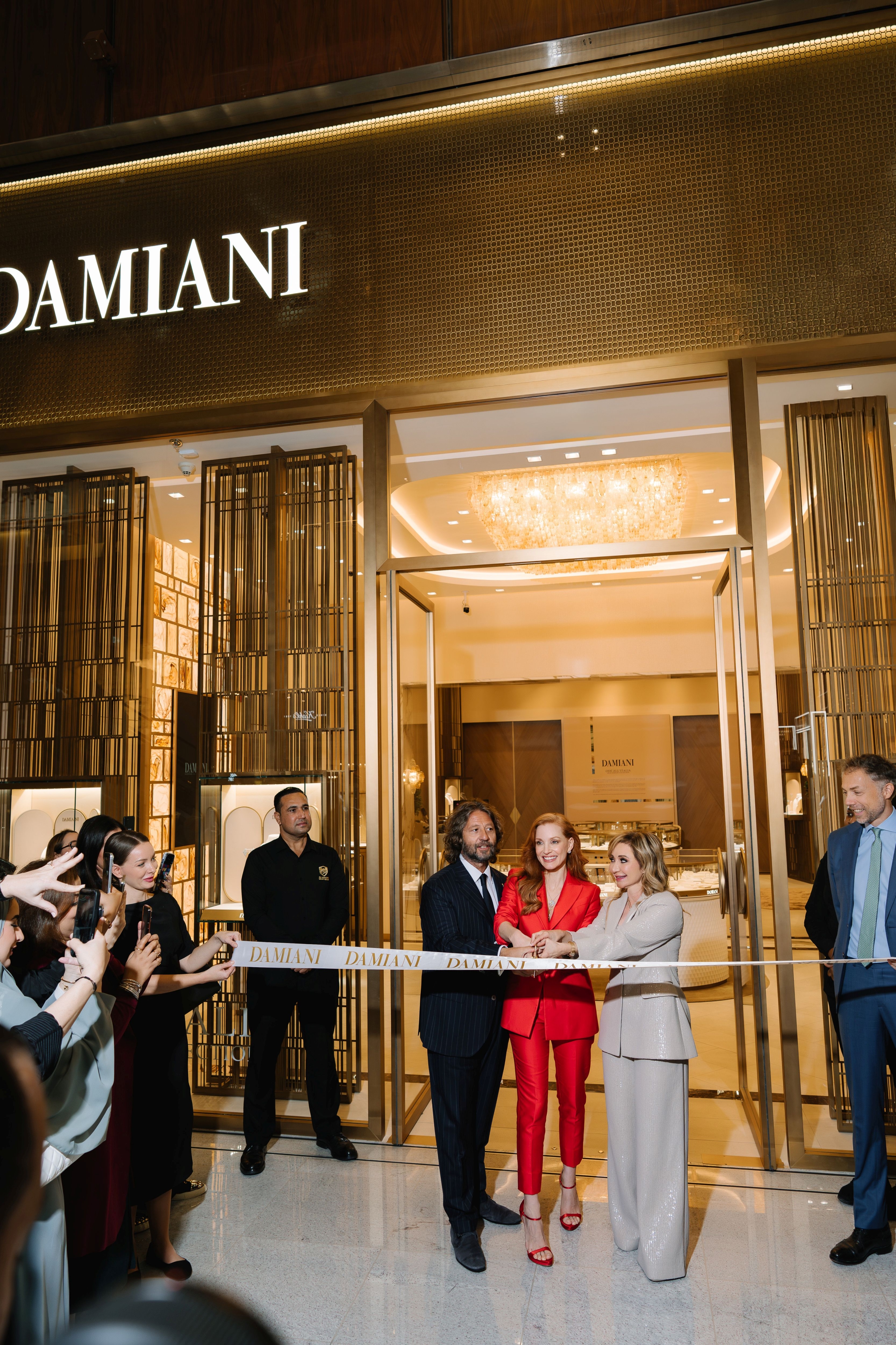
“Let’s do it together”: Jessica Chastain, in a red suit, cut the ribbon, taking the hands of her Italian friends. The Oscar-winning actress arrived with her husband for the inauguration of the Damiani boutique in the gigantic Dubai Mall, metropolis of the United Arab Emirates, a small state that everyone looks to, as recounted by Guido Grassi Damiani – third generation of the proudly Italian and family-run jewelry company – in his role as president, here with his sister Silvia (vice president) dispensing hugs in a cream suit.
The renovated boutique is a tribute to Italianness: in the warm and luxurious atmosphere, gold dominates with touches of beige and brown, the brand’s nuances. At the center is the Venini chandelier – Damiani’s latest acquisition – with Murano blown glass elements like the amber checkerboard wall. A splendid frame for the maison’s high jewelry “Ode to Italy,” in three chapters: “Luci del mare” evoking the Mediterranean, “Paesaggi dell’anima” looking inland, and “Dimore del tempo,” dedicated to cities.
Why does Dubai seem to have become central for Italian entrepreneurs?
Many investments, even though the jewelry market, like others in luxury, seems to have slowed its pace?
“We look ahead over the years, so we have a long-term strategy and it seems right to us, knowing that this market will become increasingly important both for history and for evolution… All the Gulf countries want to excel and have the possibility to do so because they still have plenty of oil and natural gas.”
Aren’t you afraid to open so many stores at this time of conflicts?
“Perhaps, considering recent events, it would have been more prudent to wait some time, but when the machines start, it’s difficult to stop them; these are important locations, and maybe in a year we risk not finding them anymore. We will suffer, but we hope that in the medium to long term we will be satisfied.”
Have you also invested in the Valenza workshops? Is Made in Italy important for jewelry too?
“Yes. And then we are Made in Valenza, we were born in 1924 in the jewelry district and grew up there, with my grandfather Enrico and my father Damiano. So we continue to believe in it. French groups have also arrived, acquiring local suppliers to produce collections. They don’t have a production culture, but they are very good at branding and retailing, and now they want to vertically integrate as much as possible, both to increase margins and for storytelling and status symbol. They have a lot of money: for them it’s easy to buy, and good for those who sell because they are paying prices out of the market.”
But do the French taking over Italian workshops worry you?
“No, because in our small way, we have always created jewelry one by one. And we have the advantage that we are also able to train our masters; we have our own school. In Dubai, we were accompanied by Sante, a craftsman who has worked with us for 60 years. He is here in the store setting diamonds in front of clients together with his granddaughter, who has worked with us for a few years.”
You were among the first to believe in stars: Sharon Stone, Tilda Swinton, Jennifer Aniston, Gwyneth Paltrow, Isabella Rossellini, Sophia Loren, and now Jessica Chastain. What contribution does an ambassador bring you?
“Our world is a world of dreams, like cinema, so testimonials help people desire and identify with a look, a person. When we started, jewelry communication was just the single object, like a catalog, while now we want to show how our jewelry is worn, which is designed to be lived with daily.”
What jewelry did Jessica Chastain choose?
“She is not only an actress who won an Oscar and a Grammy, but also a beautiful person. She came to us for a Venini chandelier, then she liked our jewelry, the craftsmanship. Here in Dubai, she tried the ring dedicated to Budelli Beach in Costa Smeralda. But even with ‘celebs,’ relationships are born from mutual esteem, from meeting the family; it’s not just a matter of fees because we are smaller than others.”
Gold is at its all-time high. Is that why all brands have jumped into high jewelry?
“Actually, we started before the increase. People today prefer to invest in a piece of jewelry rather than a designer handbag, which, among other things, has a much higher markup… Then, unfortunately, it’s true that with the cost of gold doubling in a year, it will unfortunately exclude a segment of consumers…”