Editor’s Note
This article reports a warning from the EcoWaste Coalition about charm bracelets containing high levels of cadmium, a carcinogenic metal. The information is sourced from the group’s public alert and is presented for public awareness.
05.02.24
– Metro Manila, Philippines –
EcoWaste Coalition
4 February 2024, Quezon City.
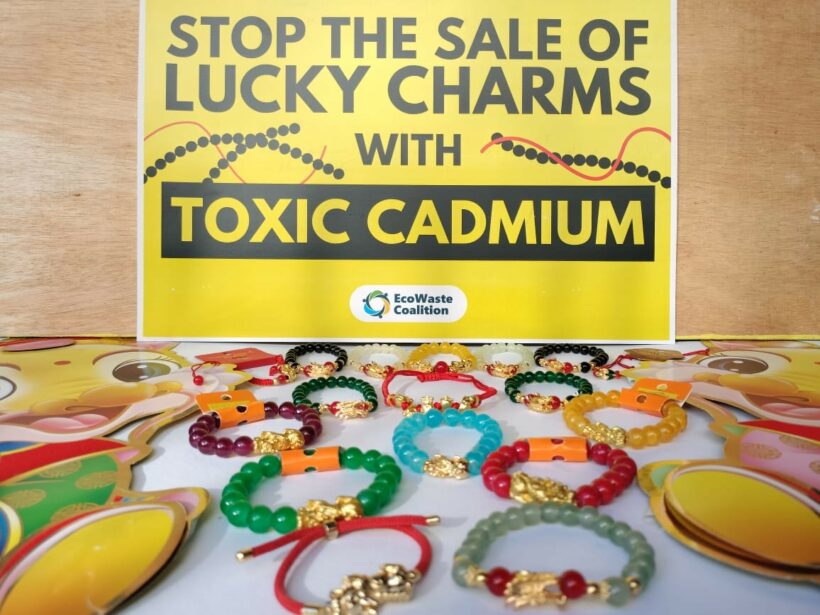
The toxics watchdog group EcoWaste Coalition is warning luck seekers against buying charm bracelets adorned with metal components containing extremely high concentrations of cadmium, a chemical linked to various types of cancer.
The group, which has been campaigning against toxic metals like cadmium, lead, mercury, and other chemicals of concern, issued the timely warning as people began flocking to Chinatown and adjacent areas to purchase charms believed to attract good health and fortune ahead of the Chinese New Year of the Wood Dragon on February 9.
As part of its periodic market monitoring, the group visited Binondo and Quiapo in Manila to acquire charm bracelets sold for P25 to P75 each. The items were subsequently screened for toxic metals using a handheld X-ray fluorescence (XRF) analyzer.
Out of the 23 charm bracelets purchased and analyzed, 17 were found to contain cadmium exceeding 100,000 parts per million (ppm). Cadmium was detected on the dragon or Pi Yao (an auspicious mythical creature) metal components of the beaded or red string bracelets.
In Europe, cadmium in jewelry is restricted to 0.01% (or 100 ppm) by weight of the metal in metal beads and other metal components for jewelry making, metal parts of jewelry, imitation jewelry articles, and hair accessories, including bracelets, necklaces, rings, piercing jewelry, wrist-watches and wrist-wear, brooches, and cufflinks, as per EU Regulation 494/2011.
The EcoWaste Coalition emphasized that the charm bracelets discovered with high cadmium content would be illegal to sell in Europe. As publicized on the Safety Gate, the EU rapid alert system for dangerous non-food products, many jewelry articles have been banned or removed from the market due to cadmium, which is “harmful to human health because it accumulates in the body, can damage the kidneys and bones, and may cause cancer,” according to the EU.
Cadmium, a heavy metal with the symbol Cd and atomic number 48, is classified as “carcinogenic to humans” by the International Agency for Research on Cancer. According to the US National Cancer Institute, cadmium is “primarily associated with human lung, prostate, and kidney cancers, and recently pancreatic cancer,” as well as with “cancers of the breast and urinary bladder.”
Cadmium exposure is further associated with reproductive and developmental disorders, including premature birth, reduced birth weight, stillbirth, spontaneous abortion, and birth defects, as well as behavioral and learning disabilities.
The WHO has listed cadmium among the 10 chemicals or groups of chemicals of major public health concern. To protect human health, WHO has recommended, among other interventions, “the elimination of the use of cadmium in products such as toys, jewelry and plastics.”
Cadmium is likewise included in the Philippine Priority Chemicals List. However, cadmium in products such as jewelry is not covered by the Chemical Control Order (CCO) issued in 2021 by the Department of Environment and Natural Resources – Environmental Management Bureau (DENR-EMB). Nonetheless, “the use of products not containing cadmium is encouraged to prevent and minimize the release of cadmium to the environment,” the CCO stated.
To prevent and reduce human exposure to cadmium, the EcoWaste Coalition backed the use of non-toxic substitutes for cadmium in jewelry making. It also advised consumers to insist on their right to information about chemicals in products, and for manufacturers, importers, distributors, and retailers to recognize such right by labeling and disclosing the identity of chemicals in their products.
References:
https://www.who.int/teams/environment-climate-change-and-health/chemical-safety-and-health/health-impacts/chemicals/cadmium
https://progressreport.cancer.gov/prevention/cadmium
http://eur-lex.europa.eu/LexUriServ/LexUriServ.do?uri=OJ:L:2011:134:0002:0005:en:PDF
https://chemical.emb.gov.ph/wp-content/uploads/2021/05/DAO-2021-08-CCO-Cadmium.pdf
https://ec.europa.eu/safety-gate-alerts/screen/search?resetSearch=true