Editor’s Note
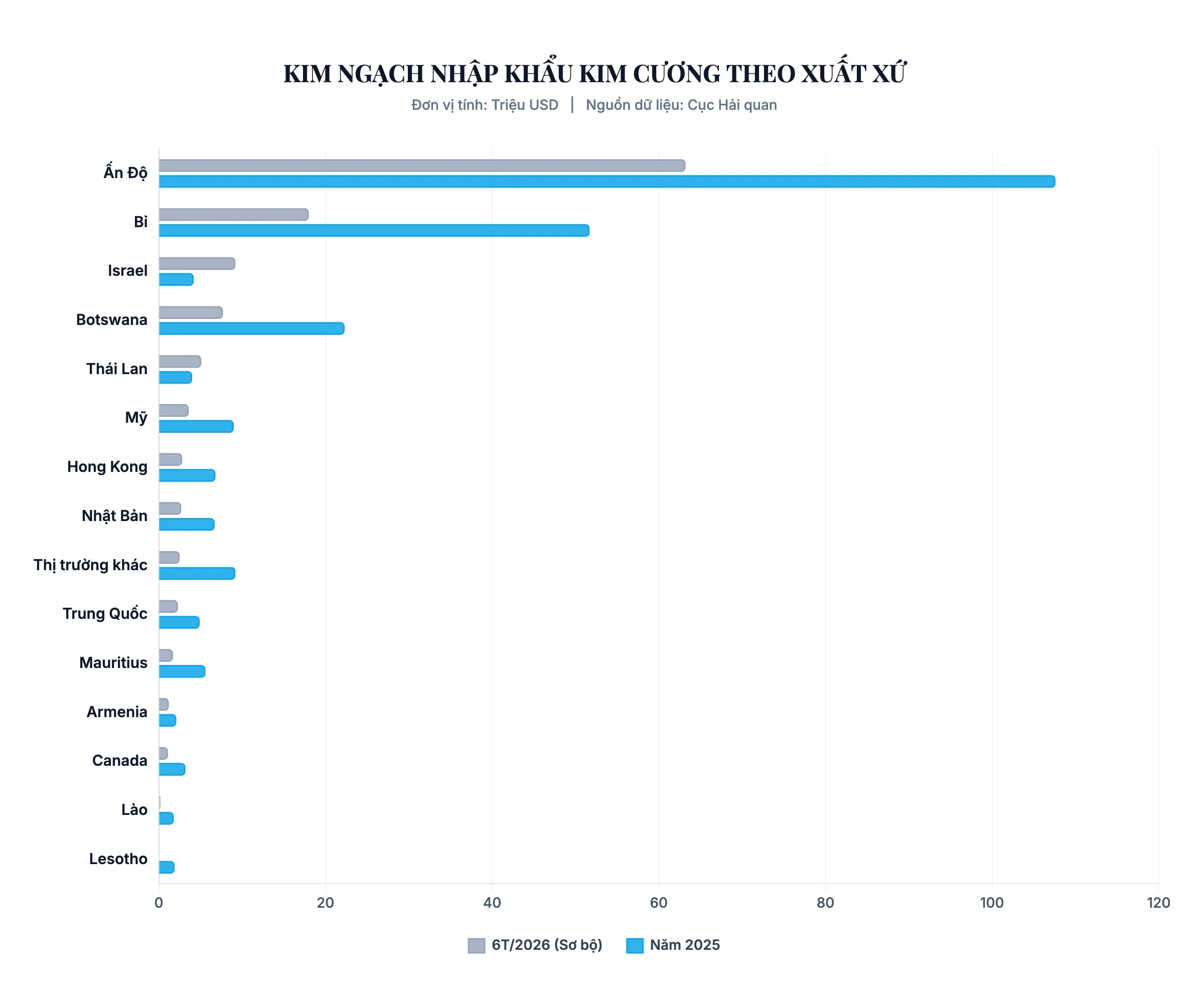
Vietnam imported diamonds worth nearly VND 3.2 trillion in the first half of this year, with minimal shares from Thailand and Hong Kong. India emerged as the largest supplier.
In the first half of this year, Vietnam imported diamonds worth approximately VND 3.2 trillion. Among them, the shares from Thailand and Hong Kong (China) were minimal.
After the former head of P-Lab, a subsidiary of Phu Nhuan Jewelry Joint Stock Company (PNJ), was charged with smuggling over 28,000 diamonds, PNJ Board Chairwoman Cao Thi Ngoc Dung stated that all diamonds used by the company were imported through official channels and that diamonds involved in smuggling had never been sold through its system.
According to data from the Customs (under the Ministry of Finance), Vietnam’s total diamond import value is expected to reach USD 241.2 million (about VND 6.3 trillion) in 2025. Diamond imports in the first half of this year are estimated at approximately USD 121.5 million (about VND 3.2 trillion).
Among these, India is the largest supplier of diamonds to Vietnam, with sales reaching USD 63.2 million in the first half of this year, accounting for about 52% of Vietnam’s total import value. Belgium followed closely with about USD 18 million, and Botswana with USD 7.7 million. Notably, Israel emerged as Vietnam’s third-largest diamond supplier with sales exceeding USD 9.1 million, more than double its total sales in 2025.
In particular, Thailand and Hong Kong (China) accounted for a minimal share of Thailand’s total diamond imports, reaching about USD 5.1 million and USD 2.8 million respectively in the first half of this year, representing about 4.2% and 2.3% of total imports.
Accordingly, rough diamonds are only allowed to be imported from Kimberley Process (KP) member countries. All imported shipments must have a valid KP certificate issued by the competent authority of the exporting country and comply with all necessary customs procedures and documentation.
Customs authorities are responsible for document review, on-site inspection of goods, issuance of certificates for imported rough diamonds, and performing management tasks in accordance with the law.
For diamond shipments, customs procedures are carried out according to current regulations based on the enterprise’s declaration, KP certificate, and other relevant documents.