Editor’s Note
**Editor’s Note:** This article examines gold price movements on July 13, 2026, highlighting the impact of the Fed’s interest rate stance. Prices are expected to remain range-bound through the summer, with a significant rally unlikely until rate hike expectations ease.
Gold prices on July 13, 2026, reflect current market pressures regarding the Fed’s interest rate stance. Gold prices are likely to trade within a certain range during the summer, and a sharp price surge is unlikely until market expectations of further Fed rate hikes diminish.
Domestic gold prices fell by 1.5 million VND per tael. At the close of last week, Saigon Jewelry Company (SJC) announced SJC gold prices at 146.9 – 149.9 million VND per tael (buy – sell). The spread between buying and selling prices was 3 million VND per tael. Compared to the closing price on July 5 (one week earlier), SJC gold bar prices at Saigon Jewelry Company fell by 1.5 million VND per tael for both buying and selling prices.
If a buyer purchased SJC gold bars on July 5 and sold them on July 13, they would incur a loss of 4.5 million VND per tael at Saigon Jewelry Company (SJC).
9999 purity gold rings also maintained a downward trend. Saigon Jewelry Company (SJC) announced gold ring prices at 145 – 149 million VND per tael (buy – sell), with buying prices down 3.4 million VND per tael and selling prices down 2.4 million VND per tael. The spread between buying and selling prices is 4 million VND per tael.
Global gold prices closed the weekend at $4,121.40 per ounce.
Gold prices continue to face downward pressure due to US interest rate expectations. The Federal Reserve’s dovish stance, high US Treasury yields, and a strong dollar could reduce the appeal of non-yielding assets like gold.
Inflation concerns from rising energy prices and heightened tensions in the Middle East also reduce the likelihood of the Fed implementing monetary easing measures soon.

The only bright spot is continued strong support from central bank gold purchases. Poland’s central bank reported adding 82 tons of gold since the beginning of the year, while China has also maintained increases in its foreign exchange reserves for several consecutive months.
According to a World Gold Council survey, 45% of central banks plan to increase their gold holdings within the next 12 months, a record high. About 90% of respondents believe total global official gold reserves will continue to increase.
Actual buying activity shows that central banks still view gold as a strategic asset for diversifying reserve assets and hedging against geopolitical and financial risks. Therefore, while gold prices are unlikely to establish a clear uptrend in the near future, the $4,000 per ounce level may continue to serve as an important support line.
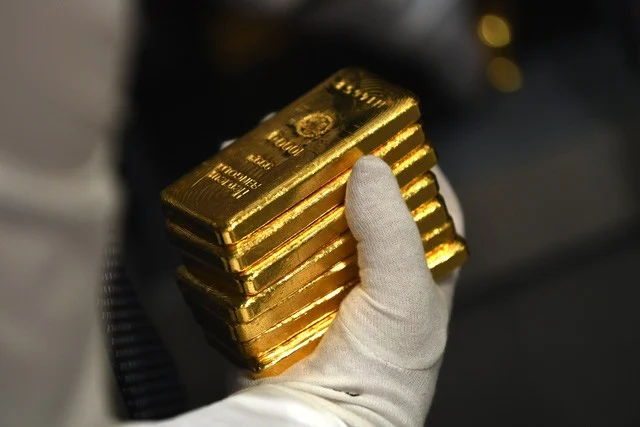
Gold prices on July 13, 2026, are fluctuating within a consolidation zone without establishing an uptrend, with significant support from central banks. (Source: Bloomberg)
– Saigon Jewelry Company (SJC): SJC gold bars at 146.9 – 149.9 million VND/tael, SJC gold rings at 146.4 – 149.4 million VND/tael.
– DOJI Group: SJC gold bars at 146.9 – 149.9 million VND/tael, 9999 gold rings (Hung Thinh Vuong brand) at 145 – 149 million VND/tael.
– PNJ Group: SJC gold bars at 146.9 – 149.9 million VND/tael, PNJ 999.9 pure gold rings (Phuc Loc Tai) at 145.7 – 149.2 million VND/tael.
– Bao Tin Minh Chau: SJC gold bars at 145 – 149.9 million VND/tael, plain gold rings at 145 – 149 million VND/tael.

According to expert forecasts, with US Treasury yields still at high levels and the Federal Reserve expected to maintain a hawkish stance on interest rates, the outlook for a sharp rise in the precious metals market is not yet clear.
Meanwhile, Robert Minter, Director of Investment Strategy at abrdn Standard Investments, argues that the market is overly focused on hawkish comments from Fed Chair Powell and is not properly evaluating the fundamental factors supporting gold prices.
According to a Metals Focus report, gold prices are likely to fluctuate within a certain range during the summer, and a sharp price surge is unlikely until the market begins to expect further rate hikes from the Fed, probably not until the end of the third quarter.
Physical gold demand is also entering a seasonal lull. July and August are typically the weakest months for jewelry gold consumption throughout the year. In major markets like China and India, high prices continue to hinder a strong recovery in demand.
The report states that the long-term uptrend for gold prices remains unchanged. The institution expects gold prices to gradually recover from the end of the third quarter as the market adjusts its outlook on Fed monetary policy.
Source: https://baoquocte.vn/gia-vang-hom-nay-13-7-2026-dao-dong-trong-vung-tich-luy-chua-xac-lap-xu-huong-tang-cac-ngan-hang-trung-uong-tao-luc-do-dang-ke-417565.html