Editor’s Note
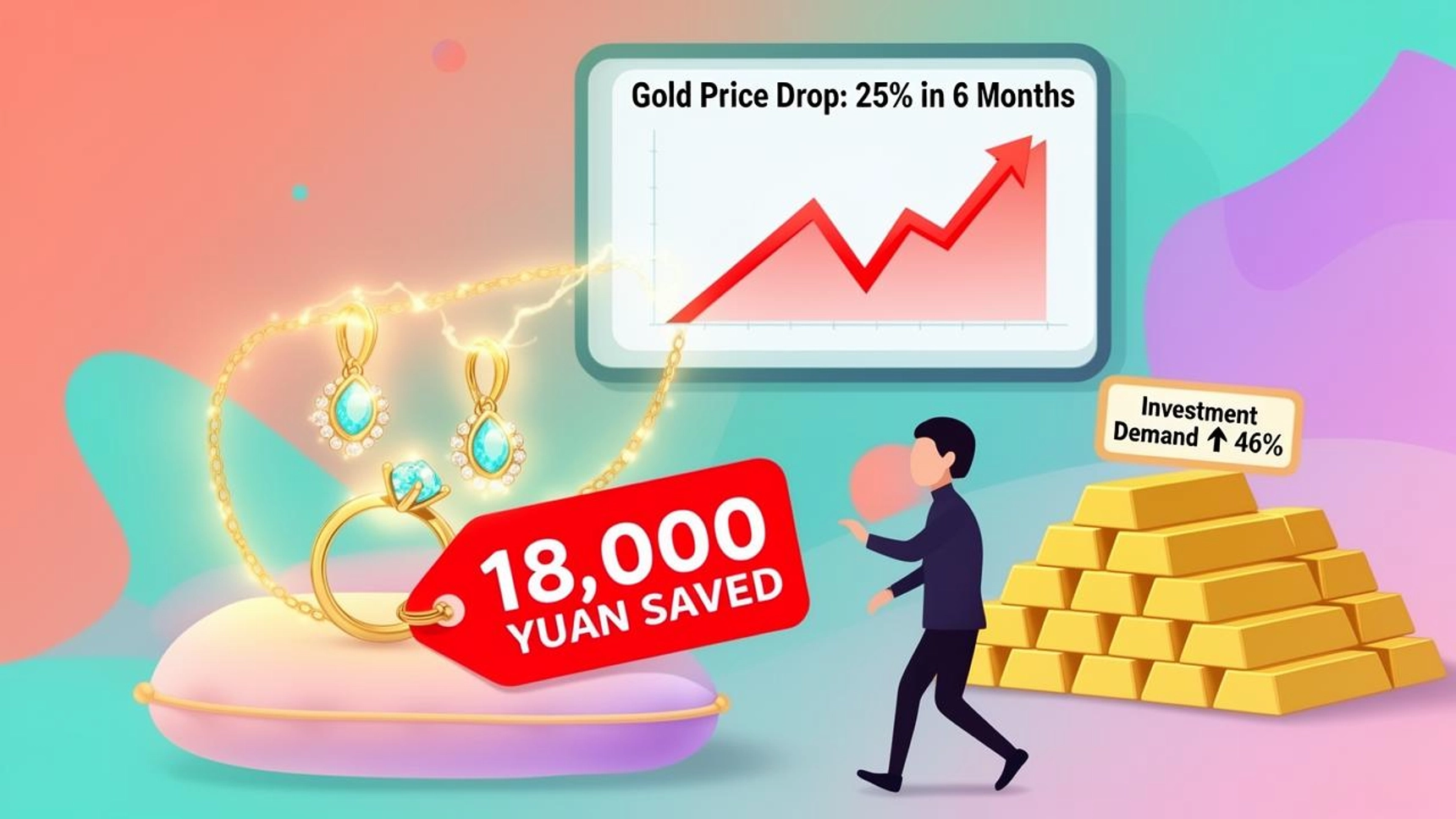
**Editor’s Note:** Despite a sharp 25% drop in gold prices, jewelry consumption in China remains sluggish as buyers adopt a “wait-and-see” approach. While wedding gold purchases have become significantly cheaper, first-quarter jewelry sales fell 37% year-on-year, contrasting with a 46% surge in investment bar demand. The market’s reluctance to buy on dips highlights shifting consumer priorities amid economic uncertainty.
International gold prices plummeted more than 25% from a high of $5,594 per ounce in the first half of 2026, dragging China’s domestic gold price down to 895 yuan per gram. Purchasing 50 grams of traditional wedding ‘Three Golds’ now saves consumers 18,000 yuan (approximately $2,656) compared to the start of the year. However, the price drop has failed to revive gold jewelry consumption, which is instead mired in a ‘buy on rise, not dip’ wait-and-see mentality. Merchants in Shenzhen’s Shuibei district report sales volumes down roughly 15% year-on-year. Data from the China Gold Association shows first-quarter jewelry consumption plummeted 37% year-on-year, while demand for investment gold bars surged 46%, though this investment demand also slowed in the second quarter. Facing shrinking sales volumes, brands like Chow Tai Seng and CHJ Jewelry are accelerating a pivot toward high-end products with gross margins reaching 30%, attempting to hedge against gold price volatility through design, craftsmanship, and cultural premiums.
After rallying for over a year, gold prices underwent a stunning correction in the first half of 2026. From its historical high at the start of the year, the international gold price oscillated downward, plunging more than 25% cumulatively in just six months. China’s domestic gold price followed suit with a significant pullback. For consumers planning to purchase traditional wedding ‘Three Golds,’ this translates to savings of nearly 20,000 yuan. However, gold jewelry retailers are not celebrating, as a ‘buy on rise, not dip’ wait-and-see mentality is severely battering their business.
After the international gold price hit its intra-year historical high of $5,594.77 per ounce in January 2026, the trend reversed. As of the close on July 9, the international gold price settled at $4,123.21 per ounce, marking a cumulative drop of over $1,400 per ounce from the January peak to July 10—a decline exceeding 25%. The single-month drop in June alone reached 10.45%, the largest monthly decline since October 2008.
Despite the cheaper gold, consumer buying enthusiasm has not been ignited. Feedback from the front lines indicates that the violent fluctuations in gold prices this year have, to some extent, suppressed gold jewelry consumption. A gold seller in Shenzhen’s Shuibei district told reporters that their product sales volume this year has likely dropped by about 15% year-on-year.
During recent visits to multiple branded gold stores in Shenzhen and Guangzhou, reporters found that despite high foot traffic in shopping malls, many stores were virtually empty of customers, starkly contrasting with the bustling atmosphere outside. Zhu Zhigang, Vice President and Chief Gold Analyst of the Guangdong Gold Association, stated that the additional 7% value-added tax on jewelry has had a certain impact on end-consumer sales. In the past, consumers bought jewelry with investment considerations in mind; now, demand has shifted more toward pure necessity, with minimalist styles or products priced per piece selling relatively better. Against this backdrop, overall market sales volume will decrease. While the decline in sales revenue is not significant as gold prices rise, the reduction in volume is more pronounced.
In stark contrast to the sluggish gold jewelry consumption, demand for investment gold experienced explosive growth in the first half of the year, though this trend also noticeably slowed in the second quarter.
Statistical data released by the China Gold Association shows that in the first quarter of 2026, China’s gold consumption was 303.29 tons, a year-on-year increase of 4.41%. However, a breakdown reveals extreme structural divergence: gold jewelry consumption in the first quarter was 84.62 tons, a year-on-year slump of 37.10%; while gold bars and coins, representing investment attributes, saw consumption reach 202.06 tons, a year-on-year surge of 46.40%.
It is noteworthy that over the past six months, the listed per-gram price of gold jewelry from mainstream Chinese brands has pulled back sharply by over 450 yuan but remains firmly above the 1,000-yuan mark. Facing the pressure of declining sales volumes, gold jewelry enterprises are accelerating their transformation toward high-value-added products, attempting to offset the impact of falling quantities by boosting gross profit margins.
Zhu Zhigang analyzed that under current circumstances, gold jewelry enterprises need to find new paths, such as moving toward high-end, luxury positioning to survive on sufficiently high profits amid declining sales volumes. Another direction is personalized customization, such as ancient-method gold and 5D hard gold.
A relevant executive from a listed gold jewelry retailer told reporters,