Editor’s Note
**Editor’s Note:** In this feature, we explore how five leading high jewelry maisons interpret the same subject—a single flower—through vastly different creative lenses. From structural precision to fleeting beauty and imaginative fantasy, each perspective reveals a unique dialogue with nature.
Even with the same single flower, high jewelry maisons see entirely different things. Some see the order within, some capture the moment of blooming, and others dream of fantasies beyond reality. Five iconic maisons of high jewelry present five perspectives on nature.
[Jewelry]
A ‘Flowerlace’ ring by Van Cleef & Arpels, featuring a voluminous yellow gold flower silhouette set with diamonds.
Van Cleef & Arpels
Jacques Arpels, the nephew of Van Cleef & Arpels’ founder who led the maison’s growth, once said, “To have luck, you must believe in luck.” The four-leaf clover, long considered a symbol of luck, became the maison’s emblem through the ‘Alhambra’ collection launched in 1968. This reflects the maison’s view of nature as a messenger of luck and a poetic companion. In Van Cleef & Arpels’ perspective, flowers do not remain in fixed forms. The ‘Pivoine Clip’ created in 1937 uses the ‘Mystery Setting’ technique, hiding metal supports to densely set gems, perfectly capturing the organic volume of a freshly bloomed petal. In reality, flowers in nature are not perfectly symmetrical; a petal may be slightly tilted or sway in the wind. Van Cleef & Arpels chooses intentional asymmetry to capture that very moment, as asymmetry is closest to the essence of a living flower. Transforming a fleeting moment into dazzling eternity—that is Van Cleef & Arpels’ attitude toward nature.
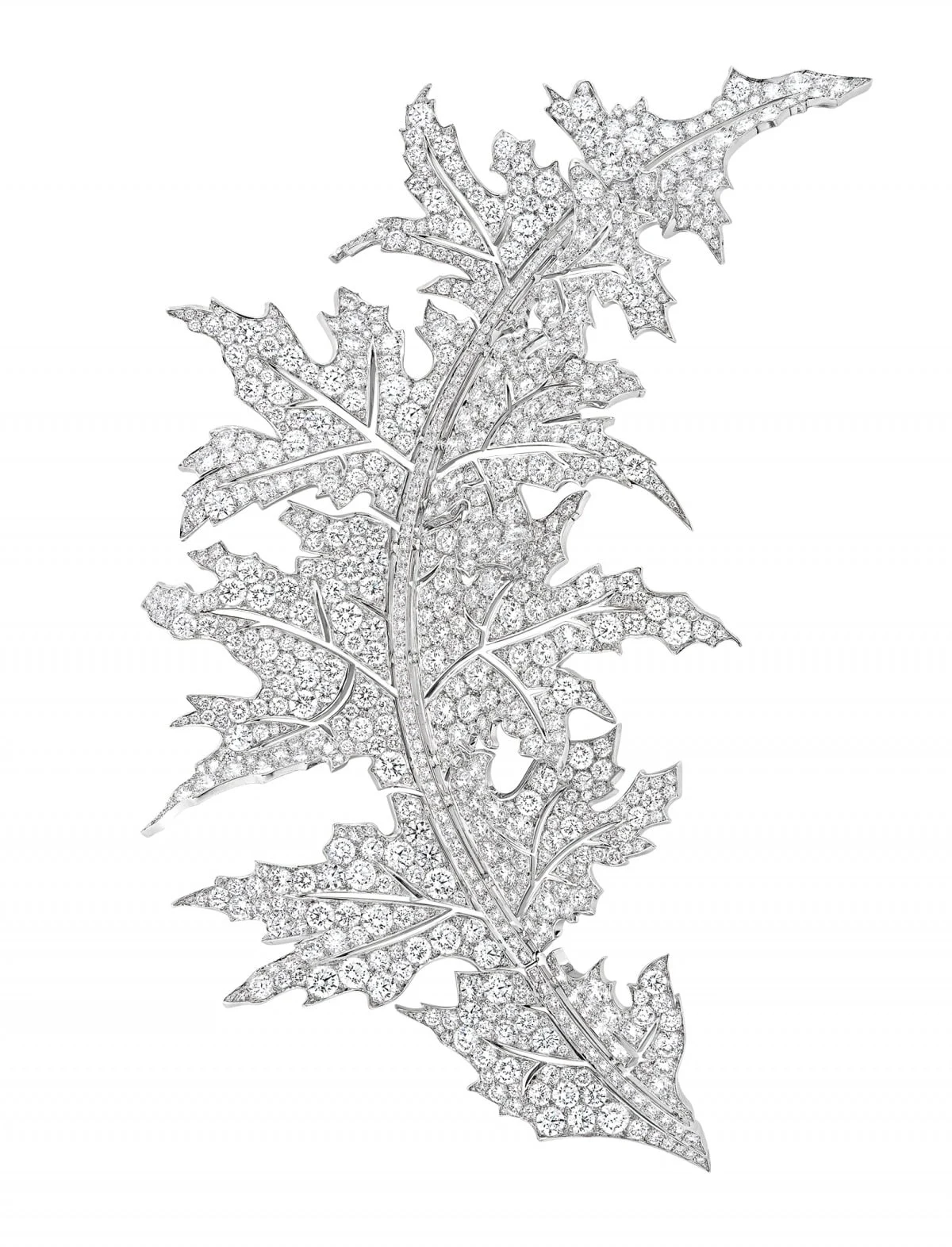
A ‘Chardon’ brooch by Boucheron, reinterpreting a thistle brooch from the 1878 archives.
Boucheron
Thistles are far from the typical image of beautiful flowers. They are thorny, grow wildly, and suit fields more than gardens. Yet Boucheron brought this thistle into the world of jewelry. Motifs like the historical thistle brooch from 1878, ivy, and ferns showcase the maison’s unique perspective on nature. For them, nature is not limited to well-tended gardens or the perfect moment of a flower in full bloom. They embrace the entire process of change and cycles—like unopened buds or already wilted flowers—as beauty. The aim is to capture in jewelry the unpredictable, cyclical vitality of nature itself. The ‘Untamed Nature’ edition of the high jewelry collection ‘Histoire de Style’ is the pinnacle of this legacy. In particular, the ‘Chardon’ necklace and brooch (French for thistle) hyper-realistically depict the thistle’s sharp contours and tenacious vitality.
A ‘Ramage’ ring by Buccellati, featuring intricate craftsmanship.

Buccellati
Mario Buccellati, who founded the maison in 1919, discovered beauty resembling nature’s structure in its delicate organization. What Buccellati focused on was not the fleeting moment of a plant blooming or withering, but the order within. Through the direction of leaf veins and the intersection of branches, the maison carves intricate, meticulous structures in metal, aiming to capture nature’s power and beauty. The ‘Ramage’ collection epitomizes Buccellati’s philosophy. It uses openwork techniques to depict the intertwined and spreading movements of leaves and flowers, making the hard material of metal appear like living plant tissue. A 1mm gold plate is hand-pierced to create silhouettes of branches and leaves, then diamonds are set on top. Transferring nature’s structure onto metal and infusing it with life—this timeless order realized in metal is Buccellati’s attitude toward plants.
A necklace from Chaumet’s ‘Jewels by Nature’ collection, exquisitely capturing the volume and vitality of dahlia petals.
Chaumet
Chaumet defines itself as a ‘naturalist jeweller’. Founder Marie-Étienne Nitot, who opened his workshop in 1780, interacted with Empress Joséphine, a lover of plants, and became deeply immersed in nature. Chaumet’s naturalism aligns with the perspective of botanical illustration. Like botanical illustrations that accurately observe and record the aesthetic beauty, form, and structure of flowers, Chaumet breathes life into gems through precise depictions of organic curves, tiny dewdrops, and even the grain of leaves. The ‘Water Lily’ piece, depicting the layered movement of lotus petals, and ‘Clover & Fern’, showcasing the essence of Chaumet’s naturalist worldview, are representative. Naturally, the ‘nature’ heritage frequently appears in high jewelry collections. The ‘Jewels by Nature’ collection, launched last year, exemplifies realistic expression, faithfully capturing every aspect of nature—from quiet stems and delicate leaf veins to light-absorbing petals.
A ring from Vever’s ‘Ginkgo’ collection, combining ginkgo leaves to form an imaginary flower.
Vever
Art Nouveau, which emerged in late 19th-century Europe, brought nature’s curves, plant rhythms, and asymmetrical forms into art and craft. Images of flowers, leaves, insects, and women expanded into a world where reality and imagination meet, within organic curves and mythological atmospheres. Founded in 1821 and taken over by brothers Paul and Henri Vever in 1881, Vever became a master of Art Nouveau jewelry, focusing on expressing the emotions and fantasies evoked by nature. The ‘Ginkgo’ collection, inspired by ginkgo leaves symbolizing growth and longevity, is a prime example. The Ginkgo collection does not simply replicate the ginkgo leaf form; it combines the leaf’s symbolism and energy to create an imaginary flower that does not exist in reality. Asymmetrically spread petals and dew-like scattered diamonds originate from nature but express a world beyond reality. Each leaf vein is meticulously carved on matte gold, preserving the ginkgo leaf’s vitality in delicate texture. Within Vever, plants bloom anew through the artist’s imagination.
Han Kyung Prestige | Text by Kim Hye-kyung

© Han Kyung Magazine & Book, unauthorized reproduction and redistribution prohibited.