Editor’s Note
**Editor’s Note:** Lamine Yamal marked his 19th birthday with a custom rose gold diamond piece—a self-gift he proudly paid for himself.
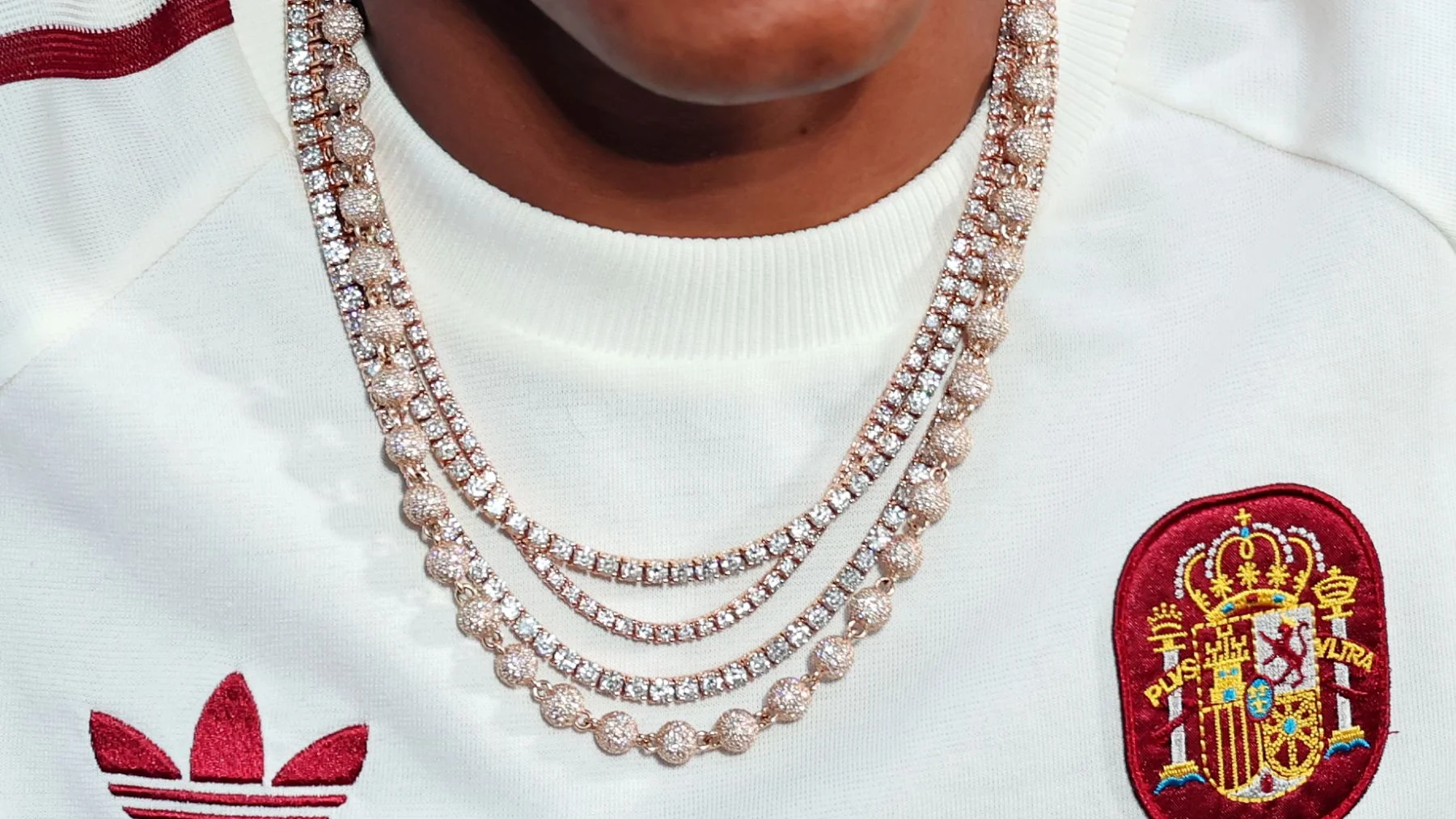
The winger appeared with a custom-made high jewelry piece that does not belong to any commercial brand and is crafted in rose gold with diamonds.
Lamine himself confessed with a laugh that it was a self-gift for his 19th birthday:
Lamine Yamal was once again in the spotlight even before the ball started rolling. The Spanish national team winger appeared before the media on the eve of the World Cup semi-final against France. Besides making headlines about the most important match of his career, he drew attention for the spectacular jewel he wore over his Spain shirt.
The footballer himself revealed with a laugh that it was not a gift:
Far from being a simple necklace, the piece is a completely personalized high jewelry creation. At first glance, it might appear to be a set of several independent chains, but its construction points to a single cascade-style choker with four integrated levels. The top three rows reproduce the classic tennis design, made of individually set diamonds arranged from smallest to largest, while the fourth incorporates a succession of spheres completely covered in brilliant pave, a finish very characteristic of urban jewelry inspired by the hip-hop world and increasingly common among major sports stars.
The piece is presumably crafted on a base of solid 14 or 18-karat rose gold, responsible for the warm tone of the metal. The stones appear to be brilliant-cut diamonds, although only the manufacturer could confirm whether they are natural or lab-grown. In any case, the level of execution and artisanal finish reflect the work of a jeweler specialized in exclusive pieces.
Precisely because of this custom fabrication, the necklace does not belong to any conventional commercial brand. This type of jewelry is usually commissioned directly from workshops specializing in urban high jewelry, where each piece is designed exclusively for the client. Although the creator of this piece has not been revealed, the design follows the line of reference jewelers who regularly work with footballers and international artists.
Its price has also not been officially confirmed, but pieces of this nature and with similar construction typically fall in a range of 25,000 to 30,000 euros, provided it is a custom-made set of gold and diamonds. This jewel should not be confused with the striking XXL necklace that Lamine received with the number 304, a creation attributed to Tajia Diamonds and valued by various media at around 400,000 euros. The one he wore before facing France is much more discreet, designed for daily use, though it remains an exclusive piece reserved for very few.