Editor’s Note
This editor’s note highlights the strategic shift from traditional gem polishing to high-tech applications in semiconductors and quantum computing, emphasizing the urgency for early investment in wafer-scale diamond production.
Beyond jewelry, a separate and far higher-value race is emerging in wafer-scale, single-crystal diamond for semiconductors, optics, and quantum computing — a niche outside the traditional gem trade that the article argues will reward whoever builds the capability now, before a mature market exists to justify it.
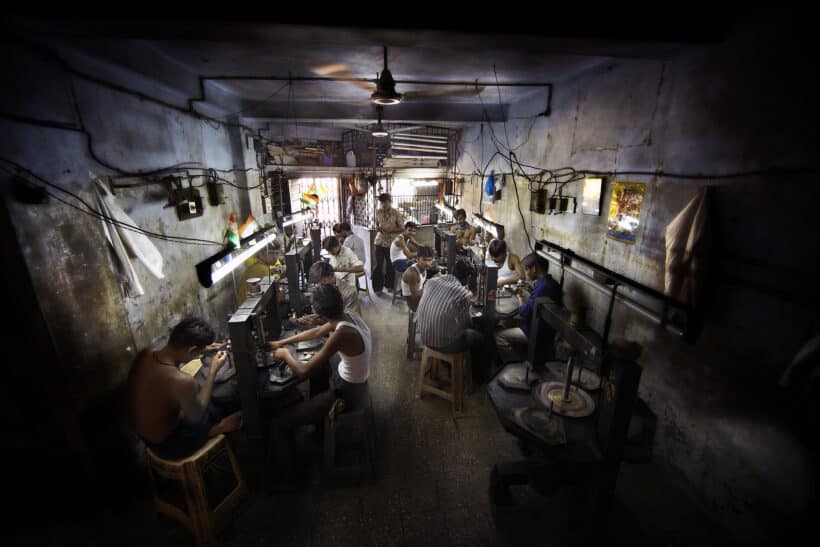
India, Surat is at the heart of India’s thriving diamond-polishing industry, which cut 80% of the world’s diamond pieces. in 1901 and by the 70s Surat-based diamond cutters began exporting stones to the US for the first time. Though a majority of polishing work takes place on small weight stones, Surat’s workshops have set their eyes on the lucrative market for finishing larger, pricier stones in the future. August 2010 © Olivier Polet (Photo by Olivier Polet/Corbis via Getty Images)
The lab-grown diamond (LGD) story is often viewed through a narrow lens, framed as a retail cycle of novelty, acceptance, and price collapse, thereby missing a far more significant shift. What the United States, India, and China have engineered over the past decade is a structural, tri-generational economy covering a mature industrial abrasives market, a consumer jewellery market, and an emerging deep-tech frontier spanning semiconductors, optics, and quantum computing. Each has its own production base, processing geography, and demand curve, with the countries that dominate each area not guaranteed a seat at the others.
The consumer jewellery segment operates as a tight, virtually unbreakable closed loop between these three dominant geographies, where no other market could currently replace any single link. It also exemplifies how modern commodity mapping is driven by hyper-specialised, deeply concentrated trade corridors.
The rough apportionment of this closed loop is stark. The US controls the demand side almost single-handedly, accounting for roughly 70 per cent of global lab-grown jewellery sales. With lab-grown stones now featuring in around six out of ten engagement rings, American bridal culture serves as the category’s primary revenue engine. If US consumers walked, both Europe and India combined would lack the depth to absorb the volume. Conversely, China commands the supply side with industry data reporting around 22 million carats of gem-quality production in 2024, representing roughly three-fifths of the global total. This is further supported by broader trade data showing China exported 35 million carats of rough lab-grown diamonds in 2025. China’s aggressive capacity expansion is precisely what made lab-grown stones cheap enough to achieve mainstream status. In the mid-stream, India anchors the conversion layer, polishing over 90 per cent of the world’s rough supply. Driven by a massive capital surge, industry estimates now put the Indian reactor fleet at 8,000 to 10,000 machines, effectively doubling its capacity in just a few years. This scale has fundamentally altered trade flows, with India’s polished lab-grown exports exceeding its polished natural exports by volume for the first time, reaching 18.8 million carats against 16 million in the financial year 2025 to 2026. Crucially, Surat keeps the conversion economics workable at a rock-bottom 60 dollars per carat, a threshold no other cutting centre on earth can operate profitably.
Consequently, the market accountability cuts both ways. While these three nations kept the jewellery segment alive, they are equally responsible for nearly destroying its wholesale value. China’s overcapacity and India’s rapid reactor expansion crushed wholesale prices by up to 90 per cent with the category only surviving thanks to US retailers sustaining the market by capturing the wide margin gap between collapsing wholesale costs and sticky retail prices. In other words, the same three actors created the boom, caused the price collapse, and are now the reason the category survives. China absorbs losses at the growing stage, India absorbs them at polishing, and US retail margins keep the shopfront buoyant. Strip out any single player, and the entire loop collapses, leaving the rest of the world a passenger on a raft they built.
Beyond gems, the underlying materials science is forcing a strategic fork in the road. Traditional industrial grit production remains anchored in China’s Henan province, where firms utilise vast fleets of cubic presses to feed global construction and mining sectors with billions of carats of low-value abrasives priced at pennies per carat.
Conversely, the high-value, low-volume deep-technology tier bypasses the traditional gemstone supply chain entirely. Electronics-grade, wafer-scale single-crystal CVD is not an extension of either the grit clusters or the jewellery clusters, but sits with a small number of specialised producers in the United States, Japan, and Europe. Pioneer growers are shifting away from gemstones to perfect wafer-scale single-crystal diamond substrates for AI data centres, advanced optics, and high-power electronics.
The constraint nobody is pricing in is that anyone can buy a generic CVD reactor and grow material good enough for budget jewellery. It is quite another challenge to produce wafers of the purity, nitrogen vacancy control, isotopic consistency, and angstrom-level surface finish that semiconductor and quantum applications demand.
If there’s any lesson to be learned, it is that the next decade will penalise hesitation. Leading in deep-technology diamond requires deploying significant capital and building rare skills before an instant market exists to bank against. Those who wait for the market to mature will find it fenced by patents, qualified supply agreements, and established relationships, and will be left competing on the shrinking margins of the commoditised gem tier. The next decade will reward the country that stops counting carats and starts perfecting crystal.
Mining
The Lab-Grown Monopoly: How the United States, India, and China Built a Hermetic Value Chain